Two people are both "Mars in Aries". One is a surgeon who never wastes a movement. The other is a man who cannot leave a grievance alone. Same sign. Same planet. The sign did not tell you which one you were looking at.
The nakshatra did.
What a nakshatra is
The zodiac of twelve signs is the one everyone knows. Vedic astrology — Jyotish — lays a second, finer zodiac on top of it: twenty-seven divisions of 13°20′ each, called nakshatras, the lunar mansions. They are older than the signs in Indian practice. The Vedic calendar was a lunar calendar, and the Moon's nightly station among the stars was the first astrology anyone did.
Each nakshatra has a ruling planet, a presiding deity, a symbol, and a character. And because 27 does not divide evenly into 12, the nakshatras cut across the signs: each sign holds two and a quarter of them. Aries, for instance, contains all of Ashwini, all of Bharani, and the first quarter of Krittika. That is why "Mars in Aries" is three different placements.
Why the nakshatra tells you more
Every planet in your chart occupies a nakshatra, and every nakshatra has a lord — one of the nine planets. That lord is the planet's star-lord, and it redirects the planet's energy through a second nature.
Mars in Ashwini is under Ketu's hand: quick, curative, first out of the gate, done before anyone noticed. Mars in Bharani is under Venus's: heavier, sensual, bound up with birth and death and the body's demands. Both are Mars in Aries. Only the nakshatra tells you which.
This runs through the whole chart. A Jupiter in Pushya is a Jupiter under Saturn's hand — disciplined, slow, structurally generous. A Saturn in Punarvasu is a Saturn under Jupiter's — softened, philosophical, willing to try again. The chain of star-lords through a chart connects planets that the sign-level reading would never connect, and it is where two charts that look alike on the surface come apart.
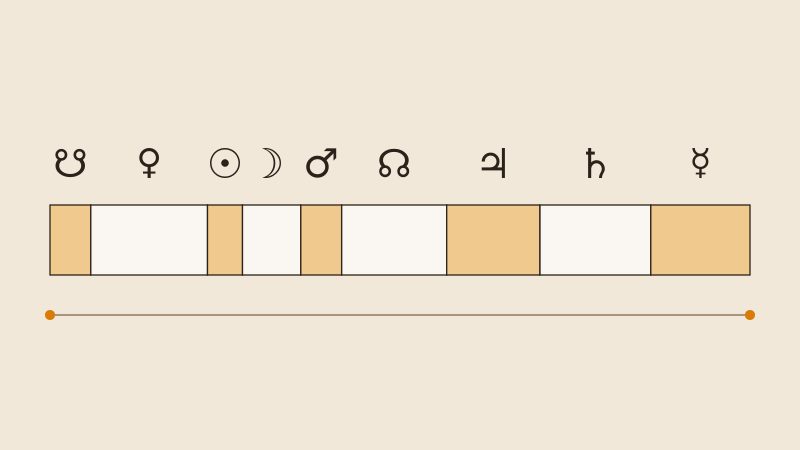
There is a further reason the nakshatra matters more than the sign, and it is the one that makes Jyotish predictive. The main timing system of Indian astrology — the Vimshottari dasha, the sequence of planetary periods every life runs through — is built entirely from the nakshatras. Your first period is set by the nakshatra your Moon occupies at birth. The signs play no part.
The three nakshatras that matter most
Every planet has one, but three placements carry most of the weight.
Your Moon's nakshatra — the janma nakshatra, the birth star. This is the one an Indian astrologer means by "your nakshatra", and the one a nakshatra calculator returns. It sets your dasha sequence and therefore the timing of your whole life; it is the reference for the daily calendar; and it is the chief source of temperament, because the Moon is the mind. When you look this up, this is what to look up.
Your rising nakshatra. The mansion on the ascendant colours how you present — how you come into a room, not how you think once seated.
The nakshatra of any planet you're asking about. If the question is marriage, it is the seventh lord's nakshatra and Venus's. If the question is career, the tenth lord's and Saturn's. This is the level at which a reading gets specific.
The twenty-seven, in one line each
A nakshatra colours a planet; it is not a personality type. Read these as the tint a planet takes on, not as twenty-seven kinds of person.
- Ashwini (Ketu) — the physician; speed, healing, initiative.
- Bharani (Venus) — the womb and the pyre; intensity, burden, fertility.
- Krittika (Sun) — the razor; sharpness, purification, pride.
- Rohini (Moon) — the harvest cart; growth, beauty, accumulation.
- Mrigashira (Mars) — the deer's head; seeking, curiosity, restlessness.
- Ardra (Rahu) — the teardrop; storm, breakthrough, grief.
- Punarvasu (Jupiter) — the bow drawn again; renewal, return, optimism.
- Pushya (Saturn) — the udder; nourishment, discipline, steady wealth.
- Ashlesha (Mercury) — the coiled serpent; insight, strategy, the hidden.
- Magha (Ketu) — the throne; lineage, authority, the ancestors.
- Purva Phalguni (Venus) — the bed; pleasure, romance, ease.
- Uttara Phalguni (Sun) — the back of the bed; loyalty, contract, duty.
- Hasta (Moon) — the hand; skill, craft, cleverness.
- Chitra (Mars) — the jewel; design, brilliance, appearance.
- Swati (Rahu) — the wind; independence, trade, adaptability.
- Vishakha (Jupiter) — the triumphal arch; ambition, focus, the long campaign.
- Anuradha (Saturn) — the lotus in the mud; devotion, friendship, endurance.
- Jyeshta (also written Jyeshtha) (Mercury) — the eldest; rank, protection, the loneliness of the top.
- Mula (Ketu) — the roots; investigation, uprooting, the bottom of things.
- Purva Ashadha (Venus) — the winnowing fan; conviction, declaration, early victory.
- Uttara Ashadha (Sun) — the elephant's tusk; endurance, the late victory that lasts.
- Shravana (Moon) — the ear; listening, learning, tradition.
- Dhanishta (Mars) — the drum; rhythm, wealth, fame.
- Shatabhisha (Rahu) — the hundred healers; secrecy, medicine, solitude.
- Purva Bhadrapada (Jupiter) — the sword; austerity, transformation, fire.
- Uttara Bhadrapada (Saturn) — the serpent of the deep; depth, patience, the long calm.
- Revati (Mercury) — the fish; nourishment, safe journeys, gentleness.
Each has a page of its own — Ashwini nakshatra, Rohini nakshatra, Mula nakshatra, and the rest — with its four quarters and the nine planets placed in it.
The quarters
Each nakshatra is divided into four padas — quarters of 3°20′ — and each pada corresponds to exactly one sign of the navamsa, the ninth divisional chart that Indian astrologers use to read marriage and the inner life. A planet in the first pada of Ashwini and one in the fourth are in different navamsa signs, and the reading changes. This is the level below the nakshatra, and for a serious reading it is where the work is done.
Below the pada, the Krishnamurti method (KP) divides each nakshatra into nine unequal sub-parts and reads the lord of the sub-part a planet falls in — the sub-lord — as the deciding factor for yes-or-no questions. Two planets in the same sign and the same nakshatra can have different sub-lords, and for a question like "will this marriage happen", that difference is often the answer.
Two mistakes to avoid
"You are a Rohini person." No one is. Your Moon in Rohini gives your mind a certain colour, and that mind sits in a chart with eleven other things in it. The list above describes a tint, not a type.
"Venus in Bharani, so a death in the family." A nakshatra colours a theme; it does not date an event. Timing comes from the dasha and the transits. A nakshatra reading that gives you a date has skipped the part of the work that produces dates.
How to find yours
You need your date, time and place of birth — the time matters, because the Moon crosses a whole nakshatra in about a day and can change its mansion between morning and evening — and a calculator set to the Lahiri ayanamsa — the sidereal zodiac Jyotish uses, which sits about 24 degrees behind the tropical zodiac of Western astrology. If you know your Western Moon sign, your Vedic Moon sign is usually the one before it, and your nakshatra is a finer division inside that.
Our nakshatra calculator gives your janma nakshatra, its lord and its pada from your birth details.
Then look up three things: your Moon's nakshatra and its lord; your rising nakshatra; and, for whatever question you have, the nakshatra of the planet that rules it.
Questions we are asked
Is my nakshatra the same as my zodiac sign? No. Your sign is one of twelve; your nakshatra is one of twenty-seven, and it sits inside a sign. Two people with the same Moon sign can have different nakshatras and very different temperaments.
Which nakshatra is the best? None. Each is the best for what it does. Pushya is the most nourishing; Ashwini the quickest; Mula the deepest. A planet in the nakshatra suited to its work is well placed; the same planet in one unsuited to it struggles. "Best" is a question about the planet, not the star.
What is a nakshatra compatibility match? The traditional marriage matching of India — ashtakoota — scores two charts partly by their Moon nakshatras: temperament class, animal symbol, and a factor called nadi. It is one input into a marriage reading, not a verdict.
Are nakshatras used in Western astrology? Rarely, and not as a system. Western astrology has fixed stars and the lunar mansions of medieval Arabic practice, but neither is built into its timing. The nakshatras are one of the things Jyotish has that Western astrology does not.
This article is for guidance and education. It is not medical, legal or financial advice, and it does not replace a reading of your own chart.
The nakshatra is where real astrology begins — that is the Astro River phrase for it, and the step of the reading order at which two similar charts come apart — and where most readings you'll find online stop short. If you want your chart read at this level — the star-lords, the quarters, and the sub-lords behind them — that is what a consultation is for.