Ardra (also called Thiruvathirai in Tamil, Arudra in Telugu, Thiruvathira in Malayalam, and known in the sky as Betelgeuse) — 6°40′ Gemini to 20°00′ Gemini, in Gemini; lord Rahu; deity Rudra. Lahiri sidereal.
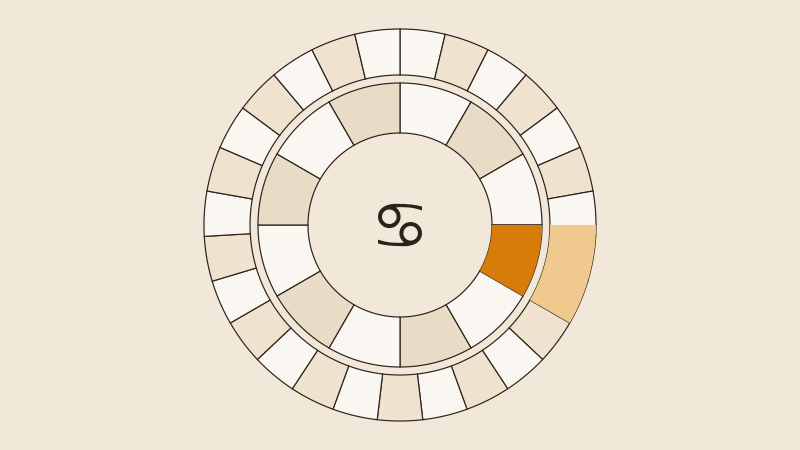
Ardra nakshatra is the sixth lunar mansion, from 6°40′ to 20°00′ of Gemini, and it is the star of the storm. Its deity is Rudra, the howler, the fierce form of Shiva who hunts and heals; its symbol is a teardrop — or, in the older telling, a human head; its lord is Rahu. In the sky it is Betelgeuse, the red giant on Orion's shoulder. The name means "the moist one", "the green one", and the mansion is the rain after the heat: destructive, necessary, and followed by growth. A person with the Moon here has an unusual mind, a sharp tongue, a capacity for suffering and for insight, and a life that tends to be rebuilt more than once.
Here is Ardra as we read it: the span and the sign, the four padas and the navamsa each reaches, the Moon and every other planet here, the sub-lords of the Krishnamurti method, the dasha a birth here begins, and the computed sky this Moon is under in 2026–27. Every Sanskrit term is glossed where it first appears.
Ardra nakshatra at a glance
| Span | 6°40′ Gemini to 20°00′ Gemini |
| Sign (rashi) | Gemini |
| Lord (star-lord) | Rahu |
| Deity | Rudra |
| Symbol | a teardrop, a human head |
| Gana (temperament) | Manushya |
| Nature (for muhurta) | Tikshna (sharp) |
| Yoni (animal, for matching) | dog (female) |
| Nadi | Adi |
| Name syllables (pada 1–4) | Ku, Gha, Ng, Chha |
| Also called | Thiruvathirai (Tamil), Arudra (Telugu), Thiruvathira (Malayalam) |
| Dasha the Moon here begins | Rahu, 18 years |
The story and the symbol
Rudra is the oldest and most frightening of the Vedic gods — the archer whose arrows bring fever and whose mercy takes it away, the lord of storms and of wild places, the one the hymns beg not to be angry. He is the hunter of the sky's oldest story: it is Rudra's arrow that strikes Prajapati, the deer of the mansion before this one, and Ardra is Rudra's mansion, the place from which the arrow was loosed. Later he becomes Shiva, and the teardrop is Shiva's: the tear he sheds, in one telling, at the suffering of the world, from which the rudraksha — Rudra's eye — is born.
The mansion carries all of it. The storm: Ardra people go through upheavals, and cause them. The arrow: they see and say the thing that wounds, and are often right. The tear: they feel more than they show, and their sharpness is very often grief with nowhere else to go. And the rain: after Ardra comes Punarvasu, "the return of the light", and the tradition reads the sixth mansion as the necessary destruction that makes the seventh's renewal possible.
Rahu as lord adds the appetite for the unusual. Rahu is the eclipse's head, the shadow that swallows the light — foreign, obsessive, brilliant, never satisfied. Ardra natives think differently from the people around them, and the difference is their gift and their loneliness. They are the mansion's scientists and its rebels, and sometimes both in one life.
Which rashi is Ardra nakshatra? (Ardra nakshatra rasi)
Ardra lies entirely inside Gemini (Mithuna or Mithun rashi), from 6°40′ to 20°00′ — the middle of the sign. An Ardra Moon is a Gemini Moon: Mercury-ruled, airy, mutable, quick, a mind before a heart. What Ardra adds is the storm. Mrigashira before it is the search; Punarvasu after it is the return; Ardra in the middle is the crisis that turns one into the other. Rahu and Mercury, the star-lord and the sign-lord, are on good terms — Rahu is read as Mercury-like and is strong in Gemini — so the Ardra Gemini Moon is a powerful mind with very little to slow it down, which is exactly the problem.
The four padas of Ardra
A nakshatra divides into four padas, quarters of 3°20′, and each pada corresponds to one sign of the navamsa — the ninth divisional chart, read for the inner life and for marriage. Ardra's padas run Sagittarius, Capricorn, Aquarius, Pisces.
| Pada | Degrees | Navamsa | Reading |
|---|---|---|---|
| 1 | 6°40′ Gemini – 10°00′ Gemini | Sagittarius | Sagittarius navamsa: the questing Ardra — the storm with a philosophy. Restless, opinionated, drawn to the foreign; the pada that turns upheaval into a journey. |
| 2 | 10°00′ Gemini – 13°20′ Gemini | Capricorn | Capricorn navamsa: the disciplined Ardra — the sharp mind put to work. Ambitious, exact, capable of great effort; the most stable pada and the one for scientists and engineers. |
| 3 | 13°20′ Gemini – 16°40′ Gemini | Aquarius | Aquarius navamsa: the reforming Ardra — Rahu's own navamsa in Rahu's mansion. Original, unconventional, humanitarian, difficult; the purest expression of the mansion's strangeness and its brilliance. |
| 4 | 16°40′ Gemini – 20°00′ Gemini | Pisces | Pisces navamsa: the grieving Ardra — the teardrop pada. Compassionate, intuitive, easily overwhelmed; the one that feels the storm most and speaks it least. |
No pada of Ardra is vargottama. The tradition marks the third pada as the most "Ardra", for good and ill, and the second as the one where the mansion's intelligence is most reliably productive.
Moon in Ardra: the janma nakshatra
The Moon's mansion at birth is the janma nakshatra — the one that names the mind and sets the dasha clock running. A Moon in Ardra gives a mind like weather. They are people of sudden moods, sudden insights, and sudden words; who see through things and say so; who are original to the point of strangeness and intelligent to the point of unrest. The old texts credit them with deceit and ingratitude — the tradition's harshest lines — and, in the same breath, with cleverness, effort and the ability to endure. The harsh lines describe the storm at its worst. The kind ones describe what it is for.
The trait beneath the traits is transformation. An Ardra Moon does not have one life; it has several, separated by breakdowns — a career lost, a home changed, a belief abandoned — and it is better after each. The tear in the symbol is real: these are people who have suffered, often early, and whose sharpness toward others is the arrow they learned from Rudra. Their task is the one the mansion's name promises: to let the storm be rain, to let the sharpness become insight rather than injury.
Rahu's lordship gives the hunger. Ardra Moons want to know, want to change things, want what is not permitted; they are the mansion's scientists, hackers, reformers and heretics. They are rarely comfortable and rarely boring.
Ardra nakshatra female and male natives
The old texts describe women and men under this star separately, and readers ask for both, so they are kept here, with the caution that a chart is not a sex — and, for Ardra, that the old texts are unkind and the kindness has to be supplied by the reader.
For a woman, the tradition gives Ardra a sharp intelligence, a sharper tongue, independence, and a life with a break in it — a marriage that is tested or remade, a home that is left. It describes her as capable in a crisis and difficult in calm. What the texts are describing is a woman ahead of her time, and the "difficulty" is usually the time's.
For a man, the tradition gives Ardra a thin, intense frame, restless energy, an unusual mind, a tendency to argue, and a career that changes direction more than once. He is described as capable of great things through effort and of great damage through speech. The caution is about cruelty in words, and about ingratitude — forgetting who helped in the storm.
For either, the Moon's aspects matter more than usual. Jupiter's aspect on an Ardra Moon turns the storm into a teacher; Saturn's into an engineer; Mars's into a fighter.
Career, money and health
Work. The mansion of Rahu and the storm gives the unconventional professions: research science, especially the hard and the new — physics, computing, electronics, artificial intelligence; engineering, above all electrical; medicine of the difficult kind — psychiatry, oncology, emergency and disaster work; investigation, intelligence, security; writing that cuts — satire, criticism, polemic; and every field that reforms or disrupts. Ardra also does well in weather, in the sea, and in anything that manages crisis for a living.
Money. Comes in storms — a windfall, a loss, a windfall. The Capricorn pada holds it best. Rahu as lord gives money through the foreign and the new, and the tradition marks Ardra as a mansion that earns well and keeps badly until the second or third rebuilding.
Health. Gemini governs the shoulders, arms, hands and lungs, and Ardra adds the nerves and the head: headaches, nervous complaints, breathing, and the illnesses that come from a mind that does not stop. The tradition's remedy of first resort is rest, which the mansion resists.
The other planets in Ardra
A planet in Ardra carries the mansion's storm and Rahu's hunger, and then speaks in its own voice.
Sun in Ardra. In a neutral sign, in Rahu's mansion — and Rahu eclipses the Sun. A self that is brilliant and unsettled; a father who was absent, unusual, or lost early; authority won through a crisis and never quite trusted. Strong for science and for reform, hard for ease.
Moon in Ardra. See the janma nakshatra section above.
Mars in Ardra. In an enemy's sign and the storm's mansion. Force without a fixed direction: the fighter who changes sides, the surgeon of emergencies, the engineer of dangerous things. Sharp anger; sharp accidents; considerable courage.
Mercury in Ardra. In its own sign, in a mansion that is Mercury-like — a mind of real power, original, fast, cutting. The scientist, the coder, the critic. The caution is the tongue: this Mercury can say the thing that cannot be unsaid.
Jupiter in Ardra. In an enemy's sign and Rahu's mansion, which is a hard place for the planet of faith. Belief tested and rebuilt; the teacher who lost a religion and found a philosophy; wisdom that came through suffering. Often gives unconventional learning and unconventional students.
Venus in Ardra. In a friend's sign, in a stormy mansion. Love that transforms and is transformed: the great affair, the marriage that is remade, the art that comes from grief. Beauty that is unusual rather than pretty. Not a constant Venus, but a deep one.
Saturn in Ardra. In a friend's sign and a Rahu mansion — Saturn and Rahu are allies in the tradition. Discipline applied to the unconventional: the researcher who spends decades on one problem, the engineer of large systems, the reformer who outlasts. The storm slowed to a long rain.
Rahu in Ardra. Rahu in its own mansion: the hunger at full strength. Obsession, brilliance, the foreign and the forbidden; the person who cannot stop and who changes the field they enter. Also the most upheaval: Rahu's own periods are the storms.
Ketu in Ardra. The head of the axis in the tail's mansion — Ketu in Rahu's star. Detachment from the storm: the person who has already been through it and is quiet now; intuition where Rahu gives obsession; sometimes a withdrawal from the world after an early crisis.
Lagna in Ardra. A thin or wiry frame, an intense gaze, a manner that is quick, restless and a little unnerving. The lagna lord Mercury's placement decides whether the mind rules the storm or the storm the mind.
Notice how much turns on the lord. A planet in one of Rahu's three mansions carries Rahu's signature, but Ardra is not the other two, and inside Ardra the nine sub-lords divide it again. This is the level at which a reading stops being a description of a type and becomes a description of a person. The nakshatra report does that work for your own chart: each planet placed to its pada and sub-lord, each placement read for what it promises and when the dasha lets it through.
The sub-lords of Ardra
This is the level at which the Krishnamurti method (KP) reads a chart: each nakshatra is cut into nine unequal parts in the proportion of the Vimshottari years, and the lord of the part — the sub-lord — decides what a planet here actually delivers. Two planets in Ardra with different sub-lords give different results. It is the step at which two charts that look alike come apart — where real astrology begins.
| Sub-lord | From | To |
|---|---|---|
| Rahu | 6°40′ Gemini | 8°40′ Gemini |
| Jupiter | 8°40′ Gemini | 10°26′40″ Gemini |
| Saturn | 10°26′40″ Gemini | 12°33′20″ Gemini |
| Mercury | 12°33′20″ Gemini | 14°26′40″ Gemini |
| Ketu | 14°26′40″ Gemini | 15°13′20″ Gemini |
| Venus | 15°13′20″ Gemini | 17°26′40″ Gemini |
| Sun | 17°26′40″ Gemini | 18°06′40″ Gemini |
| Moon | 18°06′40″ Gemini | 19°13′20″ Gemini |
| Mars | 19°13′20″ Gemini | 20°00′ Gemini |
Three of Ardra's sub-lords are worth knowing by heart. The Rahu sub at the start (6°40′ to 8°40′) is Rahu in its own mansion and its own sub — the purest Ardra degrees, the most brilliant and the most turbulent; a planet there is the storm itself. The Saturn sub (10°26′40″ to 12°33′20″) is where the mansion's energy is most usable, since Saturn and Rahu work together: the disciplined scientist's degrees. The Venus sub (15°13′20″ to 17°26′40″), the widest part of the mansion's second half, is where Ardra's grief is most likely to become art or love rather than injury.
The dasha the Moon here gives
A Moon in Ardra starts life in the Rahu mahadasha (18 years), and the balance left at birth is the fraction of Ardra the Moon has still to cross, times 18: a Moon exactly halfway through Ardra has 9 years of Rahu left. The order after that is fixed — Jupiter → Saturn → Mercury → Ketu → Venus → Sun → Moon → Mars — and it is the same for everyone born with the Moon here; what differs is where in it a life is standing at any moment. An Ardra life begins in the eighteen-year Rahu mahadasha, and since most Ardra Moons are born partway through the mansion, the Rahu period runs through childhood and often into the teens — a childhood the tradition expects to be unsettled, foreign, or marked by an upheaval in the family. Then the sixteen-year Jupiter, which usually covers the twenties and thirties and is the rebuilding; then the nineteen-year Saturn, which is the long consolidation. An Ardra native's life tends to be lived in the order the mansion promises: storm, then rain, then harvest.
Ardra nakshatra compatibility and marriage life
Nakshatra matching turns on three tables: the yoni (the animal), the gana (the temperament) and the nadi (the constitution, which must differ). Ardra is dog yoni, manushya gana, adi nadi.
Best matches by yoni — the dog, whose other mansion is Mula (full marks); no other animal scores three with the dog, and the horse, elephant, serpent, cat, cow, buffalo and monkey score two. Most difficult by yoni — the deer (Anuradha, Jyeshta), the dog's enemy, scoring nothing; the sheep, rat, tiger, mongoose and lion score one.
By gana — Ardra is manushya, which matches deva and manushya well and rakshasa with difficulty. Ardra with Bharani, Rohini, Purva and Uttara Phalguni, Purva and Uttara Ashadha, Purva and Uttara Bhadrapada is manushya to manushya.
By nadi — Ardra is adi nadi. Ardra with Ashwini, Punarvasu, Uttara Phalguni, Hasta, Jyeshta, Mula, Shatabhisha or Purva Bhadrapada makes the nadi dosha the tradition warns of.
Past the tables: an Ardra native needs a partner who can stand in the weather without taking it personally, and who understands that the sharpness is the tear turned outward.
Which pada of Ardra is best, and which is difficult?
When readers ask this they mean "which pada carries the trouble." For Ardra the tradition's answer is the third pada, in the Aquarius navamsa — Rahu's own navamsa in Rahu's own mansion — where the strangeness and the upheaval are at full strength; a Moon there lives the storm without a shelter. The second pada, in Capricorn, is the most stable and the most productive. The first turns the upheaval into travel and philosophy; the fourth, in Pisces, feels it most and is the one to watch for depression and withdrawal. No pada of Ardra is bad for everyone; the third is the one that needs the rest of the chart to hold it.
The sky for Ardra Moons in 2026–27
All dates here are computed — Swiss Ephemeris, Lahiri ayanamsa, true node. Saturn is in the tenth house from your Moon until 3 June 2027, then in the eleventh (with a return to the tenth from 20 October 2027 to 23 February 2028). Jupiter, exalted, is in the second house from your Moon until 31 October 2026, previews the third from 31 October to 25 January 2027, returns to the second until 26 June 2027, and then settles in the third. Rahu is in the ninth and Ketu in the third until 25 November 2026; after that Rahu is in the eighth and Ketu in the second for eighteen months. Put simply: an Ardra Moon is not in sade sati. Saturn is in the tenth from the Moon until June 2027 — a demanding but productive transit for work — and then in the eleventh, the house of gains. Jupiter's year is spent in the second from the Moon — money and family — and its preview of the third from 31 October to 25 January is the window for effort and short journeys. Rahu, Ardra's own lord, is in the ninth from the Moon until 25 November — faith and the foreign under Rahu's hunger — and then in the eighth, where Rahu's transits are the tradition's hardest; Ketu moves from the third to the second. Mars enters Leo, the third from your Moon, on 12 November and meets Jupiter and Ketu there.
→ Sade Sati · Mars Meets Jupiter in Leo
Remedy and mantra
The classical remedy for an afflicted Ardra placement is worship of Rudra — the Rudram, or its short form, or Shiva's mantra Om Namah Shivaya — and of Rahu as the mansion's lord, with the Rahu mantra Om Rahave Namah on Saturday. The rudraksha, Rudra's own tear, is the mansion's bead, and Durga is worshipped for Rahu's periods. The first remedy, before any rite, is service to those in a storm of their own — the mansion's sharpness is softened by being used to help. A remedy — a puja, a gemstone, a rudraksha, a yantra — is prescribed to the chart, and the chart decides which.
Questions we are asked
What is Ardra nakshatra? The sixth of the 27 nakshatras, 6°40′ to 20°00′ Gemini, ruled by Rahu, with Rudra as deity and a teardrop as symbol. In the sky it is Betelgeuse. It stands for the storm, the sharp mind, suffering, and the renewal that follows.
Ardra nakshatra is which rashi? Gemini (Mithuna, or Mithun rashi). The whole nakshatra lies inside Gemini.
Who is the lord of Ardra nakshatra? Rahu. The dasha for a Moon here begins with Rahu's eighteen years, then Jupiter's sixteen.
What are the Ardra nakshatra characteristics? Brilliant, unconventional, sharp-tongued, restless, capable of great effort and great upheaval; a life rebuilt more than once; insight that came through suffering.
Which pada of Ardra is bad? None for everyone. The third, in Aquarius, is the most turbulent and the most original; the second, in Capricorn, is the most stable.
What is the Ardra nakshatra symbol? A teardrop — Shiva's, from which the rudraksha is born — and, in the older texts, a human head.
Is Ardra nakshatra good for marriage? Deep, transforming partners, not easy ones. Match by yoni (dog), gana (manushya) and nadi (adi); the dog–deer pairing is the pairing the yoni table scores at zero.
Why is Ardra nakshatra considered difficult? Because its deity is the storm and its lord is Rahu, and the old texts describe the storm rather than the rain. The mansion's natives suffer early and see clearly; the difficulty is real and so is what it produces.
What does 2026 hold for Ardra nakshatra? Saturn in the tenth from the Moon until June 2027, then the eleventh; Jupiter in the second; Rahu, the mansion's own lord, moving from the ninth to the eighth on 25 November. The computed sky is above.
For education. Not medical, legal or financial advice; a nakshatra is one line of a chart, not the chart.
Your own Ardra placements — Moon, lagna, sub-lords and dasha read together — are a consultation's work: time with the chart, not a page.
→ Book a private consultation · Reading the Nakshatra, Not the Sign · Paper C, Nakshatras · ← Mrigashira · Punarvasu →