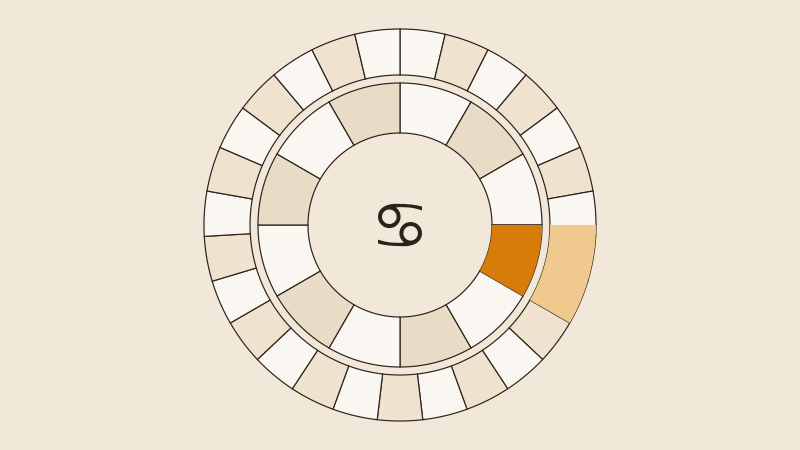
Uttara Ashadha (also called Uthiradam in Tamil, Uttarashada in Telugu, Uthradam in Malayalam, also written Uttarashada or Uttarashadha) — 26°40′ Sagittarius to 10°00′ Capricorn, in Sagittarius and Capricorn; lord Sun; deity the Vishvadevas. Lahiri sidereal.
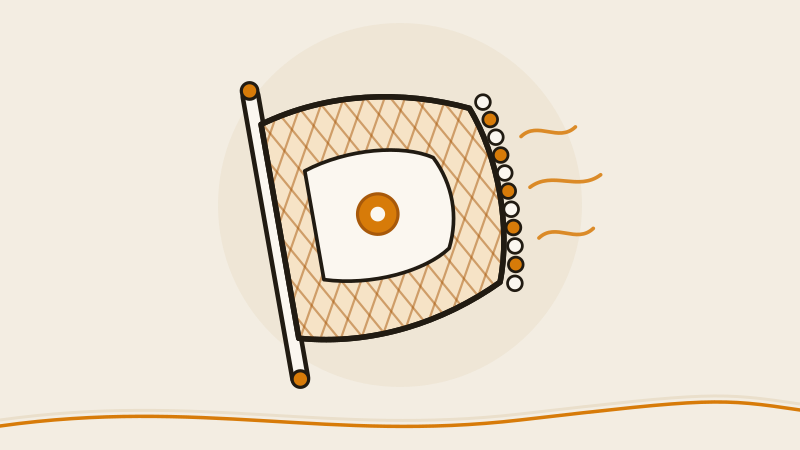
Uttara Ashadha nakshatra (also written Uttarashada) is the twenty-first lunar mansion, from 26°40′ Sagittarius to 10°00′ Capricorn — the seventh of the nine that straddle two signs. Its deities are the Vishvadevas, the "all-gods", the ten sons of Dharma who embody the universal virtues; its symbol is an elephant's tusk, or a small bed, or the planks of a bed; its lord is the Sun. The name means "the latter invincible one", the second of the Ashadha pair, and where Purva Ashadha is the early victory that flows, Uttara Ashadha is the final victory that endures: the win that was earned, the cause that was right, the standing that lasts because it was built on principle. A person with the Moon here is principled, responsible, ambitious in the long way, and slow to move and impossible to move back; the one who wins in the end.
Here is Uttara Ashadha as we read it: the two-sign span, the four padas and the navamsa each reaches — two of them vargottama — the Moon and every other planet here, the sub-lords of the Krishnamurti method, the dasha a birth here begins, and the computed sky this Moon is under in 2026–27. Every Sanskrit term is glossed where it first appears.
Uttara Ashadha nakshatra at a glance
| Span | 26°40′ Sagittarius to 10°00′ Capricorn |
| Sign (rashi) | Sagittarius and Capricorn |
| Lord (star-lord) | Sun |
| Deity | the Vishvadevas |
| Symbol | the tusk of an elephant; a small bed |
| Gana (temperament) | Manushya |
| Nature (for muhurta) | Sthira (fixed) |
| Yoni (animal, for matching) | mongoose (male) |
| Nadi | Antya |
| Name syllables (pada 1–4) | Bhe, Bho, Ja, Ji |
| Also called | Uthiradam (Tamil), Uttarashada (Telugu), Uthradam (Malayalam) |
| Dasha the Moon here begins | Sun, 6 years |
The story and the symbol
The Vishvadevas are the universal gods — in the Puranic count, the ten sons of Dharma and Vishva: Vasu (goodness), Satya (truth), Kratu (will), Daksha (skill), Kala (time), Kama (desire), Dhriti (steadiness), Kuru (the ancestors), Pururavas (abundance) and Madrava (joy). They are invoked together, as the sum of what a just life is made of, and Uttara Ashadha is their mansion: the victory that is not one god's but all of them at once — the win that truth, skill, time and steadiness bring together. The elephant's tusk is the symbol, as in the mansion before, but here it is the tusk of the elephant that has already fought and stands; the planks of the bed are the other symbol — the foundation the rest is laid on.
The Sun as lord gives the mansion its authority and its long view. The Sun is the king who answers for the realm, the father, the self that is seen; in the Vishvadevas' mansion it becomes the leader whose victory is a matter of principle, the person whose standing comes from being right for a long time. Uttara Ashadha natives are the tradition's statesmen, judges and founders — the people who build the thing that outlasts them — and their shadow is the Sun's when it is fixed: rigidity, self-righteousness, and a slowness to begin that looks like laziness and is really the weighing of a cause.
The mansion straddles Sagittarius and Capricorn, and the crossing is its story: Jupiter's fire of principle becoming Saturn's earth of endurance. Two of its padas — the first, in Sagittarius, and the second, in Capricorn — are vargottama, one on each side of the line. The Sun's entry into sidereal Capricorn — Makar Sankranti, at 0° Capricorn, exactly where Uttara Ashadha's second pada begins — is the tradition's uttarayana, the turn of the year toward the light; the auspicious half of the year opens in this mansion.
Which rashi is Uttara Ashadha nakshatra? (Uttara Ashadha nakshatra rasi)
Uttara Ashadha straddles two signs. Its first pada is in Sagittarius (Dhanu rashi), 26°40′ to 30°00′, and its second, third and fourth padas are in Capricorn (Makara or Makar rashi), 0°00′ to 10°00′. So most Uttara Ashadha Moons are Capricorn Moons — Saturn-ruled, earthy, cardinal, disciplined, ambitious over the long term — with the Sun as star-lord giving the Capricorn endurance a purpose and a standing; this is the Uttara Ashadha that builds institutions. A Moon in the first pada is a Sagittarius Moon — Jupiter-ruled, principled, expansive — and vargottama, since the pada's navamsa is also Sagittarius: the mansion's fire of principle at its purest. The Sun and Saturn, the star-lord and the sign-lord of the Capricorn padas, are father and son and enemies in the Parashari table — the king and the servant, the light and the weight — and the friction is the Uttara Ashadha signature: authority that is earned by labour, standing that costs. The Sun and Jupiter, for the first pada, are friends.
The four padas of Uttara Ashadha
A nakshatra divides into four padas, quarters of 3°20′, and each pada corresponds to one sign of the navamsa — the ninth divisional chart, read for the inner life and for marriage. Uttara Ashadha's padas run Sagittarius, Capricorn, Aquarius, Pisces, with the sign boundary between the first and second and vargottama on both sides of it.
| Pada | Degrees | Navamsa | Reading |
|---|---|---|---|
| 1 | 26°40′ Sagittarius – 0°00′ Capricorn | Sagittarius | Sagittarius navamsa, in Sagittarius: vargottama — the pure Sagittarius Uttara Ashadha. Principle at full strength: the judge, the teacher of dharma, the leader whose cause is the point. The most philosophical pada and one of the two strongest. |
| 2 | 0°00′ Capricorn – 3°20′ Capricorn | Capricorn | Capricorn navamsa, in Capricorn: vargottama — the pure Capricorn Uttara Ashadha. Endurance at full strength: the founder, the administrator, the one who builds over decades. Begins at 0° Capricorn, the uttarayana point. The other of the two strongest, and the tradition's favourite for career. |
| 3 | 3°20′ Capricorn – 6°40′ Capricorn | Aquarius | Aquarius navamsa, in Capricorn: the reforming victory — the principle applied to society, the institution that changes the rules. The most humanitarian pada and the least conventional. |
| 4 | 6°40′ Capricorn – 10°00′ Capricorn | Pisces | Pisces navamsa, in Capricorn: the compassionate victory — the win given away, the standing used for others. The gentlest pada and the most easily burdened. |
Two vargottama padas make Uttara Ashadha unusually strong across its first half. The tradition reads the first for the cause and the second for the building of it — the Sagittarius principle and the Capricorn structure that carries it.
Moon in Uttara Ashadha: the janma nakshatra
The Moon's mansion at birth is the janma nakshatra — the one that names the mind and sets the dasha clock running. A Moon in Uttara Ashadha makes a mind that holds a line. They are people of principle and endurance, who decide slowly and do not undecide; who are ambitious in the long way — the career built over thirty years, the institution founded, the family's standing raised a generation at a time; who are respected, often widely, and who take responsibility as a matter of course. The old texts credit them with modesty, virtue, many friends, gratitude, and the affection of others — and, in the caution, obstinacy and a fondness for being right.
The trait beneath the traits is the Vishvadevas': the victory that is everyone's. An Uttara Ashadha Moon wants to win for a cause larger than itself, and its persistence is the persistence of someone who believes the cause is just. The old texts' caution is exactly that belief — the self-righteousness of the principled, the rigidity of the one who has been right before — and a slowness to start that the texts call laziness and is really the weighing of whether the thing is worth the decades it will take. Their task is the small bed's: to rest, once in a while, on the foundation they have built.
The Sun in Saturn's sign gives the mansion's people their peculiar authority — earned, heavy, and lasting. Uttara Ashadha Moons are the tradition's late-reigning kings: the standing comes after the labour, and it stays.
Uttara Ashadha nakshatra female and male natives
The old texts describe women and men under this star separately, and readers ask for both, so they are kept here, with the caution that a chart is not a sex.
For a woman, the tradition gives Uttara Ashadha dignity, principle, intelligence, a strong sense of duty and of justice, and a standing in her family and community that grows with the years; it describes her as a faithful partner, a good manager of a household or an institution, and as someone whose word is kept and whose judgement is sought. The caution is rigidity, and a slowness to forgive what she considers a breach of principle.
For a man, the tradition gives Uttara Ashadha a strong, well-built frame, a serious and courteous manner, ambition of the lasting kind, learning, and a respect that arrives in middle life and stays; it describes him as a leader by example, generous to dependents, obstinate in a cause, and as someone who is slow to begin and impossible to stop. The caution is self-righteousness, and the burden he takes on for others and does not put down.
For either, the first pada gives the Sagittarius fire of the cause; the Capricorn padas give the Saturn weight of building it.
Career, money and health
Work. The Vishvadevas' mansion under the Sun gives the professions of lasting authority: government at its senior levels, the judiciary, the civil service, the founding and running of institutions; the law as principle; the military at command; and every field where the long build is rewarded — architecture of the civic kind, engineering of infrastructure, the family firm raised over generations. Jupiter's pada adds teaching and the priesthood; Saturn's padas add administration, the land, and the management of large things. Uttara Ashadha also does well in social reform of the patient kind, and in any work where being trusted with the whole is the job.
Money. Comes late and stays; the tradition marks Uttara Ashadha as prosperous after the middle of life and never poor thereafter. The Capricorn padas hold most and build most. The caution is the fortune tied up in the institution — the founder who is rich on paper and poor at the table.
Health. The Sagittarius pada governs the hips, the thighs and the liver; the Capricorn padas the knees, the bones and the skin. Complaints of the knees and the joints from long standing, of the bones under Saturn, and of the stomach from responsibility swallowed are classical, along with the illnesses of a body that would not rest. The tradition's remedy of first resort is the small bed — rest before the victory, not after.
The other planets in Uttara Ashadha
A planet in Uttara Ashadha carries the mansion's principle and the Sun's standing, and then speaks in its own voice. The sign changes the reading at the first-pada boundary.
Sun in Uttara Ashadha. In its own mansion; in the first pada, in a friend's sign and vargottama — authority with a cause, one of the Sun's strongest placements for leadership. In the Capricorn padas, in an enemy's sign: the authority is earned against resistance, the king who works. A father who was a builder or a judge; a self that answers for the whole.
Moon in Uttara Ashadha. See the janma nakshatra section above.
Mars in Uttara Ashadha. In a friend's sign in Sagittarius; exalted in Capricorn — Mars's exaltation is Capricorn, deepest at 28°, far ahead in Dhanishta, so here the exaltation is early but real. The general's Mars: force with a principle and a long campaign. In the Capricorn padas one of the stronger Mars placements in the zodiac.
Mercury in Uttara Ashadha. In a neutral sign in both halves; in the mansion of its friend the Sun. The administrator's mind at the level of the state: exact, principled, trusted with the record. Speech that is measured and final.
Jupiter in Uttara Ashadha. In its own sign in the first pada, vargottama — the guru of dharma at full strength, wisdom that is also authority. In the Capricorn padas, debilitated — Jupiter's fall is Capricorn, deepest at 5°, inside the third pada — and the wisdom has to be earned through labour; neecha bhanga through Saturn or Mars lifts it, and the Sun as star-lord gives the fallen Jupiter a standing to work toward.
Venus in Uttara Ashadha. In a neutral sign in Sagittarius, a friend's in Capricorn; in the mansion of its enemy the Sun. Love as principle: the faithful, dutiful, lasting marriage; beauty in structure; art that endures. Not a warm Venus, but a permanent one.
Saturn in Uttara Ashadha. In a neutral sign in Sagittarius; in its own sign in Capricorn; in the mansion of its enemy the Sun. Endurance at full strength in the Capricorn padas: the builder of institutions, the servant who becomes the founder, the labour honoured late. Saturn here is the mansion's own weight, and in Capricorn it is a foundation.
Rahu in Uttara Ashadha. The standing one was not born to: the outsider who founds the institution, the foreign authority, the ambition for the lasting win. Rahu in the Sun's mansion eclipses the inherited standing and builds a new one.
Ketu in Uttara Ashadha. The victory renounced: the founder who steps down, the judge who retires, the detachment from standing once it is earned. Often a spiritual placement — the one who built it and let it go.
Lagna in Uttara Ashadha. A strong, upright, well-proportioned frame, a serious face, a manner that is courteous and unhurried. In the first pada the lagna lord is Jupiter; in the others, Saturn — the difference between the judge and the builder.
Notice how much turns on the lord. A planet in one of the Sun's three mansions carries the Sun's signature, but Uttara Ashadha is not the other two, and inside Uttara Ashadha the nine sub-lords divide it again. This is the level at which a reading stops being a description of a type and becomes a description of a person. The nakshatra report does that work for your own chart: each planet placed to its pada and sub-lord, each placement read for what it promises and when the dasha lets it through.
The sub-lords of Uttara Ashadha
This is the level at which the Krishnamurti method (KP) reads a chart: each nakshatra is cut into nine unequal parts in the proportion of the Vimshottari years, and the lord of the part — the sub-lord — decides what a planet here actually delivers. Two planets in Uttara Ashadha with different sub-lords give different results. It is the step at which two charts that look alike come apart — where real astrology begins.
| Sub-lord | From | To |
|---|---|---|
| Sun | 26°40′ Sagittarius | 27°20′ Sagittarius |
| Moon | 27°20′ Sagittarius | 28°26′40″ Sagittarius |
| Mars | 28°26′40″ Sagittarius | 29°13′20″ Sagittarius |
| Rahu | 29°13′20″ Sagittarius | 1°13′20″ Capricorn |
| Jupiter | 1°13′20″ Capricorn | 3°00′ Capricorn |
| Saturn | 3°00′ Capricorn | 5°06′40″ Capricorn |
| Mercury | 5°06′40″ Capricorn | 7°00′ Capricorn |
| Ketu | 7°00′ Capricorn | 7°46′40″ Capricorn |
| Venus | 7°46′40″ Capricorn | 10°00′ Capricorn |
Three of Uttara Ashadha's sub-lords are worth knowing by heart. The Sun sub at the very start (26°40′ to 27°20′ Sagittarius) is the Sun in its own mansion and its own sub inside the vargottama Sagittarius pada — the most authoritative, most principled degrees of the star. The Rahu sub (29°13′20″ Sagittarius to 1°13′20″ Capricorn) holds the sign boundary and the uttarayana point at 0° Capricorn; a planet there stands where fire becomes earth and the year turns toward the light, with Rahu's restlessness laid over the mansion's steadiness. The Saturn sub (3°00′ to 5°06′40″ Capricorn) holds Jupiter's deepest fall at 5°00′; a Jupiter there is at the bottom of its dignity with Saturn's own weight by sub — the tradition's picture of wisdom that must be earned by labour, and the mansion's hardest degrees for the guru.
The dasha the Moon here gives
A Moon in Uttara Ashadha starts life in the Sun mahadasha (6 years), and the balance left at birth is the fraction of Uttara Ashadha the Moon has still to cross, times 6: a Moon exactly halfway through Uttara Ashadha has 3 years of Sun left. The order after that is fixed — Moon → Mars → Rahu → Jupiter → Saturn → Mercury → Ketu → Venus — and it is the same for everyone born with the Moon here; what differs is where in it a life is standing at any moment. An Uttara Ashadha life begins in the six-year Sun mahadasha, and since the Sun's period is short, most natives are out of it in early childhood — the father's period, and the one in which the family's standing was set. Then the ten-year Moon, the seven-year Mars, the eighteen-year Rahu: so the twenties and thirties are typically Rahu's, the period of ambition and of building in the unfamiliar, before Jupiter's sixteen years arrive in the forties and bring the recognition the mansion promises — the late-reigning king's own period.
Uttara Ashadha nakshatra compatibility and marriage life
Nakshatra matching turns on three tables: the yoni (the animal), the gana (the temperament) and the nadi (the constitution, which must differ). Uttara Ashadha is mongoose yoni, manushya gana, antya nadi.
Best matches by yoni — the mongoose has no second mansion; it stands alone. The sheep (Krittika, Pushya) scores three with the mongoose, and the horse, elephant, cat, rat, cow, buffalo, deer, monkey and lion score two. Most difficult by yoni — the serpent (Rohini, Mrigashira), the mongoose's enemy, scoring nothing; the dog and the tiger score one.
By gana — Uttara Ashadha is manushya, which matches deva and manushya well and rakshasa with difficulty. Uttara Ashadha with Bharani, Rohini, Ardra, Purva and Uttara Phalguni, Purva Ashadha, Purva and Uttara Bhadrapada is manushya to manushya.
By nadi — Uttara Ashadha is antya nadi. Uttara Ashadha with Krittika, Rohini, Ashlesha, Magha, Swati, Vishakha, Shravana or Revati makes the nadi dosha the tradition warns of.
Past the tables: an Uttara Ashadha native is a faithful, principled, slow-to-commit and slower-to-leave partner, and needs one who shares the long view — and who can persuade them, occasionally, that being right is not the same as being kind.
Which pada of Uttara Ashadha is best, and which is difficult?
No pada of Uttara Ashadha is bad; the tradition ranks it among the most fortunate mansions for lasting success. The first and second padas, both vargottama, are the strongest — the first for principle and learning, the second for career and building. The third, in Aquarius, is the most reforming. The fourth, in Pisces, is the gentlest and the most easily burdened, and is the one to watch, because its duty can become self-sacrifice. The third pada's opening degrees hold Jupiter's deepest fall at 5°00′ Capricorn — strong for everything except Jupiter itself.
The sky for Uttara Ashadha Moons in 2026–27
All dates here are computed — Swiss Ephemeris, Lahiri ayanamsa, true node. Put simply: an Uttara Ashadha Moon in the first pada (Sagittarius) is in the small panoti — Saturn in the fourth from the Moon until June 2027, the ardhashtama Shani, then the fifth; Jupiter in the eighth until 31 October, previewing the ninth until 25 January; Rahu in the third and Ketu in the ninth until 25 November, then the second and the eighth. An Uttara Ashadha Moon in the Capricorn padas has Saturn — the sign's own lord — in the third from the Moon until June 2027, one of Saturn's easiest transits, and then in the fourth, where the ardhashtama begins; Jupiter in the seventh from that Moon until 31 October, the house of partnership and one of Jupiter's good transits, previewing the eighth until 25 January and returning to the seventh until June 2027; Rahu in the second and Ketu in the eighth until 25 November — and then, from 25 November, Rahu enters the Moon's own sign, Capricorn, for eighteen months, with Ketu in the seventh: for a Capricorn-pada Uttara Ashadha Moon, the mansion's steadiness is the year's chief asset, and the year is read for the hunger Rahu brings to a mind that does not usually want more. Mars enters Leo on 12 November: the ninth from a Sagittarius Moon, the eighth from a Capricorn one.
→ Sade Sati · Mars Meets Jupiter in Leo
Remedy and mantra
The classical remedy for an afflicted Uttara Ashadha placement is worship of the Vishvadevas — the offering to all the gods together, the vaishvadeva rite of the household fire — and of the Sun as the mansion's lord, with Om Suryaya Namah at sunrise and the Aditya Hridayam; Ganesha is worshipped for the mansion's beginnings, since its natives are slow to start. The first remedy, before any rite, is the small bed — a rest taken before the work is done, which the mansion's people otherwise never allow themselves. A remedy — a puja, a gemstone, a rudraksha, a yantra — is prescribed to the chart, and the chart decides which.
Questions we are asked
What is Uttara Ashadha nakshatra? The twenty-first of the 27 nakshatras, from 26°40′ Sagittarius to 10°00′ Capricorn, ruled by the Sun, with the Vishvadevas — the universal gods — as deities and an elephant's tusk, or the planks of a bed, as symbol. It stands for the victory that lasts: principle, endurance, and earned authority.
Uttara Ashadha nakshatra is which rashi? Two. The first pada is in Sagittarius (Dhanu); the second, third and fourth are in Capricorn (Makara or Makar). Most Uttara Ashadha Moons are Capricorn Moons.
Who is the lord of Uttara Ashadha nakshatra? The Sun. The dasha for a Moon here begins with the Sun's six years, then the Moon's ten.
What are the Uttara Ashadha nakshatra characteristics? Principled, enduring, responsible, ambitious in the long way, respected, obstinate; slow to start and impossible to stop; wins in the end.
Which pada of Uttara Ashadha is best? The first and second are both vargottama — the first for principle, the second for career. None is bad; the fourth is the most easily burdened.
What is the Uttara Ashadha nakshatra symbol? An elephant's tusk — the weapon of the animal that has already won — and the planks of a bed, the foundation the rest is laid on.
Is Uttara Ashadha nakshatra good for marriage? Faithful, principled, lasting partners. Match by yoni (mongoose), gana (manushya) and nadi (antya); the mongoose–serpent pairing is the pairing the yoni table scores at zero.
Is Jupiter debilitated in Uttara Ashadha? In the Capricorn padas, yes — Jupiter's fall is Capricorn, and its deepest point, 5°00′, is at the start of the third pada. In the first pada, in Sagittarius, Jupiter is in its own sign and vargottama.
What does 2026 hold for Uttara Ashadha nakshatra? It depends on the pada. Sagittarius-pada Moons have Saturn in the fourth — the ardhashtama; Capricorn-pada Moons have Saturn in the third until June 2027 and Rahu entering the Moon's sign on 25 November. The computed sky for both is above.
For education. Not medical, legal or financial advice; a nakshatra is one line of a chart, not the chart.
Your own Uttara Ashadha placements — Moon, lagna, sub-lords and dasha read together — are a consultation's work: time with the chart, not a page.
→ Book a private consultation · Reading the Nakshatra, Not the Sign · Paper C, Nakshatras · ← Purva Ashadha · Shravana →