Revati (also called Revathi in Tamil, Revati in Telugu, Revathi in Malayalam, also written Revathi) — 16°40′ Pisces to 0°00′ Aries, in Pisces; lord Mercury; deity Pushan. Lahiri sidereal.
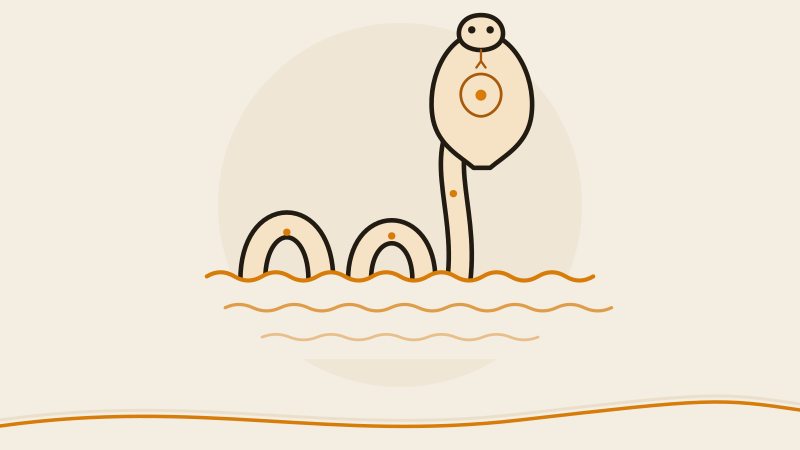
Revati nakshatra (also written Revathi) is the twenty-seventh and last lunar mansion, the final 13°20′ of Pisces, and it is the star of the journey's end. Its deity is Pushan, the nourisher, the keeper of roads and of flocks, who guides travellers and the souls of the dead safely to where they are going; its symbol is a fish, or a pair of fish, or a drum for keeping time; its lord is Mercury. The name means "the wealthy", "the abundant", and the mansion is the abundance at the end of the road: the harvest brought home, the flock counted, the traveller arrived. It holds the deepest degree of Venus's exaltation, and it ends the zodiac in a gandanta. A person with the Moon here is gentle, protective, faithful, well-loved and a little out of time, the one who looks after everyone on the way — and whose lesson is that the road ends, and that is not a loss.
What follows is our reading of Revati: the span and the sign, the four padas and the navamsa each reaches — including the vargottama last pada — the gandanta at the end, the Moon and every other planet here, the sub-lords of the Krishnamurti method, the dasha a birth here begins, and the computed sky this Moon is under in 2026–27, the peak of sade sati with Saturn on the mansion's own degrees for most of the year. Sanskrit terms are explained on first use.
Revati nakshatra at a glance
| Span | 16°40′ Pisces to 0°00′ Aries |
| Sign (rashi) | Pisces |
| Lord (star-lord) | Mercury |
| Deity | Pushan |
| Symbol | a fish; a drum for keeping time |
| Gana (temperament) | Deva |
| Nature (for muhurta) | Mridu (soft) |
| Yoni (animal, for matching) | elephant (female) |
| Nadi | Antya |
| Name syllables (pada 1–4) | De, Do, Cha, Chi |
| Also called | Revathi (Tamil), Revati (Telugu), Revathi (Malayalam) |
| Dasha the Moon here begins | Mercury, 17 years |
The story and the symbol
Pushan is one of the Adityas, the solar gods, and the gentlest of them: the god of paths and of cattle, who knows every road, who finds what is lost, who drives the flock home at evening and leads the dead along the way to the fathers. He is toothless — in the story, Rudra broke his teeth at Daksha's sacrifice — and so he eats only soft food, and the tradition reads the toothlessness as the mansion's gentleness: Pushan nourishes without biting. Revati is his mansion, and the fish are its symbol because the fish are Pisces' own and because two fish swimming together are the tradition's image of safe passage through the water. The drum for keeping time is the other symbol — the last mansion keeps the count of the whole cycle, and the year's rhythm ends here to begin again in Ashwini.
Mercury as lord gives the mansion its intelligence and its care for the practical road. Mercury is the mind, the messenger, the one who knows the way; in Pushan's mansion it becomes the guide — the one who gets others home, who keeps the accounts of the flock, who nurses and teaches and counts. Revati natives are the tradition's protectors of the vulnerable — children, animals, travellers, the dying — and their shadow is the end of the road's: a sadness at the passing of things, a tendency to live in the past or the beyond, and an over-giving that leaves nothing for the last mile.
The mansion holds Venus's deepest exaltation at 27°00′ Pisces, in its vargottama fourth pada — love at the top of the zodiac, in the mansion of the journey's end — and it closes the zodiac with a gandanta: its last 0°48′, from 29°12′ Pisces, is the water end of the knot that Ashwini opens.
Which rashi is Revati nakshatra? (Revati nakshatra rasi)
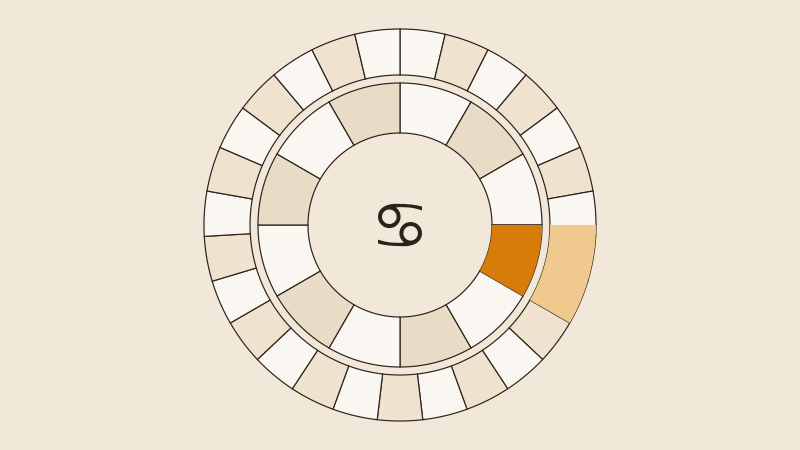
Revati lies entirely inside Pisces (Meena or Meen rashi), from 16°40′ to 30°00′ — the last third of Jupiter's ocean sign and the last degrees of the zodiac. A Revati Moon is a Pisces Moon: compassionate, intuitive, receptive, dissolving, attached to everything and to nothing. What Revati adds is Pushan's road — the Pisces compassion given a direction and a flock to bring home, the intuition given Mercury's practical mind. Mercury, the star-lord, and Jupiter, the sign-lord, are the two teachers who do not agree — the clever and the wise — and the friction is the Revati signature: the dreamer who keeps the accounts, the guide who does not always know where they themselves are going. Mercury is debilitated in Pisces, so the mansion's own lord is weak in its own sign; the mansion holds Venus's deepest exaltation at 27°00′ and ends in the gandanta.
The four padas of Revati
Four padas of 3°20′ make up every nakshatra; each one maps to a navamsa sign, the ninth division of the chart, where the inner life and the marriage are read. Revati's padas run Sagittarius, Capricorn, Aquarius, Pisces, and the fourth is vargottama — the last pada of the zodiac in its own sign.
| Pada | Degrees | Navamsa | Reading |
|---|---|---|---|
| 1 | 16°40′ Pisces – 20°00′ Pisces | Sagittarius | Sagittarius navamsa: the guiding road — the teacher who leads, the guide with a philosophy, the protector who knows why. The most expansive pada and the most confident. |
| 2 | 20°00′ Pisces – 23°20′ Pisces | Capricorn | Capricorn navamsa: the working road — the practical nourisher, the nurse with a schedule, the shepherd who counts. Holds 20°31′, where Saturn stationed retrograde on 27 July 2026. The most disciplined pada and the tradition's favourite for the mansion's care made reliable. |
| 3 | 23°20′ Pisces – 26°40′ Pisces | Aquarius | Aquarius navamsa: the road for the many — the protector of the crowd, the charity, the humanitarian guide. The most detached pada and the most idealistic. |
| 4 | 26°40′ Pisces – 0°00′ Aries | Pisces | Pisces navamsa: vargottama — Pisces in both the rashi and the navamsa, the zodiac's last quarter in its own sign. The pure Revati: compassion, faith, protection and love at full depth. Holds Venus's deepest exaltation at 27°00′; ends in the gandanta from 29°12′. The strongest pada and the most delicate at its edge. |
The fourth pada, being vargottama and holding Venus's exact exaltation, is where Revati's gentleness and its love are least diluted — and its last 0°48′ is the water-fire gandanta, where the zodiac ends. A Moon or lagna in those degrees is at the last threshold, and the tradition reads it as a life that arrives with the whole cycle's weight and the next cycle's beginning in it.
Moon in Revati: the janma nakshatra
Janma nakshatra means the mansion the Moon occupied at birth: the mind's own star, and the start of the dasha count. A Moon in Revati is a mind that brings others home. The natives are people of gentleness and protection, who look after the vulnerable by instinct — children, animals, the old, the lost; who are well-loved, often physically beautiful in a soft way, and liked by strangers; who are intuitive, faithful, fond of travel and of the return, and prosperous in the tradition's word — the abundance at the end of the road. The texts assign them a well-formed body, popularity, courage, wealth, and — in the caution — a tendency to sorrow, and to being taken advantage of.
The deeper mark is Pushan's: they are guides, and guides are not always at home themselves. A Revati Moon spends its care on the road and the flock, and the classical caution is the sadness at the end of things — the nostalgia, the sense of living slightly out of time, the sorrow the texts name — and the giving that leaves nothing for the last mile. The work of the placement is the fish's: to swim with the other fish, and to let themselves be brought home.
Mercury in Jupiter's sign gives the mansion's people their practical kindness. Revati Moons are the tradition's nurses, teachers of the young, protectors of animals and keepers of the road, and they are the people the tradition sends the dying to.
Revati nakshatra female and male natives
Because the queries ask for it, the texts' separate portraits of the woman and the man of this star are kept, with the caution that a chart is not a sex.
For a woman, the tradition gives Revati beauty of a soft kind, a gentle and protective nature, intuition, faith, a talent for the care of children and animals, and a popularity she does not seek; it describes her as a devoted partner and mother, generous to a fault, and as someone whose sorrow is for others' passing more than her own. The caution is the over-giving, and a sadness that lives in her without a cause.
For a man, the tradition gives Revati a well-formed, pleasant frame, courtesy, intelligence of the practical and caring kind, prosperity that arrives through the goodwill of others, and a gift for guiding — students, travellers, the lost; it describes him as faithful, well-liked, a little dreamy, and as someone who finds his way for everyone but himself. The caution is the road not taken home, and the wealth given away.
In each case, the fourth pada deepens the gentleness and the love, and Mercury's condition in the chart decides whether the guide knows the road.
Career, money and health
Work. Pushan's mansion under Mercury gives the professions of the guide and the flock: teaching, especially of the young; nursing, midwifery, care of the old and the dying — the road's last mile; veterinary work and everything with animals; travel — the guide, the pilot, the navigator, the shepherd of tourists; and the professions of finding what is lost — search, rescue, the counsellor of the bereaved. Mercury adds accounts, trade, writing and the keeping of time; Pisces adds the arts of consolation — music, film, the story that brings people home. Revati also does well in charity, in hospitality, and in astrology, since the last mansion keeps the count of the whole cycle.
Money. Comes through the goodwill of others and through the harvest brought home; the tradition marks Revati as prosperous — the name means it — and as generous past the point of prudence. The Capricorn pada keeps most. The caution is the flock fed and the shepherd hungry.
Health. Pisces governs the feet and the lymph, and Revati adds the ankles, the abdomen, and the sorrow the texts name — the mind's weather at the end of the road. Complaints of the feet, of fluid, of the digestion, and of a melancholy that the tradition treats as the mansion's own are classical. The first prescription is company on the road — the guide accompanied.
The other planets in Revati
A planet placed in Revati inherits the mansion's gentleness and Mercury's care, before its own nature shows.
Sun in Revati. In a friend's sign, in the mansion of its friend Mercury. A self that leads by looking after; a father who was a guide, a teacher, or absent on the road; authority that is gentle and well-loved. A comfortable, warm Sun, without much fire.
Moon in Revati. Read above, under the janma nakshatra.
Mars in Revati. In a friend's sign, in the mansion of its enemy Mercury. Force turned to protection: the guardian of the flock, the rescuer, the soldier who brings everyone home. Courage in service; the classical caution is the fight taken up for someone else's cause.
Mercury in Revati. In its own mansion, but debilitated in Pisces — the deepest fall, 15°, is behind in Uttara Bhadrapada, so here Mercury is rising out of it. The guide's mind, intuitive rather than exact: the nurse who knows, the teacher of the young, the counsellor who feels the road. Neecha bhanga through Venus or Jupiter lifts it, and its own lordship of the mansion gives it standing.
Jupiter in Revati. In its own sign, in the mansion of Mercury, with whom Jupiter does not agree. Wisdom at the end of the road: the teacher of the last things, faith that brings others home, grace at the threshold. One of the more benevolent Jupiter placements, and a slightly restless one.
Venus in Revati. Exalted, at its deepest exaltation at 27°00′ in the vargottama fourth pada — the strongest Venus in the zodiac. Love, beauty, art, devotion and fortune all at full strength in the mansion of the journey's end: the tradition's placement for the great artist, the beloved, and the marriage that is a homecoming. The caution is the gandanta a few degrees on.
Saturn in Revati. In a neutral sign, in Mercury's mansion, with which Saturn works well. The patient guide: the shepherd of decades, the long care, the road kept open by discipline. Saturn is in Revati now — from its retrograde station at 20°31′ on 27 July 2026 until 9 October, and again from 8 February 2027 until it leaves Pisces on 3 June.
Rahu in Revati. The hunger at the end of the road: the foreign flock, the guide who cannot stop travelling, the compassion that becomes obsession. Rahu in Mercury's mansion in Pisces is the wanderer who nourishes strangers and does not come home.
Ketu in Revati. The road's end already reached: detachment from the flock, the guide who has delivered everyone and is free, the mystic at the last gate. One of the most spiritual Ketu placements — and one that begins, often, with a loss at the threshold.
Lagna in Revati. A soft, well-formed, often beautiful frame, a gentle face, a manner that is kind and slightly dreamy. The lagna lord is Jupiter, and its placement decides whether the guide knows their own road.
Notice how much turns on the lord. A planet in one of Mercury's three mansions carries Mercury's signature, but Revati is not the other two, and inside Revati the nine sub-lords divide it again. This is the level at which a reading stops being a description of a type and becomes a description of a person. The nakshatra report does that work for your own chart: each planet placed to its pada and sub-lord, each placement read for what it promises and when the dasha lets it through.
The sub-lords of Revati
This is the level at which the Krishnamurti method (KP) reads a chart: each nakshatra is cut into nine unequal parts in the proportion of the Vimshottari years, and the lord of the part — the sub-lord — decides what a planet here actually delivers. Two planets in Revati with different sub-lords give different results. It is the step at which two charts that look alike come apart — where real astrology begins.
| Sub-lord | From | To |
|---|---|---|
| Mercury | 16°40′ Pisces | 18°33′20″ Pisces |
| Ketu | 18°33′20″ Pisces | 19°20′ Pisces |
| Venus | 19°20′ Pisces | 21°33′20″ Pisces |
| Sun | 21°33′20″ Pisces | 22°13′20″ Pisces |
| Moon | 22°13′20″ Pisces | 23°20′ Pisces |
| Mars | 23°20′ Pisces | 24°06′40″ Pisces |
| Rahu | 24°06′40″ Pisces | 26°06′40″ Pisces |
| Jupiter | 26°06′40″ Pisces | 27°53′20″ Pisces |
| Saturn | 27°53′20″ Pisces | 0°00′ Aries |
Three places in Revati's sub-lord table matter more than the rest. The Mercury sub at the start (16°40′ to 18°33′20″) is Mercury in its own mansion and its own sub, debilitated by sign — the guide's mind at its most intuitive and least exact. The Rahu sub (24°06′40″ to 26°06′40″) is where the mansion's compassion becomes hunger; a planet there gives without a floor. The Saturn sub at the end (27°53′20″ to 30°00′) sits just past Venus's deepest exaltation at 27°00′ and holds the gandanta from 29°12′; a planet there — and above all the Moon or the lagna — is at the last threshold of the zodiac, under Saturn's weight by sub, and is read with the care Paper C sets out. Saturn's retrograde station of 27 July 2026 at 20°31′ fell in the Venus sub (19°20′ to 21°33′20″).
The dasha the Moon here gives
A Moon in Revati starts life in the Mercury mahadasha (17 years), and the balance left at birth is the fraction of Revati the Moon has still to cross, times 17: a Moon exactly halfway through Revati has 8.5 years of Mercury left. The order after that is fixed — Ketu → Venus → Sun → Moon → Mars → Rahu → Jupiter → Saturn — and it is the same for everyone born with the Moon here; what differs is where in it a life is standing at any moment. A Revati life begins in the seventeen-year Mercury mahadasha, and since most Revati Moons are born partway through the mansion, Mercury usually runs through childhood and into the teens — a childhood of learning, of care given and received, of the road travelled with the family. Then the seven-year Ketu, which typically falls in the late teens or twenties and is the mansion's first threshold — a loss, a letting go; then the twenty-year Venus, which usually covers the thirties and forties and is where the abundance the name promises arrives — love, art, the harvest brought home.
Revati nakshatra compatibility and marriage life
The tradition matches by three tables — the yoni (the animal), the gana (the temperament) and the nadi (the constitution, which must differ). Revati is elephant yoni, deva gana, antya nadi.
Best matches by yoni — the elephant, whose other mansion is Bharani (full marks); then the sheep (Krittika, Pushya), the serpent (Rohini, Mrigashira), the buffalo (Hasta, Swati) and the monkey (Purva Ashadha, Shravana), each scoring three with the elephant. Most difficult by yoni — the lion (Dhanishta, Purva Bhadrapada), the elephant's enemy, scoring nothing; the tiger scores one.
By gana — Revati is deva, which matches deva and manushya well; deva with rakshasa is the classical mismatch. Revati with Ashwini, Mrigashira, Punarvasu, Pushya, Hasta, Swati, Anuradha and Shravana is deva to deva.
By nadi — Revati is antya nadi. Revati with Krittika, Rohini, Ashlesha, Magha, Swati, Vishakha, Uttara Ashadha or Shravana is nadi dosha in the classical count.
Off the tables: a Revati native is a gentle, faithful, protective partner who brings everyone home, and needs one who will bring them home in turn — and who will not take the giving as a given.
Which pada of Revati is best, and which is difficult?
Revati has no bad pada; the tradition ranks it among the most auspicious mansions and reads every quarter kindly. The fourth pada, vargottama, holding Venus's deepest exaltation, is the strongest — the best in the zodiac for Venus and among the best for the Moon — and its last 0°48′, from 29°12′, is the gandanta, the one place in the mansion that asks for care: a Moon or lagna there is at the zodiac's last threshold, and the tradition reads it for a life that begins at an ending. The second, in Capricorn, is the most dependable. The first, in Sagittarius, is the most confident. The third, in Aquarius, is the most idealistic. If the question is "which pada is bad", the answer is none; if it is "which forty-eight minutes need reading", it is the last.
The sky for Revati Moons in 2026–27
Every date below was calculated with the Swiss Ephemeris (Lahiri, true node), not recalled. For a Pisces Moon this is the peak of sade sati — Saturn on your Moon — until 3 June 2027, and again from 20 October 2027 to 23 February 2028. Jupiter, exalted, is in the fifth house from your Moon until 31 October 2026, previews the sixth from 31 October to 25 January 2027, returns to the fifth until 26 June 2027, and then settles in the sixth. Rahu is in the twelfth and Ketu in the sixth until 25 November 2026; after that Rahu is in the eleventh and Ketu in the fifth for eighteen months. In plain words, and precisely: a Revati Moon is at the peak of sade sati, and Saturn is on the mansion's own degrees for most of the year. Saturn stationed retrograde on 27 July 2026 at 20°31′ Pisces — inside Revati's second pada — and walks back through the mansion until it leaves for Uttara Bhadrapada on 9 October at 20:51 IST (15:21 UTC); it turns direct at 13°42′ on 11 December at 05:59 IST (00:29 UTC) and returns to Revati on 8 February 2027 at 07:51 IST (02:21 UTC), walking forward through the whole mansion again until it leaves Pisces on 3 June 2027 at 05:28 IST (2 June, 23:58 UTC). So a Revati Moon between 16°40′ and 20°31′ has Saturn cross it three times in all — going forward in May–July 2026, back in August–October, and forward again in February–April 2027 — and every Revati Moon has Saturn on the mansion from now until 9 October and again from 8 February to 3 June. Saturn returns to Pisces between 20 October 2027 and 23 February 2028, walking back as far as 26°46′ — inside Revati's fourth pada — where it turns direct on 24 December 2027; so the mansion's last degrees see Saturn once more, a year on. Jupiter's year is in the fifth, one of its good transits, with the sixth previewed over the winter; Rahu moves from the twelfth to the eleventh on 25 November. Mars enters Leo, the sixth from your Moon, on 12 November. For the last mansion, this is the last stretch of the long transit — the road's last mile, which is Revati's own subject — and the mansion's gentleness is the tradition's advice for it: bring the flock home, and let yourself be brought.
→ Sade Sati · Mars Meets Jupiter in Leo
Remedy and mantra
The classical remedy for an afflicted Revati placement is worship of Pushan — through the Sun, of whom he is an Aditya, with the Aditya Hridayam, and through the feeding of animals, which is Pushan's own offering — and of Mercury as the mansion's lord, with Om Budhaya Namah on Wednesday and the worship of Vishnu for Mercury's periods; for the peak of sade sati the tradition also names the Shani Stotra, the Hanuman Chalisa, and service to travellers and the old. The tradition prescribes the gandanta remedies where the chart shows a Moon or lagna in the last degrees. Before any rite the tradition prescribes the road home — a return to a place, a person, a practice that was left. A remedy — a puja, a gemstone, a rudraksha, a yantra — is prescribed to the chart, and the chart decides which.
Questions we are asked
What is Revati nakshatra? The twenty-seventh and last of the nakshatras, 16°40′ to 30°00′ Pisces, ruled by Mercury, with Pushan — the nourisher, the keeper of roads — as deity and a fish, or a pair of fish, as symbol. It stands for the journey's end: protection, guidance, abundance, and the road home.
Revati nakshatra is which rashi? Pisces (Meena, or Meen rashi). The whole nakshatra lies inside Pisces, the last sign of the zodiac.
Who is the lord of Revati nakshatra? Mercury. The dasha for a Moon here begins with Mercury's seventeen years, then Ketu's seven.
What are the Revati nakshatra characteristics? Gentle, protective, faithful, intuitive, well-loved, generous to a fault; the guide who brings everyone home; prone to a sorrow at the passing of things.
Which pada of Revati is best? The fourth, in Pisces — vargottama, holding Venus's deepest exaltation at 27°. None is bad; the last 0°48′ of the fourth pada is the gandanta and needs reading.
What is the Revati nakshatra symbol? A fish, or a pair of fish swimming together — safe passage through the water — and a drum for keeping time, since the last mansion keeps the count of the cycle.
Is Revati nakshatra good for marriage? Among the best, by the tradition's ranking: gentle, devoted, homecoming partners. Match by yoni (elephant), gana (deva) and nadi (antya); the elephant–lion pairing is the one the table scores lowest.
Is Venus exalted in Revati? Yes — Venus's exaltation is Pisces, and its deepest point, 27°00′, is in Revati's fourth pada. Venus there is the strongest Venus in the zodiac.
Is Saturn in Revati in 2026? Yes — Saturn stationed retrograde at 20°31′ Pisces, in Revati, on 27 July 2026, leaves the mansion on 9 October, and returns from 8 February to 3 June 2027; its 2027–28 retrograde brings it back to 26°46′ Pisces, inside the fourth pada. The peak of sade sati, on the mansion's own degrees; computed.
What does 2026 hold for Revati nakshatra? The peak of sade sati with Saturn on the mansion itself until October and again from February; Jupiter in the fifth for most of the year; Rahu moving to the eleventh on 25 November. The computed sky is above.
This is teaching, not advice — not medical, legal or financial — and a nakshatra is one line of a chart, never the whole of it.
To have your Revati placements read as one chart — the Moon, the lagna, the sub-lords, the dasha — is what a private consultation is for.
→ Book a private consultation · Reading the Nakshatra, Not the Sign · Paper C, Nakshatras · ← Uttara Bhadrapada · Ashwini →