Shravana (also called Thiruvonam in Tamil, Sravana in Telugu, Thiruvonam in Malayalam, also written Sravana or Thiruvonam, and known in the sky as Altair) — 10°00′ Capricorn to 23°20′ Capricorn, in Capricorn; lord Moon; deity Vishnu. Lahiri sidereal.
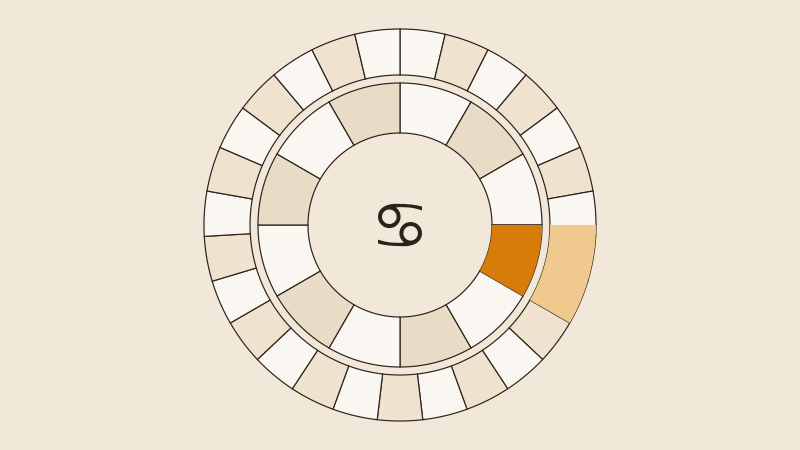
Shravana nakshatra (also written Sravana) is the twenty-second lunar mansion, from 10°00′ to 23°20′ of Capricorn, and it is the star of the ear. Its deity is Vishnu, the preserver, who crossed the three worlds in three steps; its symbol is an ear, or three footprints; its lord is the Moon. In the sky it is Altair, the eagle's eye. The name comes from the root "to hear", and the mansion is everything that is learned by listening: the scripture heard from a teacher before it was ever written, the counsel received, the news carried, the connection made across a distance. A person with the Moon here is intelligent, receptive, well-read and well-connected, the one who knows because they listened — and whose lesson is to speak with the same care.
What follows is our reading of Shravana: the span and the sign, the four padas and the navamsa each reaches, the Moon and every other planet here, the sub-lords of the Krishnamurti method, the dasha a birth here begins, and the computed sky this Moon is under in 2026–27. Sanskrit terms are explained on first use.
Shravana nakshatra at a glance
| Span | 10°00′ Capricorn to 23°20′ Capricorn |
| Sign (rashi) | Capricorn |
| Lord (star-lord) | Moon |
| Deity | Vishnu |
| Symbol | an ear; three footprints |
| Gana (temperament) | Deva |
| Nature (for muhurta) | Chara (movable) |
| Yoni (animal, for matching) | monkey (female) |
| Nadi | Antya |
| Name syllables (pada 1–4) | Ju, Je, Jo, Gha |
| Also called | Thiruvonam (Tamil), Sravana (Telugu), Thiruvonam (Malayalam) |
| Dasha the Moon here begins | Moon, 10 years |
The story and the symbol
Vishnu is the preserver of the three worlds, the one who keeps order by returning to it — Rama, Krishna, the avatars who come when dharma fails. His oldest story is the three steps: as the dwarf Vamana he asked the demon-king Bali for as much land as he could cover in three paces, and then grew until the first step covered the earth, the second the heavens, and the third came down on Bali's own head, sending him to the underworld and keeping the worlds in their places. The three footprints are Shravana's symbol, and the mansion is Vishnu's in its listening aspect: the god who hears every prayer, and the tradition that was carried from ear to ear — shruti, "what was heard", the oldest name for the Veda.
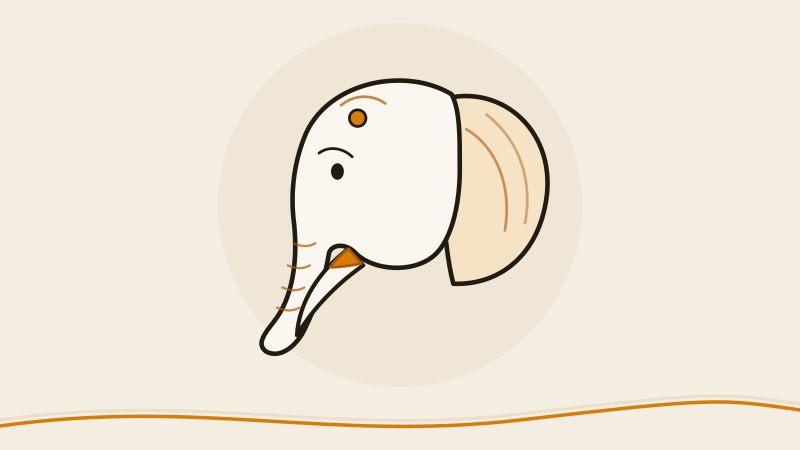
The ear is the other symbol and the deeper one. Shravana is the mansion of the student who learns by listening, the scholar of the oral tradition, the counsellor who hears before advising, the messenger who carries what was said. Its natives are the tradition's learned and its connected — the people who know everyone and have read everything — and its shadow is the ear's: gossip, the hearing of what was not meant for them, and the knowledge held without the wisdom to use it.
The Moon as lord in Saturn's sign gives the mansion its receptivity and its discipline together: the mind that takes in and the earth that keeps. Shravana is the tradition's star of education and of fame that comes from being known for knowing.
Which rashi is Shravana nakshatra? (Shravana nakshatra rasi)
Shravana lies entirely inside Capricorn (Makara or Makar rashi), from 10°00′ to 23°20′ — the middle of Saturn's earth sign. A Shravana Moon is a Capricorn Moon: disciplined, practical, ambitious, reserved, and patient. What Shravana adds is the ear — the Moon's receptivity given Saturn's structure, the listener who remembers. The Moon, the star-lord, and Saturn, the sign-lord, are enemies in the Parashari table — the mind and the weight, the mother and the taskmaster — and the friction is the Shravana signature: the feeling nature under a disciplined surface, the scholar who is also anxious, the connected person who is privately alone. It is a strong placement for learning and a demanding one for ease.
The four padas of Shravana
Four padas of 3°20′ make up every nakshatra; each one maps to a navamsa sign, the ninth division of the chart, where the inner life and the marriage are read. Shravana's padas run Aries, Taurus, Gemini, Cancer.
| Pada | Degrees | Navamsa | Reading |
|---|---|---|---|
| 1 | 10°00′ Capricorn – 13°20′ Capricorn | Aries | Aries navamsa: the active listener — the one who hears and acts, the messenger who runs. The most ambitious pada and the most restless; the journalist, the envoy. |
| 2 | 13°20′ Capricorn – 16°40′ Capricorn | Taurus | Taurus navamsa: the keeping listener — the one who hears and holds: the archivist, the scholar with a library, the counsellor with a practice. The steadiest pada and the tradition's favourite for learning turned to wealth. |
| 3 | 16°40′ Capricorn – 20°00′ Capricorn | Gemini | Gemini navamsa: the carrying listener — the one who hears and tells: the teacher, the broadcaster, the translator. The most communicative pada and the one where the ear's shadow, gossip, is most likely. |
| 4 | 20°00′ Capricorn – 23°20′ Capricorn | Cancer | Cancer navamsa: the Moon's own navamsa in the Moon's own mansion — the feeling listener, the one who hears what is under the words: the counsellor, the mother, the healer of the heard. The most receptive pada and the most easily wounded. |
No pada of Shravana is vargottama. The fourth pada, the Moon's navamsa in the Moon's mansion, is where the star's receptivity is deepest; the second is where its learning is most secure.
Moon in Shravana: the janma nakshatra
Janma nakshatra means the mansion the Moon occupied at birth: the mind's own star, and the start of the dasha count. A Moon in Shravana is a mind that listens. The natives are people of learning and connection, who read widely, remember what they hear, and know who to ask; who are intelligent in the receptive way — the student, the scholar, the counsellor — and who rise through knowledge and through the people it brings them. They are disciplined, reserved, and more anxious than they show; the classical texts give them prosperity, learning, a devoted partner, fame, and generosity — and, in the caution, a taste for hearing what they should not.
The deeper mark is Vishnu's: they preserve. A Shravana Moon holds what it has heard — the tradition, the family's stories, the teacher's words — and carries it forward, and the classical caution is that the carrying becomes the telling: the gossip, the secret passed on, the knowledge used to connect rather than to understand. The work of the placement is the three steps': to cover the ground without treading on anyone's head.
The Moon in Saturn's sign gives the mansion's people their reserve and their ambition. Shravana Moons are the tradition's late and lasting achievers — the scholar recognised in middle life, the counsellor whose reputation was built one listened-to conversation at a time.
Shravana nakshatra female and male natives
Because the queries ask for it, the texts' separate portraits of the woman and the man of this star are kept, with the caution that a chart is not a sex.
For a woman, the tradition gives Shravana intelligence, learning, a good memory, a talent for counsel and for social connection, religious feeling, and a reserve that reads as dignity; it describes her as a devoted partner, a good manager of a household's relationships, generous, and as someone whose advice is sought. The caution is the ear — the news carried, the confidence broken — and an anxiety kept behind the discipline.
For a man, the tradition gives Shravana a well-proportioned frame, a thoughtful manner, learning, a wide acquaintance, prosperity through knowledge and through the people it brings, and fame of the respectable kind; it describes him as a natural teacher and adviser, honest, and slow to reveal himself. The caution is the scholar's pride, and the loneliness of one who listens to everyone and is heard by no one.
In each case, Saturn's condition in the chart decides how heavy the discipline is on the Moon's receptivity.
Career, money and health
Work. Vishnu's mansion under the Moon gives the professions of the ear and the word: education at every level, scholarship, the study and teaching of scripture and of languages; counselling, psychotherapy, advisory work of every kind — the professions of listening; media, broadcasting, journalism, publishing, translation — the professions of carrying what was heard; and the professions of connection — networking, public relations, diplomacy, the agent and the go-between. The three footprints give travel and transport. Shravana also does well in music, especially the vocal arts and the recording of sound, and in the law as counsel rather than combat.
Money. Comes through learning, reputation and connection, and comes in middle life; the tradition marks Shravana as prosperous once the ear has been trained. The Taurus pada holds most. The caution is the fortune spent on the acquaintance — the connected person who is always paying for the connection.
Health. Capricorn governs the knees, the bones and the skin, and Shravana adds the ears — hearing, and the balance that lives in the ear — and the lymph. Complaints of the ears, of the knees and joints under Saturn, and of the anxiety the Moon carries in Saturn's sign are classical. The first prescription, in the old texts, is silence — the ear rested, and the mind with it.
The other planets in Shravana
A planet placed in Shravana inherits the mansion's receptivity and the Moon's changeability, then Saturn's weight from the sign, then its own nature.
Sun in Shravana. In the sign of its enemy Saturn, in the Moon's mansion. A self that is known for knowing; a father who was a teacher, a counsellor, or absent in his work; authority through learning, earned against the sign's resistance. The Sun's heat is cooled and disciplined here.
Moon in Shravana. Read above, under the janma nakshatra. In its own mansion, in an enemy's sign.
Mars in Shravana. Exalted in Capricorn; the deepest degree of the exaltation, 28°, is ahead in Dhanishta, so here the exaltation is strong and still rising. Force with an ear: the strategist who listens first, the soldier-scholar, the athlete who studies the game. One of Mars's finest placements, and the mansion gives it patience.
Mercury in Shravana. In a neutral sign, in the Moon's mansion — though Mercury and the Moon are not friends. The scholar's mind, the translator's, the counsellor's: a memory for what was said and a gift for saying it again well. Strong for education and for the media.
Jupiter in Shravana. Debilitated in Capricorn, past its deepest degree at 5°. Wisdom that has to be earned by listening rather than received by grace; the teacher who studied under a hard master; faith learned late. Neecha bhanga through Saturn or Mars lifts it, and the Moon as star-lord gives the fallen Jupiter a receptive mind to work with.
Venus in Shravana. In a friend's sign, in the Moon's mansion. Love that listens: the partner who hears, the marriage held together by conversation; beauty in the voice and in music. A patient Venus, and a faithful one.
Saturn in Shravana. In its own sign, in the Moon's mansion — the mansion's own weight in its own house. Discipline at full strength on the receptive mind: the scholar of decades, the counsellor whose authority is age, the listener who has heard everything. Saturn here is heavy and it is wise.
Rahu in Shravana. The ear that wants more: the hunger for knowledge, for connection, for the foreign learning; the broadcaster, the collector of secrets. Rahu in the Moon's mansion in Saturn's sign is ambitious, anxious and well-informed.
Ketu in Shravana. The ear turned inward: the listener who has stopped listening to the world and hears the inner voice; detachment from learning once learned, from connection once made. Often a placement of meditation and of the shruti heard directly.
Lagna in Shravana. A well-proportioned, sometimes slight frame, an attentive face, a manner that is reserved, courteous and watchful. The lagna lord is Saturn, and its placement decides whether the listening is wisdom or anxiety.
A Moon placement is never one story. A Sun in Shravana under the Venus sub and a Sun in Shravana under the Saturn sub are two different fathers, two different careers, two different men — and the Moon rules two other mansions besides this one, each with its own nine subs. That is why a chart is read planet by planet at this level, and why a page can only give you the outline. The nakshatra report takes your own chart and reads every planet in it to the pada and the sub-lord — which mansion, which quarter, whose sub — and says what each placement promises and in which dasha it delivers.
The sub-lords of Shravana
This is the level at which the Krishnamurti method (KP) reads a chart: each nakshatra is cut into nine unequal parts in the proportion of the Vimshottari years, and the lord of the part — the sub-lord — decides what a planet here actually delivers. Two planets in Shravana with different sub-lords give different results. It is the step at which two charts that look alike come apart — where real astrology begins.
| Sub-lord | From | To |
|---|---|---|
| Moon | 10°00′ Capricorn | 11°06′40″ Capricorn |
| Mars | 11°06′40″ Capricorn | 11°53′20″ Capricorn |
| Rahu | 11°53′20″ Capricorn | 13°53′20″ Capricorn |
| Jupiter | 13°53′20″ Capricorn | 15°40′ Capricorn |
| Saturn | 15°40′ Capricorn | 17°46′40″ Capricorn |
| Mercury | 17°46′40″ Capricorn | 19°40′ Capricorn |
| Ketu | 19°40′ Capricorn | 20°26′40″ Capricorn |
| Venus | 20°26′40″ Capricorn | 22°40′ Capricorn |
| Sun | 22°40′ Capricorn | 23°20′ Capricorn |
Three places in Shravana's sub-lord table matter more than the rest. The Moon sub at the start (10°00′ to 11°06′40″) is the Moon in its own mansion and its own sub in Saturn's sign — the most receptive degrees of the star, and the most anxious; a planet there hears everything. The Saturn sub (15°40′ to 17°46′40″) is Saturn's own part of Saturn's sign under the Moon's star, the mansion's discipline at full strength — the scholar's degrees, and the heaviest. The Venus sub (20°26′40″ to 22°40′) is where the ear becomes the voice: music, counsel given with warmth, the mansion's kindest degrees.
The dasha the Moon here gives
A Moon in Shravana starts life in the Moon mahadasha (10 years), and the balance left at birth is the fraction of Shravana the Moon has still to cross, times 10: a Moon exactly halfway through Shravana has 5 years of Moon left. The order after that is fixed — Mars → Rahu → Jupiter → Saturn → Mercury → Ketu → Venus → Sun — and it is the same for everyone born with the Moon here; what differs is where in it a life is standing at any moment. A Shravana life begins in the ten-year Moon mahadasha, and since most Shravana Moons are born partway through the mansion, the Moon period usually ends in childhood — a childhood close to the mother and full of what was heard: stories, lessons, the family's talk. Then the seven-year Mars, then the eighteen-year Rahu, which typically covers the teens and twenties: the education abroad or in the unfamiliar, the hunger for knowledge, the connections made. Jupiter's sixteen years usually arrive in the thirties or forties and bring the recognition — and, for a Capricorn Moon, the fallen Jupiter's lesson that recognition is earned.
Shravana nakshatra compatibility and marriage life
The tradition matches by three tables — the yoni (the animal), the gana (the temperament) and the nadi (the constitution, which must differ). Shravana is monkey yoni, deva gana, antya nadi.
Best matches by yoni — the monkey, whose other mansion is Purva Ashadha (full marks); then the horse (Ashwini, Shatabhisha), the elephant (Bharani, Revati) and the cat (Punarvasu, Ashlesha), each scoring three with the monkey. Most difficult by yoni — the sheep (Krittika, Pushya), the monkey's enemy, scoring nothing; the tiger scores one.
By gana — Shravana is deva, which matches deva and manushya well; deva with rakshasa is the classical mismatch. Shravana with Ashwini, Mrigashira, Punarvasu, Pushya, Hasta, Swati, Anuradha and Revati is deva to deva.
By nadi — Shravana is antya nadi. Shravana with Krittika, Rohini, Ashlesha, Magha, Swati, Vishakha, Uttara Ashadha or Revati is nadi dosha in the classical count.
Off the tables: the texts give Shravana a devoted partner, and its natives are attentive, faithful, conversational partners who need to be listened to in return — and who need a partner who will not mistake the reserve for coldness, or the network for a substitute for them.
Which pada of Shravana is best, and which is difficult?
Shravana has no bad pada; the tradition ranks it among the most fortunate mansions for learning and for a good name. The second pada, in Taurus, is the strongest for wealth and the most secure. The fourth, in Cancer, is the most receptive and the most easily hurt. The first, in Aries, is the most ambitious. The third, in Gemini, is the one the tradition watches, because the ear's shadow — gossip, the confidence carried — is most likely there; if the question is "which pada needs care", it is that one.
The sky for Shravana Moons in 2026–27
Every date below was calculated with the Swiss Ephemeris (Lahiri, true node), not recalled. Saturn is in the third house from your Moon until 3 June 2027, then in the fourth (with a return to the third from 20 October 2027 to 23 February 2028) — a dhaiya, the small panoti, for the whole of that stretch. Jupiter, exalted, is in the seventh house from your Moon until 31 October 2026, previews the eighth from 31 October to 25 January 2027, returns to the seventh until 26 June 2027, and then settles in the eighth. Rahu is in the second and Ketu in the eighth until 25 November 2026; after that Rahu is in the first and Ketu in the seventh for eighteen months. In everyday terms: a Shravana Moon is not in sade sati, and the first half of the year is easy. Saturn, the sign's own lord, is in the third from the Moon until June 2027 — one of Saturn's kindest transits, for effort and courage — and then moves into the fourth, where the ardhashtama Shani, the small panoti, begins. Jupiter's year is in the seventh, partnership, one of its good transits. On 25 November Rahu enters the Moon's own sign, Capricorn, for eighteen months, with Ketu in the seventh. For Shravana, the listener's star, Rahu on the Moon is the ear that cannot stop taking in: the tradition would read the stretch from 25 November for a hunger for knowledge and connection, and for the anxiety that comes with it. Mars, exalted here, enters Leo — the eighth from your Moon — on 12 November and meets Jupiter and Ketu there.
→ Sade Sati · Mars Meets Jupiter in Leo
Remedy and mantra
The classical remedy for an afflicted Shravana placement is worship of Vishnu — the Vishnu Sahasranama, the thousand names, is the mansion's own recitation, and the Vamana story its own reading — and of the Moon as the mansion's lord, with Om Chandraya Namah on Monday. Saraswati is worshipped for the mansion's learning, and the tradition prescribes shravana itself — the hearing of scripture — as the remedy for a Shravana Moon in trouble. Before any rite the tradition prescribes a confidence kept — the mansion's affliction is the thing heard and passed on. A remedy — a puja, a gemstone, a rudraksha, a yantra — is prescribed to the chart, and the chart decides which.
Questions we are asked
What is Shravana nakshatra? The twenty-second of the 27 nakshatras, 10°00′ to 23°20′ Capricorn, ruled by the Moon, with Vishnu as deity and an ear, or three footprints, as symbol. In the sky it is Altair. It stands for learning by listening, connection, counsel, and the preserved tradition.
Shravana nakshatra is which rashi? Capricorn (Makara, or Makar rashi). The whole nakshatra lies inside Capricorn, Saturn's earth sign.
Who is the lord of Shravana nakshatra? The Moon. The dasha for a Moon here begins with the Moon's ten years, then Mars's seven.
What are the Shravana nakshatra characteristics? Intelligent, receptive, well-read, well-connected, disciplined, reserved, generous; learns by listening; famous for knowing; prone to the ear's shadow, gossip.
Which pada of Shravana is best? The second, in Taurus, for wealth and security; the fourth, in Cancer, for receptivity. None is bad; the third needs care.
What is the Shravana nakshatra symbol? An ear — the organ of shruti, what was heard — and three footprints, Vishnu's three steps across the worlds.
Is Shravana nakshatra good for marriage? The texts give it a devoted partner: attentive, faithful, conversational. Match by yoni (monkey), gana (deva) and nadi (antya); the monkey–sheep pairing is the one the table scores lowest.
What is Thiruvonam? The Malayalam name for Shravana. Onam, Kerala's harvest festival, falls on the day the Moon is in Thiruvonam in the month of Chingam — the mansion's own festival, and the day of Bali's return, the demon-king Vishnu sent under with his third step.
What does 2026 hold for Shravana nakshatra? Saturn in the third from the Moon until June 2027, then the fourth — the ardhashtama; Jupiter in the seventh; Rahu entering the Moon's sign on 25 November. The computed sky is above.
This is teaching, not advice — not medical, legal or financial — and a nakshatra is one line of a chart, never the whole of it.
To have your Shravana placements read as one chart — the Moon, the lagna, the sub-lords, the dasha — is what a private consultation is for.
→ Book a private consultation · Reading the Nakshatra, Not the Sign · Paper C, Nakshatras · ← Uttara Ashadha · Dhanishta →