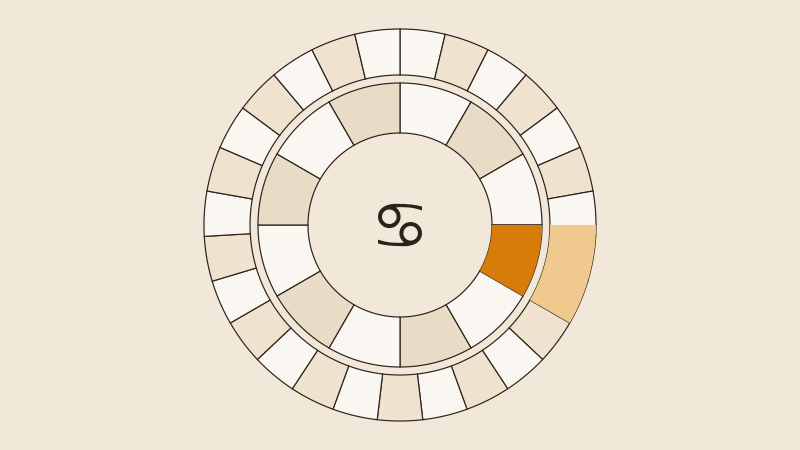
Magha (also called Makam in Tamil, Makha in Telugu, Makam in Malayalam, and known in the sky as Regulus) — 0°00′ Leo to 13°20′ Leo, in Leo; lord Ketu; deity the Pitris. Lahiri sidereal.
Magha nakshatra is the tenth lunar mansion, the first 13°20′ of Leo, and it is the star of the throne. Its deities are the Pitris, the ancestors — the fathers who watch from beyond and to whom every family owes its standing; its symbol is a royal throne, or a palanquin; its lord is Ketu. In the sky it is Regulus, the heart of the lion, the "little king". The name means "the mighty", "the great", and the mansion is about inherited power: the seat one is born to, the name one carries, the debt to those who came before. A person with the Moon here is proud, loyal, generous and traditional, and their whole life is a negotiation between the throne and the ancestors who gave it.
The page walks Magha through in full: the span and the sign, the four padas and the navamsa each reaches, the Moon and every other planet here, the sub-lords of the Krishnamurti method, the dasha a birth here begins, and the computed sky this Moon is under in 2026–27 — which for Magha is the most eventful of the twenty-seven, with Jupiter, Mars and Ketu all on its first degrees in November. Terms in Sanskrit are explained where they arise.
Magha nakshatra at a glance
| Span | 0°00′ Leo to 13°20′ Leo |
| Sign (rashi) | Leo |
| Lord (star-lord) | Ketu |
| Deity | the Pitris |
| Symbol | a royal throne; a palanquin |
| Gana (temperament) | Rakshasa |
| Nature (for muhurta) | Ugra (fierce) |
| Yoni (animal, for matching) | rat (male) |
| Nadi | Antya |
| Name syllables (pada 1–4) | Ma, Mi, Mu, Me |
| Also called | Makam (Tamil), Makha (Telugu), Makam (Malayalam) |
| Dasha the Moon here begins | Ketu, 7 years |
The story and the symbol
The Pitris are the ancestors — not the dead in general but the fathers of the line, honoured at the annual shraddha with water and rice, who are held to bless or withhold blessing from their descendants according to how they are remembered. Magha is their mansion, and its symbol is the throne because the throne is inherited: no one sits on it who was not put there by those before. The mansion is the seat of the lion, the king's own, and its lesson is that a king is the servant of his line.
Ketu as lord is the key. Ketu is the tail of the eclipse-dragon, the past, what was already done; and in Magha the past is the ancestors themselves — the karma of the family, the inheritance of standing and of debt. Magha natives feel their forebears at their back. They are proud because the pride is not their own; they are generous because a king gives; they are traditional because the throne is held on the ancestors' terms. Ketu also gives the mansion its detachment — the ruler who knows the seat is not really theirs — and its sudden reversals: the king dethroned, the heir who walks away.
Regulus, the star, was one of the four royal stars of the ancient world, the watcher of the north, and its name for kingship and for sudden fall is older than Jyotish; Magha keeps both. The first 0°48′ of the mansion is the fire end of the water-fire gandanta — the throne's foot is on a threshold.
Which rashi is Magha nakshatra? (Magha nakshatra rasi)
Magha lies entirely inside Leo (Simha rashi), from 0°00′ to 13°20′ — the first third of the Sun's own sign. A Magha Moon is a Leo Moon: proud, warm, generous, needing to be seen, loyal to its own. What Magha adds is the ancestry. Purva Phalguni after it is the throne enjoyed; Uttara Phalguni after that is the throne's duty; Magha is the throne inherited. Ketu, the star-lord, and the Sun, the sign-lord, are on uneasy terms — Ketu eclipses the Sun — and the unease is the Magha signature: the king with a doubt about his right to the crown, or a detachment from it that reads as humility or as contempt.
The four padas of Magha
Each pada is a quarter of the mansion, 3°20′, and carries the sign of the navamsa, the ninth division, in which the inner life and the marriage are read. Magha's padas run Aries, Taurus, Gemini, Cancer.
| Pada | Degrees | Navamsa | Reading |
|---|---|---|---|
| 1 | 0°00′ Leo – 3°20′ Leo | Aries | Aries navamsa: the warrior king — the throne taken as well as inherited. Bold, commanding, impatient; the most active pada. The first 0°48′ is gandanta. Jupiter meets Ketu here on 12 November 2026 and Mars meets Jupiter here on the 16th. |
| 2 | 3°20′ Leo – 6°40′ Leo | Taurus | Taurus navamsa: the wealthy king — the throne as estate: land, gold, the family's holdings. The most material pada and the steadiest; the tradition's favourite for money. |
| 3 | 6°40′ Leo – 10°00′ Leo | Gemini | Gemini navamsa: the learned king — the throne as court: counsel, letters, the family's reputation for intelligence. The most sociable pada; the diplomat and the scholar-ruler. |
| 4 | 10°00′ Leo – 13°20′ Leo | Cancer | Cancer navamsa: the mother-king — the throne as home: the family itself, the ancestral house, the mother's line. The most emotional pada, and the most attached to the past. |
No pada of Magha is vargottama. The first pada carries the gandanta at its start; the fourth is the one the tradition reads for the ancestral home and the mother's family.
Moon in Magha: the janma nakshatra
A birth is dated by its janma nakshatra, the Moon's mansion; the mind takes its colour from it and the dasha its starting point. A Moon in Magha gives a mind that remembers where it came from. These are people of loyalty and lineage — proud of their family, their tradition, their name, and ready to defend all three; generous as a matter of standing; warm to those who honour them and cold to those who do not; and drawn to authority, whether they hold it or serve it. In the classical descriptions they have wealth, many servants, devotion to the gods and the ancestors, a fondness for enjoyment, and a temper.
The deeper current is the debt. A Magha Moon carries the ancestors — sometimes as a blessing, an inheritance of standing that opens doors; sometimes as a weight, the family's expectations or its unfinished business. What the texts warn of is pride: the king who cannot be told, the heir who mistakes the throne for himself. Ketu's lordship supplies the correction — the sudden detachment, the loss of position that teaches what position was for — and the Magha native who has been through it becomes the mansion's best version: the ruler who serves.
The Sun's sign gives the warmth. Magha Moons are generous hosts, faithful friends, and fierce protectors of their own; the throne has a table, and everyone is fed at it.
Magha nakshatra female and male natives
The texts split the description by sex; both halves are kept, as readers want them, with the caution that a chart is not a sex.
For a woman, the tradition gives Magha a regal manner, a strong sense of family and of her place in it, devotion to elders and to tradition, generosity, and a pride that will not be slighted. She is described as respected, capable in the management of a large household, and as someone whose marriage joins two lines rather than two people. The caution is about pride, and about quarrels with the in-laws over precedence.
For a man, the tradition gives Magha a strong, imposing frame, a commanding manner, loyalty to family and to superiors, generosity, and religious feeling — especially toward the ancestors. He is described as prosperous, often through inheritance or through the family's name, and as a natural authority who does not always know when to stop being one. The caution is arrogance, and the fall that Ketu brings to correct it.
For both, Ketu's condition in the chart decides whether the throne is held lightly or grasped.
Career, money and health
Work. The throne's mansion gives government, administration, politics, and every position of inherited or institutional authority; the family business, especially in its second or third generation; the professions of lineage — genealogy, history, archaeology, heritage, the priesthood that serves the ancestors; and the professions of standing — law at the bench, the senior ranks of any service, the chair of the board. Magha also does well in large organisations, in royalty and its modern equivalents, and in any work where the name opens the door.
Money. Comes through the family, the position, and the ancestors' goodwill — inheritance is the mansion's classical source — and goes on the maintenance of standing: the house, the ceremonies, the dependents. The Taurus pada holds most. Ketu's lordship warns of the sudden loss that follows pride.
Health. Leo governs the heart, the spine and the upper back, and Magha adds the hereditary — the illnesses of the line. Complaints of the heart and the back are classical, along with the conditions that run in families; the tradition's first prescription is the shraddha, the honouring of the ancestors, which it holds to be medicine for this mansion.
The other planets in Magha
A planet in Magha takes on the mansion's inheritance and Ketu's detachment, and then does what that planet does.
Sun in Magha. In its own sign, in Ketu's mansion. The king on his throne, with Ketu's shadow across it: full authority, the father's standing, a self that is royal and knows it is borrowed. One of the Sun's strongest placements by sign; Ketu makes it either humble or suddenly unseated.
Moon in Magha. See above.
Mars in Magha. In a friend's sign and a friend's mansion — Mars and Ketu are allies. The general, the enforcer of the throne, courage in the family's name. Strong and hot; the classical caution is the quarrel over precedence. Mars is here from 12 November 2026, and meets Jupiter and Ketu in the first pada.
Mercury in Magha. In a friend's sign, in Ketu's mansion. The court's intelligence: the minister, the scribe, the keeper of the family's records. A mind that respects tradition and argues within it.
Jupiter in Magha. In a friend's sign and a friend's mansion. Wisdom in the service of lineage: the family priest, the teacher of tradition, the elder whose word settles things. Jupiter is here from 31 October 2026 to 25 January 2027, and again from 26 June 2027.
Venus in Magha. In an enemy's sign, in Ketu's mansion. Love that is dynastic — the marriage of lines, the partner chosen for standing; beauty that is regal; pleasure taken as a right. A proud Venus; not always a warm one.
Saturn in Magha. In an enemy's sign, in Ketu's mansion. The servant on the throne, or the king who serves: authority held through long labour, the family's burden carried for decades. Saturn here can be the ancestral debt itself.
Rahu in Magha. The head of the axis in the tail's mansion: ambition for the throne one was not born to; the outsider who becomes the dynasty; the foreign name grafted onto the old one. Rahu here often reverses the family's standing — up or down.
Ketu in Magha. Ketu in its own mansion: the ancestors' own planet on their own star. Detachment from lineage — the heir who renounces, the one who leaves the family house — or the deepest connection to it, the native who feels the dead. Ketu is here until 25 November 2026.
Lagna in Magha. A strong, upright frame, a large face, a manner that expects deference and usually gets it. The lagna lord is the Sun, and its placement decides whether the throne is a seat or a stage.
A Ketu placement is never one story. A Sun in Magha under the Venus sub and a Sun in Magha under the Saturn sub are two different fathers, two different careers, two different men — and Ketu rules two other mansions besides this one, each with its own nine subs. That is why a chart is read planet by planet at this level, and why a page can only give you the outline. The nakshatra report takes your own chart and reads every planet in it to the pada and the sub-lord — which mansion, which quarter, whose sub — and says what each placement promises and in which dasha it delivers.
The sub-lords of Magha
This is the level at which the Krishnamurti method (KP) reads a chart: each nakshatra is cut into nine unequal parts in the proportion of the Vimshottari years, and the lord of the part — the sub-lord — decides what a planet here actually delivers. Two planets in Magha with different sub-lords give different results. It is the step at which two charts that look alike come apart — where real astrology begins.
| Sub-lord | From | To |
|---|---|---|
| Ketu | 0°00′ Leo | 0°46′40″ Leo |
| Venus | 0°46′40″ Leo | 3°00′ Leo |
| Sun | 3°00′ Leo | 3°40′ Leo |
| Moon | 3°40′ Leo | 4°46′40″ Leo |
| Mars | 4°46′40″ Leo | 5°33′20″ Leo |
| Rahu | 5°33′20″ Leo | 7°33′20″ Leo |
| Jupiter | 7°33′20″ Leo | 9°20′ Leo |
| Saturn | 9°20′ Leo | 11°26′40″ Leo |
| Mercury | 11°26′40″ Leo | 13°20′ Leo |
Three sub-lords of Magha to read first. The Ketu sub at the start (0°00′ to 0°46′40″) is Ketu in its own mansion and its own sub and inside the gandanta — the throne's foot on the threshold; a Moon or lagna there is at the most detached, most karmic degrees of the star. The Venus sub (0°46′40″ to 3°00′) is where the mansion's royalty is most enjoyed, and it is the sub in which the Jupiter–Ketu and Mars–Jupiter meetings of November 2026 fall (1°18′ and 1°39′ Leo). The Saturn sub (9°20′ to 11°26′40″) is where the throne is a burden — the servant-king's degrees.
The dasha the Moon here gives
A Moon in Magha starts life in the Ketu mahadasha (7 years), and the balance left at birth is the fraction of Magha the Moon has still to cross, times 7: a Moon exactly halfway through Magha has 3.5 years of Ketu left. The order after that is fixed — Venus → Sun → Moon → Mars → Rahu → Jupiter → Saturn → Mercury — and it is the same for everyone born with the Moon here; what differs is where in it a life is standing at any moment. A Magha life begins in the seven-year Ketu mahadasha, and since most Magha Moons are born partway through the mansion, Ketu usually ends in early childhood — a childhood the tradition expects to carry a loss, a move, or the strong presence of a grandparent. Then the twenty-year Venus, which typically covers the school years and the twenties and is the mansion's enjoyment of its inheritance; then the Sun's six and the Moon's ten, the thirties and forties, in which the throne has to be held rather than inherited.
Magha nakshatra compatibility and marriage life
The match is made on three counts: the yoni (the animal), the gana (the temperament) and the nadi (the constitution, which must differ). Magha is rat yoni, rakshasa gana, antya nadi.
Best matches by yoni — the rat, whose other mansion is Purva Phalguni (full marks); no other animal scores three with the rat, and the horse, elephant, sheep, cow, buffalo, tiger, deer, monkey, mongoose and lion score two. Most difficult by yoni — the cat (Punarvasu, Ashlesha), the rat's enemy, scoring nothing; the serpent and the dog score one.
By gana — Magha is rakshasa, which matches rakshasa best (Krittika, Ashlesha, Chitra, Vishakha, Jyeshta, Mula, Dhanishta, Shatabhisha) and manushya acceptably; rakshasa with deva is the classical mismatch.
By nadi — Magha is antya nadi. Magha with Krittika, Rohini, Ashlesha, Swati, Vishakha, Uttara Ashadha, Shravana or Revati is what the tradition calls nadi dosha.
After the tables comes the part that matters: a Magha native marries a family as much as a person, and needs a partner who respects the line without competing with it — and who can tell the Magha native, once in a while, that the throne is only a chair.
Which pada of Magha is best, and which is difficult?
Asked plainly, the question is where the trouble sits. For Magha the tradition's answer is the first pada — not because Aries is a poor navamsa but because its first 0°48′ is the fire end of the gandanta, and a Moon or lagna there begins life on a threshold. The second pada, in Taurus, is the strongest for wealth and the steadiest. The third is the cleverest. The fourth, in Cancer, is the most attached to the ancestral home and the one to read for the mother's line. In November 2026 the first pada is also where the sky's traffic is: Jupiter, Ketu and Mars all meet within its first two degrees, which makes it, for a few weeks, the most-transited pada in the zodiac.
The sky for Magha Moons in 2026–27
Dates computed, not remembered: Swiss Ephemeris, Lahiri ayanamsa, true node. Saturn is in the eighth house from your Moon until 3 June 2027, then in the ninth (with a return to the eighth from 20 October 2027 to 23 February 2028). Jupiter, exalted, is in the twelfth house from your Moon until 31 October 2026, previews the first from 31 October to 25 January 2027, returns to the twelfth until 26 June 2027, and then settles in the first. Rahu is in the seventh and Ketu in the first until 25 November 2026; after that Rahu is in the sixth and Ketu in the twelfth for eighteen months. To say it directly: a Magha Moon is not in sade sati, but it is in the small panoti — Saturn in the eighth from the Moon until June 2027, the ashtama Shani that the tradition ranks just below sade sati for difficulty, followed by the ninth. Jupiter is in the twelfth from the Moon until 31 October — expense and retreat — and then, from 31 October to 25 January, on the Moon itself, in Magha's own degrees: the guru on the throne. Ketu is on the Magha Moon until 25 November, and Rahu opposite in the seventh; then Ketu moves to the twelfth and Rahu to the sixth. And Mars enters Leo on 12 November at 20:18 IST (14:48 UTC), meets Ketu on the 14th at 23:20 IST (17:50 UTC) and Jupiter on the 16th at 11:53 IST (06:23 UTC) — all within Magha's first two degrees. For a Magha Moon, and above all a first-pada Magha Moon, the week of 12 to 16 November 2026 is the year: force, grace and detachment on the mind at once, with Saturn in the eighth watching. The tradition would read it as an inheritance settled — something handed over, something taken up — and would say to move nothing that does not need moving until Mars is clear of Jupiter, a degree past it by 19 November.
→ Sade Sati · Mars Meets Jupiter in Leo
Remedy and mantra
The classical remedy for an afflicted Magha placement is the honouring of the ancestors — the shraddha, the tarpana, the pitru paksha offerings — which the tradition holds to be this mansion's medicine before any other; and worship of Ketu as the lord, with Om Ketave Namah and the worship of Ganesha for Ketu's periods. The Sun's mantra Om Suryaya Namah at sunrise serves the sign. Before the mantra comes the paying of a debt — to a parent, a teacher, a family — since the mansion's affliction is the throne held without acknowledging who gave it. A remedy — a puja, a gemstone, a rudraksha, a yantra — is prescribed to the chart, and the chart decides which.
Questions we are asked
What is Magha nakshatra? The tenth of the 27 nakshatras, 0°00′ to 13°20′ Leo, ruled by Ketu, with the Pitris — the ancestors — as deities and a royal throne as symbol. In the sky it is Regulus. It stands for inherited power, lineage, loyalty, and the debt to those who came before.
Magha nakshatra is which rashi? Leo (Simha). The whole nakshatra lies inside Leo, the Sun's own sign.
Who is the lord of Magha nakshatra? Ketu. The dasha for a Moon here begins with Ketu's seven years, then Venus's twenty.
What are the Magha nakshatra characteristics? Proud, loyal, generous, traditional, devoted to family and ancestors; drawn to authority; warm to those who honour it and unforgiving of those who do not.
Which pada of Magha is bad? None for everyone. The first pada begins in the gandanta, and a Moon or lagna in its first 0°48′ needs care; the second is the strongest for wealth.
What is the Magha nakshatra symbol? A royal throne, or a palanquin — the seat that is inherited, carried by others.
Is Magha nakshatra good for marriage? Loyal, dynastic partners who marry a family as much as a person. Match by yoni (rat), gana (rakshasa) and nadi (antya); the rat–cat pairing is the pair the yoni count marks at nothing.
What happens in Magha nakshatra in November 2026? Jupiter enters Magha on 31 October, meets Ketu at 1°18′ Leo on 12 November; Mars enters on 12 November, meets Ketu on the 14th and Jupiter at 1°39′ Leo on the 16th; Ketu leaves on 25 November. All in the first pada.
What does 2026 hold for Magha nakshatra? Saturn in the eighth from the Moon until June 2027 — the ashtama Shani; Jupiter on the Moon from 31 October to 25 January; Mars, Jupiter and Ketu together on the Moon in mid-November. The computed sky is above.
This page teaches; it does not advise on health, law or money. A nakshatra is one line in a chart, not the chart.
The reading of your own Magha — Moon, lagna, sub-lord and dasha at once — is a consultation, not a page, and it comes with the remedy if one is called for.
→ Book a private consultation · Reading the Nakshatra, Not the Sign · Paper C, Nakshatras · ← Ashlesha · Purva Phalguni →