Mula (also called Moolam in Tamil, Moola in Telugu, Moolam in Malayalam, also written Moola or Mool, and marked in the sky by the tail of the Scorpion at the centre of the galaxy) — 0°00′ Sagittarius to 13°20′ Sagittarius, in Sagittarius; lord Ketu; deity Nirriti. Lahiri sidereal.
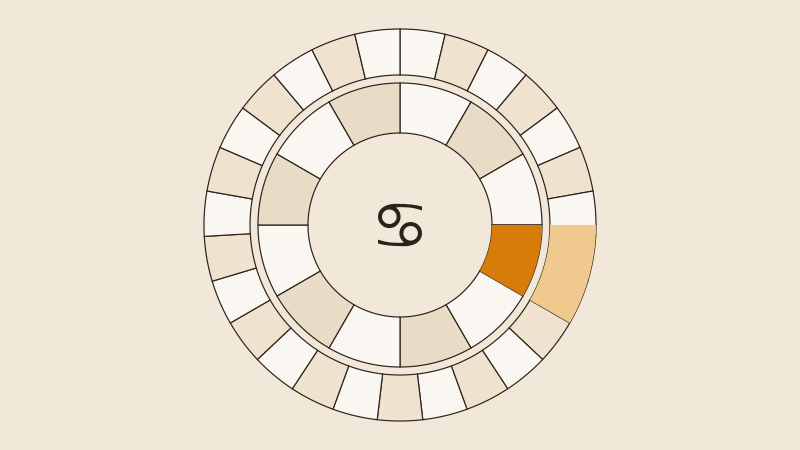
Mula nakshatra (also written Moola, or mool nakshatra) is the nineteenth lunar mansion, the first 13°20′ of Sagittarius, and the one most people are afraid of. Its deity is Nirriti, the goddess of dissolution, calamity and the dark; its symbol is a tied bundle of roots, or an elephant goad; its lord is Ketu. In the sky its stars are the Scorpion's tail and its sting, and they point at the centre of the galaxy — the tradition calls this mansion "the root" because it is where the sky itself is rooted. The name means exactly that, root, foundation, origin; and the mansion is the pulling-up of a root: the ending that goes all the way down, the loss that clears the ground, the truth that is found by destroying what stood on it. A person with the Moon here is investigative, direct, deep, and unafraid of endings, and their life is a series of foundations dug out and rebuilt — better each time, if they let the digging finish.
This is Mula, read in the Institute's order: the span and the sign, the four padas and the navamsa each reaches, the gandanta at its start, the "Mula dosha" the folklore speaks of and what the chart actually says, the Moon and every other planet here, the sub-lords of the Krishnamurti method, the dasha a birth here begins, and the computed sky this Moon is under in 2026–27. Each Sanskrit word is explained the first time it is used.
Mula nakshatra at a glance
| Span | 0°00′ Sagittarius to 13°20′ Sagittarius |
| Sign (rashi) | Sagittarius |
| Lord (star-lord) | Ketu |
| Deity | Nirriti |
| Symbol | a tied bundle of roots; an elephant goad |
| Gana (temperament) | Rakshasa |
| Nature (for muhurta) | Tikshna (sharp) |
| Yoni (animal, for matching) | dog (male) |
| Nadi | Adi |
| Name syllables (pada 1–4) | Ye, Yo, Bha, Bhi |
| Also called | Moolam (Tamil), Moola (Telugu), Moolam (Malayalam) |
| Dasha the Moon here begins | Ketu, 7 years |
The story and the symbol
Nirriti is the oldest goddess of the dark in the Vedic hymns — the personification of nir-riti, the absence of order, the lawless place outside the sacrifice; she receives the offerings the other gods refuse, and she is asked, in hymn after hymn, to go away. She rules the south-west, death's direction, and the cremation ground. Mula is her mansion, and the tradition does not soften it: this is the star of calamity, of the ending that cannot be argued with, of the ground taken out from under the feet.
But the root is the symbol, and the root is the point. A root is what holds; it is also what is pulled up when a thing must be moved or ended for good; and it is the medicine — the mula of the Ayurvedic pharmacy, the herb whose root cures. Mula's endings are the kind that clear ground for something the old growth was blocking, and its natives are the tradition's investigators, healers and philosophers: people who go to the root of a matter because the surface has never been enough for them. The elephant goad, the other symbol, is the sharp hook that steers a beast too big to be pushed. Mula steers by a small, painful, exact pressure.
Ketu as lord is what makes the mansion spiritual rather than merely destructive. Ketu is the tail of the dragon, the past already lived, the detachment that comes from having lost before; in Nirriti's mansion it is the loss that turns out to have been a release. The mansion opens with a gandanta — its first 0°48′ is the fire end of the knot between Scorpio and Sagittarius — and the tradition places the galactic centre in Mula's degrees: the root of the sky, and the root of the self, are held to be the same place.
Which rashi is Mula nakshatra? (Mula nakshatra rasi)
Mula lies entirely inside Sagittarius (Dhanu rashi), from 0°00′ to 13°20′ — the first third of Jupiter's fire sign. A Mula Moon is a Sagittarius Moon: philosophical, direct, optimistic, freedom-loving, aimed at something far off. What Mula adds is Nirriti's depth and Ketu's severance to the Sagittarius aim: the archer whose arrow goes to the root, the philosopher who tears down. Ketu, the star-lord, and Jupiter, the sign-lord, are on good terms — Ketu is read as Jupiter-like in its wisdom — and the ease is the Mula signature: destruction that is somehow enlightening, the ending that teaches. The mansion's first 0°48′ is a gandanta.
Mula nakshatra dosha: what the folklore says, and what the chart says
Readers come to this page frightened. The folklore holds that a child born in Mula — above all in its first pada — is dangerous to the father, the father-in-law, or the family's fortune, and that a Mula shanti puja must be done to avert it. We record the belief because it is real and widespread, and we read it as what it is: the tradition's memory that Mula is Nirriti's, and that its first degrees are a gandanta, a threshold. Here is what the chart actually says.
The gandanta is real and computed: 0°00′ to 0°48′ Sagittarius, the fire end of the water-fire knot. A Moon or a lagna in those degrees is at a threshold, and the classical texts read it for instability in early life and for something in the birth that needed untying. That is a matter of forty-eight minutes of arc, not of the whole mansion, and it is a reading, not a curse.
The rest of the first pada (0°48′ to 3°20′) is not gandanta; the folklore extends the fear across it because the padas are what most people know how to find. The second, third and fourth padas carry no such point at all.
The classical Mula shanti is a remedy prescribed for a Moon in the gandanta degrees, and for the specific afflictions the chart shows — a debilitated or afflicted Ketu, a damaged fourth or ninth house, the parent's significator under strain. It is not a tax on being born under a star. If you were born in Mula and no one has read the chart, the honest advice is to have it read: the mansion's reputation is the gandanta's, and the gandanta is a place, not a people.
The four padas of Mula
The four padas — quarters of 3°20′ — are how a nakshatra reading gets specific; each pada belongs to one navamsa sign, the ninth divisional chart, read for what is inward and for marriage. Mula's padas run Aries, Taurus, Gemini, Cancer, and the first opens in the gandanta.
| Pada | Degrees | Navamsa | Reading |
|---|---|---|---|
| 1 | 0°00′ Sagittarius – 3°20′ Sagittarius | Aries | Aries navamsa: the uprooting fire — direct, courageous, the one who tears down first and asks after. The first 0°48′ is gandanta. The most forceful pada and the one the folklore fears; strong for Mars and the Sun, delicate for the Moon in its first degrees. |
| 2 | 3°20′ Sagittarius – 6°40′ Sagittarius | Taurus | Taurus navamsa: the rooted digger — the investigator who builds on what is found, the healer with a practice, the philosopher with a house. The steadiest pada and the tradition's favourite for wealth from the mansion's depth. |
| 3 | 6°40′ Sagittarius – 10°00′ Sagittarius | Gemini | Gemini navamsa: the questioning root — the researcher, the writer, the one who digs with words. The most intellectual pada and the most restless; the classical placement of the scholar of endings. |
| 4 | 10°00′ Sagittarius – 13°20′ Sagittarius | Cancer | Cancer navamsa: the feeling root — the loss felt as grief, the digging done in the heart. The most emotional pada; the healer of the family's wounds, and the one most in need of a home after the uprooting. |
No pada of Mula is vargottama. The first pada carries the gandanta at its start and the mansion's reputation with it; the second is where the tradition reads Mula's depth as most productive.
Moon in Mula: the janma nakshatra
The janma nakshatra — the Moon's mansion at the moment of birth — is where the mind is read and the dasha is counted from. A Moon in Mula produces a mind that goes to the root. These are people who cannot leave a question half-answered or a wound half-examined; who are direct, sometimes blunt, in speech; who are drawn to philosophy, medicine, investigation, and the study of endings — death, the occult, the deep past; who lose things and rebuild, and are stronger after. The tradition credits them with wealth, a steady mind, a life of enjoyment, a wandering nature, and — in the harsher lines — a destructive temper and a bitterness toward their own people.
The signature underneath is Nirriti's: they have been through the ending. The tradition expects a Mula Moon to carry an early loss — a parent, a home, a first foundation — and reads that loss as the source of both the depth and the fear the folklore attaches. The classical warning is the digging that will not stop: the person who uproots every relationship looking for its flaw, who destroys because they can see the rot and cannot see the tree. Their lesson is the goad's: the small, exact pressure, not the axe.
Ketu in Jupiter's sign gives the mansion's people their spiritual gift. Mula Moons are the tradition's seekers of liberation — the root of the self is what they are after, and many of the texts' saints and philosophers were born here.
Mula nakshatra female and male natives
Readers search for the female and the male native separately, so the classical pair of portraits is given, with the caution that a chart is not a sex — and, for Mula, that the old texts' warnings about the native's family belong to the gandanta, not the mansion.
For a woman, the tradition gives Mula intelligence, directness, independence, a philosophical or religious turn, and a courage in endings that others lack; it describes her as capable of rebuilding her life from nothing, devoted to truth over comfort, and as someone whose marriage is tested by her need to go to the root of it. The old texts add the folklore about the husband's family, which we have addressed above.
For a man, the tradition gives Mula a strong, sometimes wiry frame, a searching gaze, a taste for investigation and for the deep sciences, a temper that uproots, and a prosperity that comes after a loss; it describes him as generous to those who survive his honesty, and as happiest in work that digs. The caution is bitterness, and the destruction of his own foundations.
With both, Ketu's condition in the chart decides whether the uprooting is liberation or ruin.
Career, money and health
Work. Nirriti's mansion under Ketu gives the professions of the root: medicine, above all pharmacology, herbal and Ayurvedic medicine — mula is the root the physician uses — surgery, and the study of disease at its origin; investigation of every kind — research, forensics, detective work, journalism that digs, the audit; philosophy, theology, and the sciences of liberation; the occult and the study of death — the crematorium, the undertaker, the priest of the last rites; and the trades of the root itself — agriculture, mining, oil, everything drawn from under the ground. Mula also does well in demolition and in restructuring — the consultant who is called to end a thing well.
Money. Comes after a loss and through depth; the tradition marks Mula as wealthy in the second half of life, once the first foundation has been dug out and replaced. The Taurus pada holds most. The caution is the fortune uprooted by the native's own hand — the business destroyed to prove a point.
Health. Sagittarius governs the hips, the thighs and the liver, and Mula adds the feet — the root of the body — and the deep diseases, the ones with a hidden cause. Complaints of the hips and legs, of the liver, and of illnesses that are found late are classical, along with the injuries of a direct nature. What the tradition prescribes before medicine is the root itself: herbal medicine, and a diet that goes back to the ground.
The other planets in Mula
Put a planet in Mula and it takes the mansion's depth and Ketu's severance, and adds itself to that.
Sun in Mula. In a friend's sign, in Ketu's mansion — and Ketu eclipses the Sun. A self that finds its standing by losing it first; a father lost, distant, or himself uprooted — this is the placement behind much of the folklore; authority that comes from having gone to the root. Strong for philosophy and for the deep sciences.
Moon in Mula. As set out above.
Mars in Mula. In a friend's sign and a friend's mansion — Mars and Ketu are allies. The surgeon's Mars, the investigator's, the demolisher's: force that goes to the root and does not stop. Courageous, direct, and dangerous to what it examines; the classical caution is the temper that uproots.
Mercury in Mula. In a neutral sign, in Ketu's mansion. The investigator's mind: research, analysis, the question behind the question. Speech that is blunt and usually right; the placement of the philosopher who argues everything down to its foundation.
Jupiter in Mula. In its own sign, in the mansion of its friend Ketu. Wisdom that has been through the ending: the philosopher of liberation, the teacher who lost everything and understood; faith that is rooted rather than inherited. One of the deeper Jupiter placements, and one of the strongest for moksha.
Venus in Mula. In a neutral sign, in Ketu's mansion, which is not Venus's friend. Love that is examined to its root, and often uprooted; the affair that ends completely; beauty in the austere. A difficult Venus for romance and a strong one for the art that comes from loss.
Saturn in Mula. In a neutral sign, in Ketu's mansion. The slow uprooting: the foundation that is dug out over decades, the long grief, the discipline of the deep sciences. Saturn here is the patient root-digger, and can be the burden of an early loss carried for life.
Rahu in Mula. The head of the axis in the tail's mansion: the hunger for the root, the obsession with origins, the foreign investigation; often the placement of the person who uproots themselves — emigration, conversion, the total change of life. Rahu here can be the calamity itself, or the drive that survives it.
Ketu in Mula. Ketu in its own mansion: severance at full strength. The renunciate, the one who has already lost and is free; the deepest spiritual placement of the star, and the one most likely to begin with a loss that defines everything after.
Lagna in Mula. A strong, direct frame, a searching gaze, a manner that is blunt and a little unsettling. The lagna lord is Jupiter, and its placement decides whether the digging is wisdom or ruin.
A Ketu placement is never one story. A Sun in Mula under the Venus sub and a Sun in Mula under the Saturn sub are two different fathers, two different careers, two different men — and Ketu rules two other mansions besides this one, each with its own nine subs. That is why a chart is read planet by planet at this level, and why a page can only give you the outline. The nakshatra report takes your own chart and reads every planet in it to the pada and the sub-lord — which mansion, which quarter, whose sub — and says what each placement promises and in which dasha it delivers.
The sub-lords of Mula
This is the level at which the Krishnamurti method (KP) reads a chart: each nakshatra is cut into nine unequal parts in the proportion of the Vimshottari years, and the lord of the part — the sub-lord — decides what a planet here actually delivers. Two planets in Mula with different sub-lords give different results. It is the step at which two charts that look alike come apart — where real astrology begins.
| Sub-lord | From | To |
|---|---|---|
| Ketu | 0°00′ Sagittarius | 0°46′40″ Sagittarius |
| Venus | 0°46′40″ Sagittarius | 3°00′ Sagittarius |
| Sun | 3°00′ Sagittarius | 3°40′ Sagittarius |
| Moon | 3°40′ Sagittarius | 4°46′40″ Sagittarius |
| Mars | 4°46′40″ Sagittarius | 5°33′20″ Sagittarius |
| Rahu | 5°33′20″ Sagittarius | 7°33′20″ Sagittarius |
| Jupiter | 7°33′20″ Sagittarius | 9°20′ Sagittarius |
| Saturn | 9°20′ Sagittarius | 11°26′40″ Sagittarius |
| Mercury | 11°26′40″ Sagittarius | 13°20′ Sagittarius |
Mula's sub-lords: the three that change a reading. The Ketu sub at the start (0°00′ to 0°46′40″) is Ketu in its own mansion and its own sub, and it lies almost entirely inside the gandanta (which runs to 0°48′): the most severed, most karmic degrees of the star, and the exact degrees the Mula folklore is about — a Moon or lagna here is the case the shanti was written for. The Rahu sub (5°33′20″ to 7°33′20″) is where the mansion's digging becomes obsession; a planet there cannot stop. The Jupiter sub (7°33′20″ to 9°20′) is where Mula's depth is most clearly wisdom — the philosopher's degrees, and the mansion's kindest.
The dasha the Moon here gives
A Moon in Mula starts life in the Ketu mahadasha (7 years), and the balance left at birth is the fraction of Mula the Moon has still to cross, times 7: a Moon exactly halfway through Mula has 3.5 years of Ketu left. The order after that is fixed — Venus → Sun → Moon → Mars → Rahu → Jupiter → Saturn → Mercury — and it is the same for everyone born with the Moon here; what differs is where in it a life is standing at any moment. A Mula life begins in the seven-year Ketu mahadasha, and since most Mula Moons are born partway through the mansion, Ketu usually ends in early childhood — and this is the other root of the folklore: the Ketu period at the start of life is the tradition's period of loss and severance, and a child born in Mula spends its first years in it. Then the twenty-year Venus, which typically covers the school years and the twenties and is the rebuilding — love, comfort, the second foundation. The Sun's six and the Moon's ten usually arrive in the thirties and forties, when the root that was pulled up has become the ground the native stands on.
Mula nakshatra compatibility and marriage life
Compatibility by nakshatra is read from the yoni (the animal), the gana (the temperament) and the nadi (the constitution, which must differ). Mula is dog yoni, rakshasa gana, adi nadi.
Best matches by yoni — the dog, whose other mansion is Ardra (full marks); no other animal scores three with the dog, and the horse, elephant, serpent, cat, cow, buffalo and monkey score two. Most difficult by yoni — the deer (Anuradha, Jyeshta), the dog's enemy, scoring nothing; the sheep, rat, tiger, mongoose and lion score one.
By gana — Mula is rakshasa, which matches rakshasa best (Krittika, Ashlesha, Magha, Chitra, Vishakha, Jyeshta, Dhanishta, Shatabhisha) and manushya acceptably; rakshasa with deva is the classical mismatch.
By nadi — Mula is adi nadi. Mula with Ashwini, Ardra, Punarvasu, Uttara Phalguni, Hasta, Jyeshta, Shatabhisha or Purva Bhadrapada carries the classical nadi dosha.
Beyond the koota count: a Mula native is an honest, deep, unsentimental partner who will go to the root of the relationship whether or not the partner wants to, and needs one who can stand being examined — and who knows that the digging is how this person loves.
Which pada of Mula is best, and which is difficult?
This is the question Mula is asked more than any other, and the answer is the first pada — 0°00′ to 3°20′ Sagittarius, the Aries navamsa — and, within it, only the first 0°48′, which is the gandanta. A Moon or lagna in those forty-eight minutes is at the knot, and it is the placement the Mula shanti and the folklore's warnings are actually about. The rest of the first pada is fiery and forceful, strong for Mars and the Sun and demanding for the Moon, but it is not a gandanta. The second pada, in Taurus, is the strongest for wealth and the steadiest. The third, in Gemini, is the most intellectual. The fourth, in Cancer, is the most emotional and the one to read for the mother and for grief. There is no pada of Mula that is bad for everyone; there are forty-eight minutes of it that are a threshold.
The sky for Mula Moons in 2026–27
Swiss Ephemeris, Lahiri, true node — computed, as every dated claim on this site is. Saturn is in the fourth house from your Moon until 3 June 2027, then in the fifth (with a return to the fourth from 20 October 2027 to 23 February 2028). Jupiter, exalted, is in the eighth house from your Moon until 31 October 2026, previews the ninth from 31 October to 25 January 2027, returns to the eighth until 26 June 2027, and then settles in the ninth. Rahu is in the third and Ketu in the ninth until 25 November 2026; after that Rahu is in the second and Ketu in the eighth for eighteen months. What that means: a Mula Moon is in the small panoti — Saturn in the fourth from the Moon until June 2027, the ardhashtama Shani that the tradition ranks with the eighth for difficulty: home, mother, property and peace of mind under Saturn's weight — followed by Saturn in the fifth from June 2027. Jupiter, the sign's lord, spends the year in the eighth — the deep house, Mula's own — with fortune previewed over the winter; Ketu, the mansion's lord, moves from the ninth to the eighth on 25 November. Mars enters Leo, the ninth from your Moon, on 12 November and meets Jupiter and Ketu there. The tradition would read this year for a Mula Moon as a foundation examined — Saturn on the fourth, Jupiter and then Ketu on the eighth — with the ninth, faith and fortune, as the ground that holds.
→ Sade Sati · Mars Meets Jupiter in Leo
Remedy and mantra
The classical remedy for an afflicted Mula placement is the Mula shanti — the pacification rite performed for a birth in the gandanta degrees, prescribed to the chart — and worship of Ketu as the mansion's lord, with Om Ketave Namah and the worship of Ganesha for Ketu's periods; Nirriti is propitiated by offerings at the threshold, and the tradition also names the worship of Kali and of Hanuman for the mansion's fears. The root is the remedy's own image: Ayurvedic herbs, and the honouring of one's origins — the ancestral place, the first teacher. The plainest remedy, and the first, is to finish the ending — the mansion's affliction is the root half-pulled. A remedy — a puja, a gemstone, a rudraksha, a yantra — is prescribed to the chart, and the chart decides which.
Questions we are asked
What is Mula nakshatra? The nineteenth of the 27 nakshatras, 0°00′ to 13°20′ Sagittarius, ruled by Ketu, with Nirriti — the goddess of dissolution — as deity and a tied bundle of roots as symbol. Its stars point at the centre of the galaxy. It stands for the root: endings that go all the way down, investigation, and the freedom that follows a loss.
Mula nakshatra is which rashi? Sagittarius (Dhanu). The whole nakshatra lies inside Sagittarius, Jupiter's fire sign.
Who is the lord of Mula nakshatra? Ketu. The dasha for a Moon here begins with Ketu's seven years, then Venus's twenty.
Is Mula nakshatra bad? What is Mula dosha? The mansion's reputation belongs to its first 0°48′, which is a gandanta — a threshold degree the classical texts read for instability early in life, and for which the Mula shanti is prescribed. That is a computed place, not the whole star. The rest of Mula carries no such point, and its natives are the tradition's investigators, physicians and philosophers.
Which pada of Mula is bad? The first, and within it only the first 0°48′ — the gandanta. The second, in Taurus, is the strongest for wealth.
What are the Mula nakshatra characteristics? Direct, deep, investigative, philosophical, unafraid of endings; loses and rebuilds; blunt in speech; drawn to the root of everything.
What is the Mula nakshatra symbol? A tied bundle of roots — what holds, what is pulled up, and what cures — and an elephant goad.
Is Mula nakshatra good for marriage? Honest, deep, examining partners. Match by yoni (dog), gana (rakshasa) and nadi (adi); the dog–deer pairing is the match the table rates worst.
What does 2026 hold for Mula nakshatra? Saturn in the fourth from the Moon until June 2027 — the ardhashtama; Jupiter in the eighth, previewing the ninth from 31 October; Ketu, the lord, moving from the ninth to the eighth on 25 November. The computed sky is above.
Educational only; not medical, legal or financial advice. A nakshatra is one thread of a chart, not the cloth.
If Mula holds your Moon or your lagna, the sub-lords and the dasha are read together in a consultation — and read against the year you are in.
→ Book a private consultation · Reading the Nakshatra, Not the Sign · Paper C, Nakshatras · ← Jyeshta · Purva Ashadha →