Vishakha (also called Visakam in Tamil, Visakha in Telugu, Vishakham in Malayalam, also written Visakha) — 20°00′ Libra to 3°20′ Scorpio, in Libra and Scorpio; lord Jupiter; deity Indra and Agni. Lahiri sidereal.
Vishakha nakshatra is the sixteenth lunar mansion, from 20°00′ Libra to 3°20′ Scorpio — the sixth of the nine that straddle two signs. Its deities are Indra and Agni together, the king of the gods and the fire — two unlike gods, a pairing no other mansion has; its symbol is a triumphal arch, or a potter's wheel, or a forked branch; its lord is Jupiter. The name means "the forked", "the two-branched", and the mansion is the goal seen down two roads at once: ambition and its cost, the triumph and the fork before it. It holds the deepest degree of Saturn's exaltation and the deepest degree of the Moon's fall. A person with the Moon here is purposeful, determined, ambitious and intense, the one who gets there — and has to learn what to do when they arrive.
Here is Vishakha as we read it: the two-sign span, the four padas and the navamsa each reaches, the Moon and every other planet here, the sub-lords of the Krishnamurti method, the dasha a birth here begins, and the computed sky this Moon is under in 2026–27. Every Sanskrit term is glossed where it first appears.
Vishakha nakshatra at a glance
| Span | 20°00′ Libra to 3°20′ Scorpio |
| Sign (rashi) | Libra and Scorpio |
| Lord (star-lord) | Jupiter |
| Deity | Indra and Agni |
| Symbol | a triumphal arch; a potter's wheel |
| Gana (temperament) | Rakshasa |
| Nature (for muhurta) | Mishra (mixed) |
| Yoni (animal, for matching) | tiger (male) |
| Nadi | Antya |
| Name syllables (pada 1–4) | Ti, Tu, Te, To |
| Also called | Visakam (Tamil), Visakha (Telugu), Vishakham (Malayalam) |
| Dasha the Moon here begins | Jupiter, 16 years |
The story and the symbol
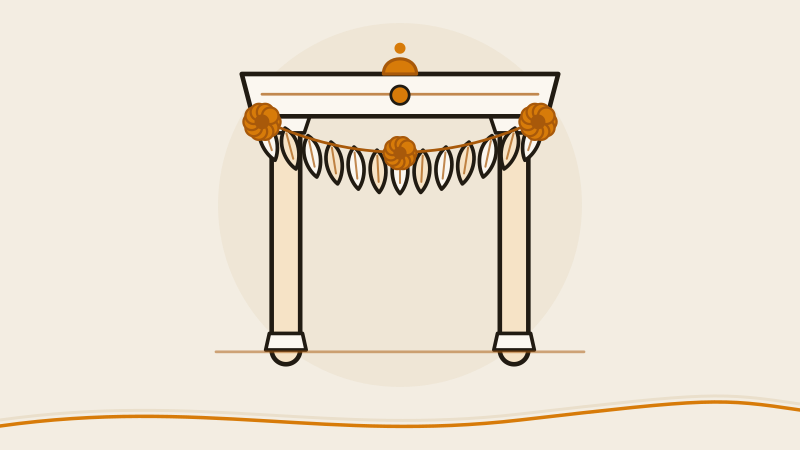
Indra is the king of the gods, the thunderbolt, the one who drinks the soma and slays the serpent Vritra to release the waters; Agni is the fire that carries every offering to him. Vishakha is theirs jointly — Indragni — and the pairing is the mansion's meaning: power and the fire that fuels it, the goal and the heat of the pursuit. The triumphal arch is the symbol because it is what one passes under having won; the potter's wheel is the other symbol because it turns and turns and shapes something only by turning; the forked branch is the third, and the truest — the point where the road divides and one has to choose.
Jupiter as lord gives the purpose. Jupiter is meaning, faith, the goal worth having; in Indra's mansion it becomes ambition with a philosophy — the crusade, the mission, the ten-year plan. Vishakha natives are the tradition's achievers, and its zealots: they know what they want and go at it with Agni's heat, and the classical caution is that the goal, once reached, can be hollow, and the heat, once lit, can burn what it was meant to warm.
The mansion straddles Libra and Scorpio, and the crossing is its fork: the balanced ambition of Venus's sign becoming the fixed intensity of Mars's. It holds Saturn's deepest exaltation at 20°00′ Libra, its first degree, and the Moon's deepest fall at 3°00′ Scorpio, in its fourth pada — the disciplined will at its strongest and the feeling heart at its weakest, in one star.
Which rashi is Vishakha nakshatra? (Vishakha nakshatra rasi)
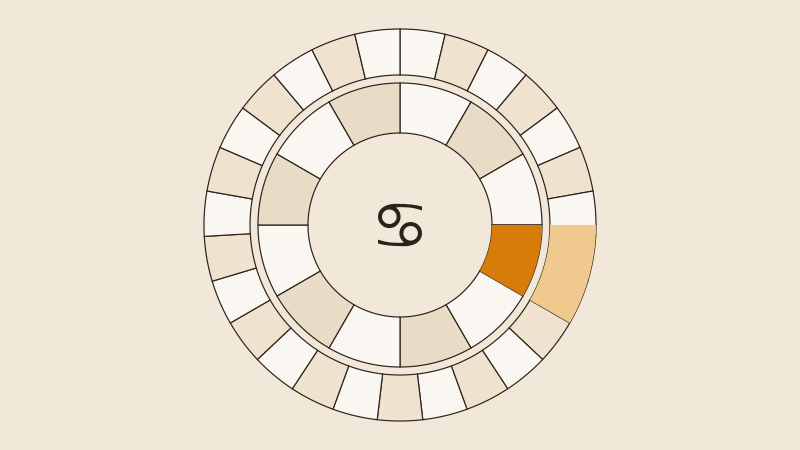
Vishakha straddles two signs. Its first three padas are in Libra (Tula rashi), 20°00′ to 30°00′, and its fourth pada is in Scorpio (Vrishchika or Vrishchik rashi), 0°00′ to 3°20′. So most Vishakha Moons are Libra Moons — Venus-ruled, balanced, relational — with Jupiter as star-lord giving the balance a purpose: this is the Vishakha that pursues its goal through people, partnerships and the law. A Moon in the fourth pada is a Scorpio Moon, and a debilitated one — the Moon's fall is Scorpio, deepest at 3°00′, inside this pada — with Jupiter as star-lord giving the fallen Moon a faith to hold: this is the Vishakha of the fixed, intense, all-or-nothing pursuit. Jupiter and Venus, the star-lord and the sign-lord of the Libra padas, are the two gurus who disagree; Jupiter and Mars, for the Scorpio pada, are friends.
The four padas of Vishakha
A nakshatra divides into four padas, quarters of 3°20′, and each pada corresponds to one sign of the navamsa — the ninth divisional chart, read for the inner life and for marriage. Vishakha's padas run Aries, Taurus, Gemini, Cancer, and the fourth sits in a different sign from the other three.
| Pada | Degrees | Navamsa | Reading |
|---|---|---|---|
| 1 | 20°00′ Libra – 23°20′ Libra | Aries | Aries navamsa, in Libra: the charging ambition — direct, competitive, impatient for the arch. Holds Saturn's deepest exaltation at 20°00′. The most forceful pada. |
| 2 | 23°20′ Libra – 26°40′ Libra | Taurus | Taurus navamsa, in Libra: the building ambition — the goal as estate, the triumph as wealth. The steadiest pada and the one for slow, sure success. |
| 3 | 26°40′ Libra – 0°00′ Scorpio | Gemini | Gemini navamsa, in Libra: the persuading ambition — the goal reached through words, alliances, and the law. The most sociable pada and the most strategic. |
| 4 | 0°00′ Scorpio – 3°20′ Scorpio | Cancer | Cancer navamsa, in Scorpio: the consuming ambition — the goal felt as need. Holds the Moon's deepest fall at 3°00′ Scorpio. The most intense pada and the one the tradition marks as difficult for the Moon. |
No pada of Vishakha is vargottama. The first and fourth padas hold the mansion's two extremes — Saturn's exact exaltation and the Moon's exact fall — and the tradition reads the mansion between them: the will at its strongest and the heart at its most exposed.
Moon in Vishakha: the janma nakshatra
The Moon's mansion at birth is the janma nakshatra — the one that names the mind and sets the dasha clock running. A Moon in Vishakha makes a mind that aims. They are people of purpose and determination, who set goals and reach them, who are intense in everything they take up, who are persuasive and often religious in the crusading sense, and who do not give up. The old texts credit them with a jealous nature, greed, cleverness in speech, quarrelsomeness, and, in the same lists, wealth, brilliance and success that comes with age.
The trait beneath the traits is the fork. A Vishakha Moon is always at the point where the road divides, and its intensity is the intensity of someone who has chosen and cannot un-choose. The old texts' caution is exactly that: the goal pursued past the point where it was worth pursuing, the zeal that becomes fanaticism, the jealousy of anyone who is further down the road. Their task is the potter's: to let the wheel turn, and to know that the vessel is shaped by the turning, not by the arrival.
Jupiter in the signs of Venus and Mars gives the mansion's people a faith — in a cause, a party, a person, a plan — and a heat in defending it. They are the tradition's late bloomers: the texts say Vishakha's success arrives after the middle of life, when the fork has been passed.
Vishakha nakshatra female and male natives
The old texts describe women and men under this star separately, and readers ask for both, so they are kept here, with the caution that a chart is not a sex.
For a woman, the tradition gives Vishakha a striking presence, determination, religious feeling, a talent for persuasion, and a will that others find formidable; it describes her as devoted to her chosen cause or partner, jealous of rivals, and successful in whatever she takes up late. The old texts add cautions about the marriage — that she may dominate it, or that it may be delayed by the pursuit of something else.
For a man, the tradition gives Vishakha a strong, sometimes heavy frame, ambition, eloquence, religious or political zeal, and a capacity for long effort toward a distant goal; it describes him as prosperous after his thirties, generous to his own, and hard on his rivals. The caution is the zealot's — the goal that eats the man — and jealousy.
For either, the fourth pada sharpens every line, since the debilitated Moon feels the fork most.
Career, money and health
Work. Indra's mansion under Jupiter gives the professions of the goal: politics, campaigning, leadership of movements; religion in its organising and preaching forms; law, especially litigation; the military; sales and marketing at the level of the target; and every field where a long pursuit is rewarded — research, competitive sport, the building of a business over decades. Agni gives the fire trades and the ritual ones; the potter's wheel gives craft. Vishakha also does well in agriculture — the harvest is the arch — and in any work with a clear finish line.
Money. Comes after the middle of life, through persistence, and comes substantially; the tradition marks Vishakha as a mansion of late wealth. The Taurus pada holds most and earns soonest. The caution is greed — the mansion's classical word — and the money spent on the campaign.
Health. The Libra padas govern the kidneys, the lower back and the skin; the Scorpio pada the reproductive organs and the excretory system. Complaints of the kidneys and of the heat — fevers, inflammations, Agni's own — are classical, along with the exhaustion of the long pursuit and, in the fourth pada, the illnesses of a troubled mind. The tradition's remedy of first resort is to rest before the arch, not after.
The other planets in Vishakha
A planet in Vishakha carries the mansion's purpose and Jupiter's faith, and then speaks in its own voice. The sign changes the reading at the fourth pada.
Sun in Vishakha. Debilitated in Libra for the first three padas, past its deepest degree in Swati; in the Scorpio pada, in a friend's sign. A self that pursues standing it does not feel it has; a father who was ambitious or absent in the pursuit; authority won at the arch. Neecha bhanga through Saturn or Venus is common here.
Moon in Vishakha. See the janma nakshatra section above. Debilitated, and at its deepest fall, in the fourth pada.
Mars in Vishakha. In a neutral sign in Libra; in its own sign in Scorpio; in the mansion of its friend Jupiter. The campaigner's Mars: force with a goal, the fight for a cause. In Scorpio one of the strongest Mars placements; in Libra a competitive, charming one.
Mercury in Vishakha. In a friend's sign in Libra, a neutral one in Scorpio; in the mansion of Jupiter, with whom Mercury does not agree. The persuader's mind: the advocate, the campaigner, the preacher. Sharp, strategic, sometimes quarrelsome.
Jupiter in Vishakha. In its own mansion — purpose at full strength. In Libra, in an enemy's sign, the faith is diplomatic and the ambition social; in Scorpio, in a friend's sign, it is fixed and deep. The tradition's placement for the religious leader and the political one.
Venus in Vishakha. In its own sign in Libra, in Jupiter's mansion — the two gurus. Love with a goal: the marriage that is a project, the partner chosen for the mission; beauty in the service of ambition. In Scorpio, in a neutral sign, passion and jealousy.
Saturn in Vishakha. Exalted in Libra, at its deepest exaltation at 20°00′ in the first pada — the strongest Saturn in the zodiac. The disciplined ambition, the long campaign won, the institution built to last. In Scorpio, in the sign of its enemy Mars, Saturn is heavier and the goal is darker.
Rahu in Vishakha. Ambition without a ceiling in the mansion of ambition; the foreign cause, the zeal for the unconventional, the goal that changes as it is reached. Rahu in Jupiter's mansion is the false guru and the true convert, sometimes in one life.
Ketu in Vishakha. The goal renounced, or already reached: detachment from ambition, the arch passed under without looking up. Often a spiritual placement — the one who has stopped wanting — and often one that begins with a failure.
Lagna in Vishakha. A strong, purposeful frame, a direct gaze, a manner that is intense and persuasive. In the Libra padas the lagna lord is Venus; in the Scorpio pada, Mars — the difference between the campaigner and the fighter.
A Jupiter placement is never one story. A Sun in Vishakha under the Venus sub and a Sun in Vishakha under the Saturn sub are two different fathers, two different careers, two different men — and Jupiter rules two other mansions besides this one, each with its own nine subs. That is why a chart is read planet by planet at this level, and why a page can only give you the outline. The nakshatra report takes your own chart and reads every planet in it to the pada and the sub-lord — which mansion, which quarter, whose sub — and says what each placement promises and in which dasha it delivers.
The sub-lords of Vishakha
This is the level at which the Krishnamurti method (KP) reads a chart: each nakshatra is cut into nine unequal parts in the proportion of the Vimshottari years, and the lord of the part — the sub-lord — decides what a planet here actually delivers. Two planets in Vishakha with different sub-lords give different results. It is the step at which two charts that look alike come apart — where real astrology begins.
| Sub-lord | From | To |
|---|---|---|
| Jupiter | 20°00′ Libra | 21°46′40″ Libra |
| Saturn | 21°46′40″ Libra | 23°53′20″ Libra |
| Mercury | 23°53′20″ Libra | 25°46′40″ Libra |
| Ketu | 25°46′40″ Libra | 26°33′20″ Libra |
| Venus | 26°33′20″ Libra | 28°46′40″ Libra |
| Sun | 28°46′40″ Libra | 29°26′40″ Libra |
| Moon | 29°26′40″ Libra | 0°33′20″ Scorpio |
| Mars | 0°33′20″ Scorpio | 1°20′ Scorpio |
| Rahu | 1°20′ Scorpio | 3°20′ Scorpio |
Three of Vishakha's sub-lords are worth knowing by heart. The Jupiter sub at the start (20°00′ to 21°46′40″ Libra) is Jupiter in its own mansion and its own sub, and it holds Saturn's deepest exaltation at 20°00′: a Saturn there is at the top of the zodiac by dignity under the guru's grace by sub — the tradition's picture of the just ruler. The Moon sub (29°26′40″ Libra to 0°33′20″ Scorpio) holds the sign boundary, and a planet there stands at the fork itself, with the Moon's feeling laid over it. The Rahu sub at the end (1°20′ to 3°20′ Scorpio) holds the Moon's deepest fall at 3°00′; a Moon there is at the bottom of its dignity with Rahu's hunger by sub — the most consuming degrees of the star, and the ones to read with the most care.
The dasha the Moon here gives
A Moon in Vishakha starts life in the Jupiter mahadasha (16 years), and the balance left at birth is the fraction of Vishakha the Moon has still to cross, times 16: a Moon exactly halfway through Vishakha has 8 years of Jupiter left. The order after that is fixed — Saturn → Mercury → Ketu → Venus → Sun → Moon → Mars → Rahu — and it is the same for everyone born with the Moon here; what differs is where in it a life is standing at any moment. A Vishakha life begins in the sixteen-year Jupiter mahadasha, and since most Vishakha Moons are born partway through the mansion, Jupiter usually runs through childhood and into the teens — a childhood with a faith in it, a teacher, a cause. Then the nineteen-year Saturn, which typically covers the twenties and thirties: the long campaign, the discipline, the wheel turning. Mercury's seventeen years usually arrive in the forties, and the tradition's "success after the middle of life" is usually Mercury's.
Vishakha nakshatra compatibility and marriage life
Nakshatra matching turns on three tables: the yoni (the animal), the gana (the temperament) and the nadi (the constitution, which must differ). Vishakha is tiger yoni, rakshasa gana, antya nadi.
Best matches by yoni — the tiger, whose other mansion is Chitra (full marks); the serpent (Rohini, Mrigashira) and the rat (Magha, Purva Phalguni) score two with the tiger, and every other animal scores one. Most difficult by yoni — the cow (Uttara Phalguni, Uttara Bhadrapada), the tiger's enemy, scoring nothing.
By gana — Vishakha is rakshasa, which matches rakshasa best (Krittika, Ashlesha, Magha, Chitra, Jyeshta, Mula, Dhanishta, Shatabhisha) and manushya acceptably; rakshasa with deva is the classical mismatch.
By nadi — Vishakha is antya nadi. Vishakha with Krittika, Rohini, Ashlesha, Magha, Swati, Uttara Ashadha, Shravana or Revati makes the nadi dosha the tradition warns of.
Past the tables: a Vishakha native is a devoted, intense, goal-driven partner who needs to share the mission, and needs one who can be loved without being a project — and who can say, at the fork, "not that road".
Which pada of Vishakha is best, and which is difficult?
When readers ask this they mean "which pada carries the trouble." For Vishakha the tradition's answer is the fourth pada, in Scorpio — for a computed reason: it holds the Moon's deepest fall at 3°00′, and a Moon there is at the bottom of its dignity, feeling the mansion's ambition as need and its fork as anguish. The first pada holds Saturn's deepest exaltation and is the strongest for discipline and authority. The second is the steadiest and the best for wealth. The third is the most persuasive. The fourth is hard for the Moon; it is strong for Mars.
The sky for Vishakha Moons in 2026–27
All dates here are computed — Swiss Ephemeris, Lahiri ayanamsa, true node. Put simply: a Vishakha Moon in the Libra padas has Saturn — exalted in Libra, the mansion's own first degree — in the sixth from the Moon until June 2027, then the seventh; Jupiter, the mansion's lord, in the tenth until 31 October, previewing the eleventh until 25 January and returning to the tenth until June 2027; Rahu in the fifth and Ketu in the eleventh until 25 November, then the fourth and the tenth; and Venus retrograde in Libra, the Moon's sign, from 3 October to 6 November — though Venus stations at 14°15′ in Swati and walks back from there, so the retrograde never touches Vishakha's own degrees. A Vishakha Moon in the Scorpio pada has Saturn in the fifth until June 2027, then the sixth; Jupiter in the ninth until 31 October — the house of fortune and faith, the mansion's own theme — previewing the tenth until 25 January and returning to the ninth until June 2027; Rahu in the fourth and Ketu in the tenth until 25 November, then the third and the ninth. Mars enters Leo on 12 November: the eleventh from a Libra Moon, the tenth from a Scorpio one.
→ Sade Sati · Mars Meets Jupiter in Leo
Remedy and mantra
The classical remedy for an afflicted Vishakha placement is worship of Indra and Agni — the lamp and the fire offering, and the Indra hymns for those who keep them — and of Jupiter as the mansion's lord, with Om Gurave Namah on Thursday; Lakshmi–Narayana are worshipped for the mansion's late fortune. The first remedy, before any rite, is a goal set down — the mansion's affliction is the pursuit that will not stop, and the potter's wheel is stilled by lifting the hands. A remedy — a puja, a gemstone, a rudraksha, a yantra — is prescribed to the chart, and the chart decides which.
Questions we are asked
What is Vishakha nakshatra? The sixteenth of the 27 nakshatras, from 20°00′ Libra to 3°20′ Scorpio, ruled by Jupiter, with Indra and Agni as its two deities and a triumphal arch — or a forked branch — as symbol. It stands for purpose, ambition, the goal, and the fork in the road.
Vishakha nakshatra is which rashi? Two. The first, second and third padas are in Libra (Tula); the fourth is in Scorpio (Vrishchika or Vrishchik). Most Vishakha Moons are Libra Moons.
Who is the lord of Vishakha nakshatra? Jupiter. The dasha for a Moon here begins with Jupiter's sixteen years, then Saturn's nineteen.
What are the Vishakha nakshatra characteristics? Purposeful, determined, ambitious, intense, persuasive, religious in the crusading way; jealous of rivals; successful after the middle of life.
Which pada of Vishakha is bad? The fourth, in Scorpio, holds the Moon's deepest fall at 3°00′ and is hard for the Moon; the first holds Saturn's deepest exaltation and is the strongest for discipline.
What is the Vishakha nakshatra symbol? A triumphal arch, a potter's wheel, or a forked branch — the goal won, the turning that shapes, and the choice before it.
Is Vishakha nakshatra good for marriage? Devoted, intense partners who need a shared mission. Match by yoni (tiger), gana (rakshasa) and nadi (antya); the tiger–cow pairing is the pairing the yoni table scores at zero.
What does 2026 hold for Vishakha nakshatra? It depends on the pada: Libra-pada Moons have Saturn in the sixth and Jupiter in the tenth; Scorpio-pada Moons have Saturn in the fifth and Jupiter in the ninth. The computed sky for both is above.
For education. Not medical, legal or financial advice; a nakshatra is one line of a chart, not the chart.
Your own Vishakha placements — Moon, lagna, sub-lords and dasha read together — are a consultation's work: time with the chart, not a page.
→ Book a private consultation · Reading the Nakshatra, Not the Sign · Paper C, Nakshatras · ← Swati · Anuradha →