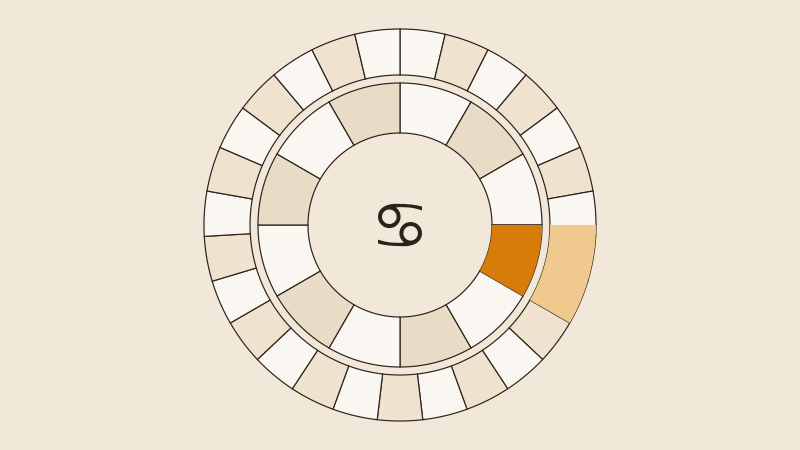
Purva Phalguni (also called Pooram in Tamil, Pubba in Telugu, Pooram in Malayalam, also written Poorva Phalguni) — 13°20′ Leo to 26°40′ Leo, in Leo; lord Venus; deity Bhaga. Lahiri sidereal.
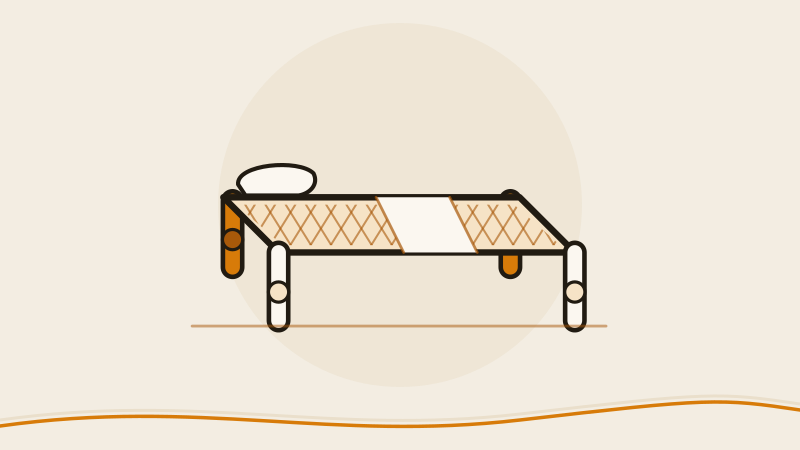
Purva Phalguni nakshatra is the eleventh lunar mansion, from 13°20′ to 26°40′ of Leo, and it is the star of enjoyment. Its deity is Bhaga, the god of good fortune, marital bliss and the share that comes to each; its symbol is the front legs of a bed — or a hammock, or a fig tree; its lord is Venus. The name means "the former red one", the first of the two Phalguni stars, and the mansion is the throne of Magha turned into a couch: rest, love, pleasure, art, and the generosity of someone who has enough. A person with the Moon here is warm, creative, charming and fond of comfort, and their whole life is a lesson in the difference between enjoying and indulging.
Here is Purva Phalguni as we read it: the span and the sign, the four padas and the navamsa each reaches — including the vargottama first pada — the Moon and every other planet here, the sub-lords of the Krishnamurti method, the dasha a birth here begins, and the computed sky this Moon is under in 2026–27. Every Sanskrit term is glossed where it first appears.
Purva Phalguni nakshatra at a glance
| Span | 13°20′ Leo to 26°40′ Leo |
| Sign (rashi) | Leo |
| Lord (star-lord) | Venus |
| Deity | Bhaga |
| Symbol | the front legs of a bed; a hammock |
| Gana (temperament) | Manushya |
| Nature (for muhurta) | Ugra (fierce) |
| Yoni (animal, for matching) | rat (female) |
| Nadi | Madhya |
| Name syllables (pada 1–4) | Mo, Ta, Ti, Tu |
| Also called | Pooram (Tamil), Pubba (Telugu), Pooram (Malayalam) |
| Dasha the Moon here begins | Venus, 20 years |
The story and the symbol
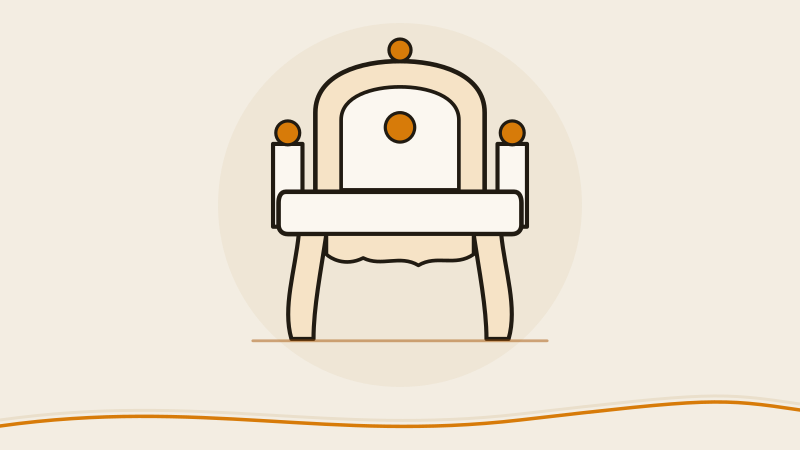
Bhaga is one of the Adityas, the solar gods, and his name is the root of the word bhagya — fortune, luck, one's allotted share. He presides over prosperity, over the pleasures of marriage, and over the fair division of good things; the hymns invoke him at dawn, when the day's share is given out. Purva Phalguni is his mansion, and the bed is its symbol because the bed is where fortune is enjoyed rather than earned: the marriage bed, the sickbed, the couch of rest after the throne's work. The tradition pairs it with Uttara Phalguni, the back legs of the same bed, and reads the two as the one piece of furniture — pleasure and the duty that supports it.
Shiva and Parvati were married under Purva Phalguni in the tradition, and the mansion is the wedding star: love, union, procreation, and the feast. Venus as lord makes it so — Venus is desire, beauty, art and the pleasure of the senses — and Venus in the Sun's sign is Venus at court: the royal artist, the king's consort, the pleasure of the powerful. The mansion's shadow is the couch that is never left: indulgence, vanity, the throne enjoyed and never earned.
Bhaga, in the old story, was blinded at Daksha's sacrifice when Shiva's fury broke it up, and the mansion carries a caution about fortune that cannot see — luck that is taken for granted and lost.
Which rashi is Purva Phalguni nakshatra? (Purva Phalguni nakshatra rasi)
Purva Phalguni lies entirely inside Leo (Simha rashi), from 13°20′ to 26°40′ — the middle of the Sun's own sign. A Purva Phalguni Moon is a Leo Moon: proud, warm, generous, creative, needing to be loved as much as seen. What the mansion adds is Venus. Venus, the star-lord, and the Sun, the sign-lord, are enemies in the Parashari table — the artist and the king, the lover and the ruler — and the friction is the Purva Phalguni signature: the royal manner with a sensual heart, the performer who wants the throne and the couch both. It is a warm placement and a proud one, and it holds the Leo vargottama degrees, 13°20′ to 16°40′, in its first pada.
The four padas of Purva Phalguni
A nakshatra divides into four padas, quarters of 3°20′, and each pada corresponds to one sign of the navamsa — the ninth divisional chart, read for the inner life and for marriage. Purva Phalguni's padas run Leo, Virgo, Libra, Scorpio, and the first is vargottama.
| Pada | Degrees | Navamsa | Reading |
|---|---|---|---|
| 1 | 13°20′ Leo – 16°40′ Leo | Leo | Leo navamsa: vargottama — Leo in both the rashi and the navamsa. The purest Purva Phalguni: creative, regal, generous, loving, vain. The strongest pada for the Sun and for performers; the one in which the mansion's pleasure and its pride are least diluted. |
| 2 | 16°40′ Leo – 20°00′ Leo | Virgo | Virgo navamsa: the working pleasure — the artist with a craft, the host who keeps the accounts. The most practical pada and the one in which the mansion's indulgence is best controlled. |
| 3 | 20°00′ Leo – 23°20′ Leo | Libra | Libra navamsa: Venus's own navamsa in Venus's mansion — the most romantic pada, the marriage star at full strength. Partnership, beauty, diplomacy; the danger of living for the other. |
| 4 | 23°20′ Leo – 26°40′ Leo | Scorpio | Scorpio navamsa: the deep pleasure — passion, jealousy, the hidden affair, the art that comes from intensity. The most secretive pada and the one the tradition watches for excess. |
The first pada, being vargottama, is where Purva Phalguni's warmth and its vanity are both at full strength; the third, in Libra, is where its Venus is happiest.
Moon in Purva Phalguni: the janma nakshatra
The Moon's mansion at birth is the janma nakshatra — the one that names the mind and sets the dasha clock running. A Moon in Purva Phalguni makes a mind that enjoys. They are people of warmth and charm, who love company, comfort, music, good food and beautiful rooms; who are generous because giving is a pleasure; who are creative, often performers; and who are loyal in love and expect the same. The old texts credit them with sweetness of speech, generosity, wandering, a fondness for the opposite sex, and service to the king — the courtier's virtues.
The trait beneath the traits is Bhaga's: they believe in their share. A Purva Phalguni Moon expects fortune, and often gets it, and the classical caution is that expectation without effort — the couch, the hammock, the throne inherited from Magha and never worked for. Their task is the one the next mansion teaches: Uttara Phalguni's duty, the bed's back legs. Vanity is the other caution; the Leo Moon wants applause and the Venus star wants to be desired, and together they can make a person who performs even in private.
Venus in the Sun's sign gives the mansion's people a natural authority in matters of taste. They know what is beautiful, and they are usually right.
Purva Phalguni nakshatra female and male natives
The old texts describe women and men under this star separately, and readers ask for both, so they are kept here, with the caution that a chart is not a sex.
For a woman, the tradition gives Purva Phalguni beauty, charm, artistic talent — especially in music and dance — a love of dress and of comfort, warmth in marriage, and a certain pride that expects to be courted. She is described as fortunate, sociable, and generous, and as someone who does not take well to being ignored. The caution is vanity, and indulgence.
For a man, the tradition gives Purva Phalguni a handsome face, a pleasant voice, generosity, a love of pleasure and of the company of women, artistic ability, and a talent for making others feel welcome. He is described as loyal to friends, fortunate through patrons, and as inclined to enjoy the fruit before the tree has grown. The caution is laziness — expecting fortune to do the work.
For either, the Sun's condition decides how much pride is in the pleasure, and Venus's how much art.
Career, money and health
Work. Venus in the Sun's sign gives the arts at court: music, dance, theatre, film and entertainment; fashion, jewellery, cosmetics, luxury; hospitality and event management — the feast is the mansion's own; and the professions of pleasure and of beauty in every form. Bhaga gives fortune-related work — finance in its gentler forms, patronage, philanthropy — and the wedding star gives marriage and everything around it: matchmaking, wedding planning, family counselling. Purva Phalguni also does well in diplomacy, in public relations, and in any work where charm is the product.
Money. Comes through fortune, patronage, marriage and talent, and goes on comfort. The Virgo pada keeps most; the Leo pada spends on display; the Libra pada on the partner. The tradition marks the mansion as fortunate — Bhaga's own — and warns that fortune enjoyed without effort is the fortune that leaves.
Health. Leo governs the heart, the spine and the upper back, and Purva Phalguni adds the organs of pleasure and reproduction — Venus's. Complaints of the heart, of the back from too much rest, and of excess in food and drink are classical. The tradition's remedy of first resort is to leave the couch.
The other planets in Purva Phalguni
A planet in Purva Phalguni carries the mansion's pleasure and Venus's charm, and then speaks in its own voice.
Sun in Purva Phalguni. In its own sign, in the mansion of its enemy Venus — and, in the first pada, vargottama. The king at leisure: authority that is charming rather than stern; a father who was generous or indulgent; a self that wants to be loved for its light. Strong by sign; softened by the star.
Moon in Purva Phalguni. See the janma nakshatra section above.
Mars in Purva Phalguni. In a friend's sign, in Venus's mansion. Passion — the lover's Mars, the performer's energy, courage in the service of pleasure. Strong drive with a taste for comfort; the classical caution is the quarrel over a lover.
Mercury in Purva Phalguni. In a friend's sign, in Venus's mansion — Mercury and Venus being friends. Sweet speech, wit, the poet and the courtier; a mind that thinks in beauty. One of the more charming Mercury placements.
Jupiter in Purva Phalguni. In a friend's sign, in Venus's mansion — the two gurus, who disagree. Wisdom that enjoys; faith that is generous rather than austere; the teacher who feasts. Good for children, for wealth, and for a philosophy of abundance.
Venus in Purva Phalguni. In its own mansion, in its enemy the Sun's sign. Desire at full strength on a proud stage: the artist, the beauty, the lover who wants a throne to lie on. The tradition's placement for the courtesan and the queen, who are sometimes the same. The caution is excess.
Saturn in Purva Phalguni. In an enemy's sign, in the mansion of its friend Venus. Pleasure disciplined, or denied: the artist who works, the fortune that comes late, the one who cannot rest. Saturn here can make the couch a workbench — or a sickbed.
Rahu in Purva Phalguni. Appetite for pleasure without a ceiling; the foreign lover, the fame that comes from performance; the hunger to be desired. Rahu in Venus's mansion is glamorous and unsatisfied.
Ketu in Purva Phalguni. Detachment from pleasure: the renunciate on the couch, the artist who does not need the audience, the one whose marriage ends or is never made. Often a spiritual placement, and often one that begins with a loss in love.
Lagna in Purva Phalguni. An attractive, well-fed frame, a warm face, a manner that is easy and a little theatrical. The lagna lord is the Sun, and its placement decides whether the charm has authority behind it.
Two people with the Moon in Purva Phalguni can have nothing else in common: one has it in the first pada under the Venus sub, the other in the fourth under Mercury's, and the same star gives them different minds, different dashas, different marriages. The paragraphs above are the mansion; the person is the combination. A nakshatra report reads that combination for your chart — every planet's nakshatra, pada and sub-lord, and the dasha the Moon starts — so that what this page says in general becomes what is true of you.
The sub-lords of Purva Phalguni
This is the level at which the Krishnamurti method (KP) reads a chart: each nakshatra is cut into nine unequal parts in the proportion of the Vimshottari years, and the lord of the part — the sub-lord — decides what a planet here actually delivers. Two planets in Purva Phalguni with different sub-lords give different results. It is the step at which two charts that look alike come apart — where real astrology begins.
| Sub-lord | From | To |
|---|---|---|
| Venus | 13°20′ Leo | 15°33′20″ Leo |
| Sun | 15°33′20″ Leo | 16°13′20″ Leo |
| Moon | 16°13′20″ Leo | 17°20′ Leo |
| Mars | 17°20′ Leo | 18°06′40″ Leo |
| Rahu | 18°06′40″ Leo | 20°06′40″ Leo |
| Jupiter | 20°06′40″ Leo | 21°53′20″ Leo |
| Saturn | 21°53′20″ Leo | 24°00′ Leo |
| Mercury | 24°00′ Leo | 25°53′20″ Leo |
| Ketu | 25°53′20″ Leo | 26°40′ Leo |
Three of Purva Phalguni's sub-lords are worth knowing by heart. The Venus sub at the start (13°20′ to 15°33′20″) is Venus in its own mansion and its own sub, inside the vargottama pada — the most pleasurable, most artistic, most vain degrees of the star, and the ones in which its fortune is strongest. The Rahu sub (18°06′40″ to 20°06′40″) is where the pleasure becomes appetite; a planet there wants more than its share. The Saturn sub (21°53′20″ to 24°00′) is where Bhaga's fortune is earned rather than given — the working artist's degrees.
The dasha the Moon here gives
A Moon in Purva Phalguni starts life in the Venus mahadasha (20 years), and the balance left at birth is the fraction of Purva Phalguni the Moon has still to cross, times 20: a Moon exactly halfway through Purva Phalguni has 10 years of Venus left. The order after that is fixed — Sun → Moon → Mars → Rahu → Jupiter → Saturn → Mercury → Ketu — and it is the same for everyone born with the Moon here; what differs is where in it a life is standing at any moment. A Purva Phalguni life begins in the twenty-year Venus mahadasha, and since most Moons here are born partway through the mansion, Venus usually runs through childhood and into the teens or twenties — a comfortable, loved, sometimes indulged beginning. Then the Sun's six years, then the Moon's ten, which typically cover the twenties and thirties: the years in which the throne has to be earned and the couch left. Mars's seven and then Rahu's eighteen usually arrive in the forties.
Purva Phalguni nakshatra compatibility and marriage life
Nakshatra matching turns on three tables: the yoni (the animal), the gana (the temperament) and the nadi (the constitution, which must differ). Purva Phalguni is rat yoni, manushya gana, madhya nadi.
Best matches by yoni — the rat, whose other mansion is Magha (full marks); no other animal scores three with the rat, and the horse, elephant, sheep, cow, buffalo, tiger, deer, monkey, mongoose and lion score two. Most difficult by yoni — the cat (Punarvasu, Ashlesha), the rat's enemy, scoring nothing; the serpent and the dog score one.
By gana — Purva Phalguni is manushya, which matches deva and manushya well and rakshasa with difficulty. Purva Phalguni with Bharani, Rohini, Ardra, Uttara Phalguni, Purva and Uttara Ashadha, Purva and Uttara Bhadrapada is manushya to manushya.
By nadi — Purva Phalguni is madhya nadi. Purva Phalguni with Bharani, Mrigashira, Pushya, Chitra, Anuradha, Purva Ashadha, Dhanishta or Uttara Bhadrapada makes the nadi dosha the tradition warns of.
Past the tables: this is the wedding star, and its natives are warm, loyal, demonstrative partners who need to be desired and told so. The partner who stays is the one who can give applause without being asked for it.
Which pada of Purva Phalguni is best, and which is difficult?
No pada of Purva Phalguni is bad; the tradition ranks it a fortunate mansion. The first pada, vargottama, is the strongest and the proudest — the one for performers and for anyone who lives by being seen. The third, in Libra, is Venus's own navamsa in Venus's mansion, the best for marriage and the arts. The second is the steadiest. The fourth, in Scorpio, is the one the tradition watches, because the mansion's pleasure turns there to passion, jealousy and the hidden affair; if the question is "which pada needs care", it is that one.
The sky for Purva Phalguni Moons in 2026–27
All dates here are computed — Swiss Ephemeris, Lahiri ayanamsa, true node. Saturn is in the eighth house from your Moon until 3 June 2027, then in the ninth (with a return to the eighth from 20 October 2027 to 23 February 2028). Jupiter, exalted, is in the twelfth house from your Moon until 31 October 2026, previews the first from 31 October to 25 January 2027, returns to the twelfth until 26 June 2027, and then settles in the first. Rahu is in the seventh and Ketu in the first until 25 November 2026; after that Rahu is in the sixth and Ketu in the twelfth for eighteen months. Put simply: a Purva Phalguni Moon is in the small panoti — Saturn in the eighth from the Moon until June 2027, the ashtama Shani, then the ninth. Jupiter is in the twelfth from the Moon until 31 October, then previews the first — on the Leo Moon, though in Magha's degrees, not Purva Phalguni's own — from 31 October to 25 January, and settles there from June 2027. Ketu is on the Leo Moon until 25 November with Rahu opposite, then moves to the twelfth. Mars enters Leo on 12 November and meets Jupiter and Ketu in Magha, then crosses into Purva Phalguni on 19 December (10:20 IST), where it turns retrograde at 16°11′ on 10 January 2027 — inside the first pada — and walks back into Magha on 31 January. So the mansion's own degrees hold Mars through December and January, retrograde from the 10th: force on the couch, and the tradition's advice is to finish rather than start in those weeks. Venus, the mansion's lord, is retrograde from 3 October to 14 November, which is the other thing a Purva Phalguni Moon should know this autumn.
→ Sade Sati · Mars Meets Jupiter in Leo
Remedy and mantra
The classical remedy for an afflicted Purva Phalguni placement is worship of Bhaga — in practice, of the Sun at dawn, when Bhaga's share is given, with Om Bhagaya Namah or the Aditya Hridayam — and of Venus as the mansion's lord, with Om Shukraya Namah on Friday; Shiva and Parvati, married under this star, are worshipped for its marriage. Lakshmi is worshipped for Venus's periods. The first remedy, before any rite, is work — the mansion's affliction is the share expected without effort. A remedy — a puja, a gemstone, a rudraksha, a yantra — is prescribed to the chart, and the chart decides which.
Questions we are asked
What is Purva Phalguni nakshatra? The eleventh of the 27 nakshatras, 13°20′ to 26°40′ Leo, ruled by Venus, with Bhaga as deity and the front legs of a bed as symbol. It stands for pleasure, love, art, fortune and rest — the wedding star.
Purva Phalguni nakshatra is which rashi? Leo (Simha). The whole nakshatra lies inside Leo, the Sun's own sign.
Who is the lord of Purva Phalguni nakshatra? Venus. The dasha for a Moon here begins with Venus's twenty years, then the Sun's six.
What are the Purva Phalguni nakshatra characteristics? Warm, charming, creative, generous, fond of comfort and company; loyal in love; fortunate; vain when unchecked and lazy when fortune does the work.
Which pada of Purva Phalguni is best? The first, in Leo, is vargottama and the strongest; the third, in Libra, is the best for marriage and the arts. None is bad; the fourth needs care.
What is the Purva Phalguni nakshatra symbol? The front legs of a bed — the couch of rest and the marriage bed — and, in some texts, a hammock or a fig tree.
Is Purva Phalguni nakshatra good for marriage? It is the wedding star: Shiva and Parvati were married under it. Warm, loyal, demonstrative partners. Match by yoni (rat), gana (manushya) and nadi (madhya); the rat–cat pairing is the pairing the yoni table scores at zero.
What does 2026 hold for Purva Phalguni nakshatra? Saturn in the eighth from the Moon until June 2027; Jupiter on the Leo Moon from 31 October; Venus, the lord, retrograde 3 October to 14 November; Mars in the mansion's own degrees from 19 December, retrograde from 10 January. The computed sky is above.
For education. Not medical, legal or financial advice; a nakshatra is one line of a chart, not the chart.
Your own Purva Phalguni placements — Moon, lagna, sub-lords and dasha read together — are a consultation's work: time with the chart, not a page.
→ Book a private consultation · Reading the Nakshatra, Not the Sign · Paper C, Nakshatras · ← Magha · Uttara Phalguni →