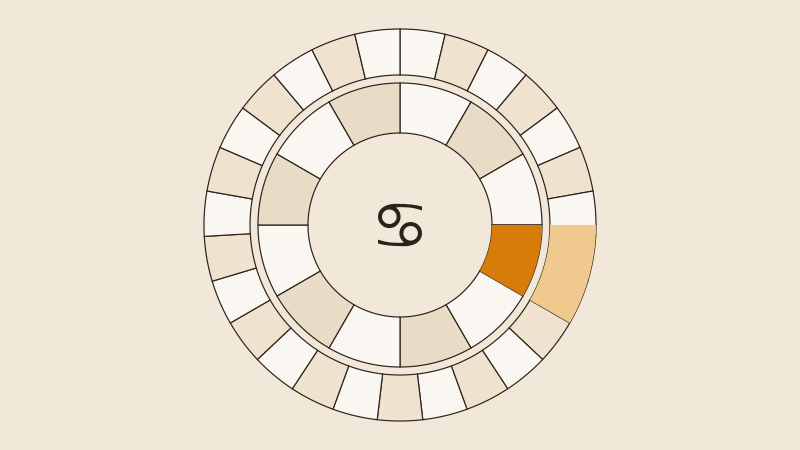
Purva Ashadha (also called Pooradam in Tamil, Poorvashada in Telugu, Pooradam in Malayalam, also written Poorvashada or Purvashada) — 13°20′ Sagittarius to 26°40′ Sagittarius, in Sagittarius; lord Venus; deity Apas. Lahiri sidereal.
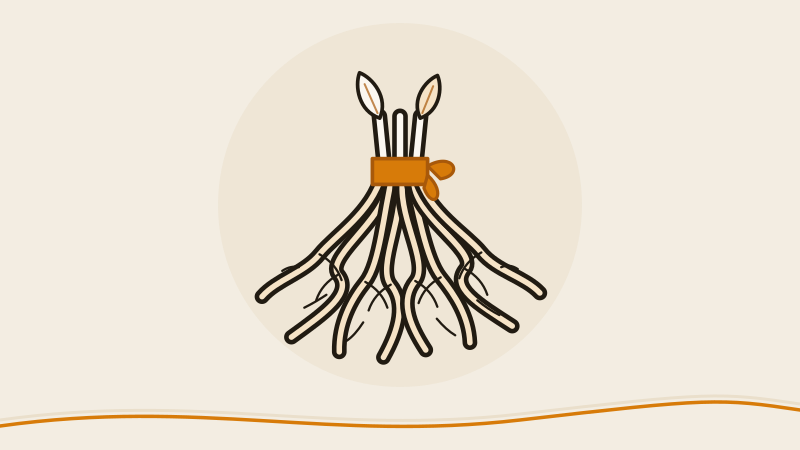
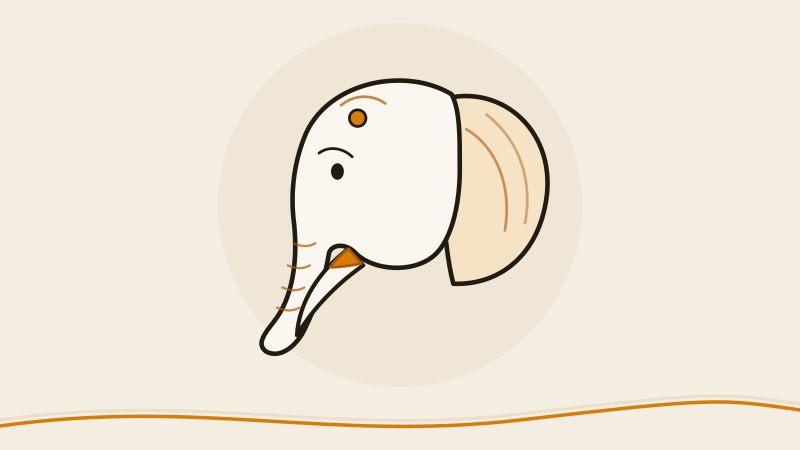
Purva Ashadha nakshatra (also written Purvashada) is the twentieth lunar mansion, from 13°20′ to 26°40′ of Sagittarius, and it is the star of the unconquered. Its deity is Apas, the waters — the goddesses of the cosmic and the earthly water, purifying, fertile, irresistible; its symbol is a fan, or a winnowing basket, or an elephant's tusk; its lord is Venus. The name means "the former invincible one", the first of the two Ashadha stars, and the mansion is the early victory: the flood that carries everything before it, the argument that wins, the charm that cannot be refused. A person with the Moon here is confident, persuasive, proud and lucky, the one who rarely loses — and whose lesson is what to do with a life in which winning came easily.
The page walks Purva Ashadha through in full: the span and the sign, the four padas and the navamsa each reaches, the Moon and every other planet here, the sub-lords of the Krishnamurti method, the dasha a birth here begins, and the computed sky this Moon is under in 2026–27. Terms in Sanskrit are explained where they arise.
Purva Ashadha nakshatra at a glance
| Span | 13°20′ Sagittarius to 26°40′ Sagittarius |
| Sign (rashi) | Sagittarius |
| Lord (star-lord) | Venus |
| Deity | Apas |
| Symbol | a fan; a winnowing basket; the tusk of an elephant |
| Gana (temperament) | Manushya |
| Nature (for muhurta) | Ugra (fierce) |
| Yoni (animal, for matching) | monkey (male) |
| Nadi | Madhya |
| Name syllables (pada 1–4) | Bhu, Dha, Pha, Dha |
| Also called | Pooradam (Tamil), Poorvashada (Telugu), Pooradam (Malayalam) |
| Dasha the Moon here begins | Venus, 20 years |
The story and the symbol
Apas is the water in its divine form — the hymns address the waters as mothers, as healers, as the carriers of every impurity away and every seed to its field. Water cannot be defeated: it goes around, it goes under, it wears down, it rises. Purva Ashadha is the waters' mansion, and ashadha means invincible; the mansion is the victory that comes by flowing rather than by fighting. The fan is the symbol because a fan moves air the way the waters move — gently, and with cumulative force; the winnowing basket is the other, the tool that separates grain from chaff by the same breath; and the elephant's tusk is the third, the weapon of the largest and most patient animal.
Venus as lord is the charm in the victory. Venus is beauty, persuasion, the pleasure that disarms; in the waters' mansion it becomes the eloquence that wins without a battle, the beauty that gets its way, the diplomat who floods the room. Purva Ashadha natives are the tradition's orators, advocates and seducers — in the old sense, those who lead by attraction — and their shadow is the flood's: they overwhelm, they do not know when they have won, and they are proud of a victory that cost them nothing.
The mansion lies in Jupiter's sign under Venus, the two gurus in one place, and the tradition reads it as the meeting of the philosopher and the pleasure-lover: the invincibility of someone who believes they are right and is charming about it.
Which rashi is Purva Ashadha nakshatra? (Purva Ashadha nakshatra rasi)
Purva Ashadha lies entirely inside Sagittarius (Dhanu rashi), from 13°20′ to 26°40′ — the middle of Jupiter's fire sign. A Purva Ashadha Moon is a Sagittarius Moon: philosophical, optimistic, direct, expansive, freedom-loving. What the mansion adds is Venus's charm and the waters' irresistibility to the Sagittarian aim: the archer who persuades rather than shoots. Venus, the star-lord, and Jupiter, the sign-lord, are the two teachers who disagree — the guru of the gods and the guru of the demons — and the friction is the Purva Ashadha signature: the philosophy that serves the pleasure, the pleasure that has a philosophy. It is a fortunate placement and a proud one.
The four padas of Purva Ashadha
Each pada is a quarter of the mansion, 3°20′, and carries the sign of the navamsa, the ninth division, in which the inner life and the marriage are read. Purva Ashadha's padas run Leo, Virgo, Libra, Scorpio.
| Pada | Degrees | Navamsa | Reading |
|---|---|---|---|
| 1 | 13°20′ Sagittarius – 16°40′ Sagittarius | Leo | Leo navamsa: the royal flood — the orator on the throne, the victory that wants to be seen. The most confident pada and the proudest; the leader, the performer, the one who is never in doubt. |
| 2 | 16°40′ Sagittarius – 20°00′ Sagittarius | Virgo | Virgo navamsa: the channelled flood — the waters put to work: irrigation, the argument made exact, the charm with a method. The most practical pada and the tradition's favourite for the professions. |
| 3 | 20°00′ Sagittarius – 23°20′ Sagittarius | Libra | Libra navamsa: Venus's own navamsa in Venus's mansion — the diplomatic flood, the beauty that negotiates, the partnership as victory. The most relational pada and the most persuasive. |
| 4 | 23°20′ Sagittarius – 26°40′ Sagittarius | Scorpio | Scorpio navamsa: the deep flood — the waters that go under, the persuasion that works in secret, the victory won by knowing. The most intense pada and the one the tradition watches for pride turned to manipulation. |
No pada of Purva Ashadha is vargottama. The third pada, Venus's own navamsa, is where the mansion's charm is purest; the fourth is where its invincibility is most likely to be used badly.
Moon in Purva Ashadha: the janma nakshatra
A birth is dated by its janma nakshatra, the Moon's mansion; the mind takes its colour from it and the dasha its starting point. A Moon in Purva Ashadha gives a mind that expects to win. These are people of confidence and persuasion, who argue well and charmingly, who believe in their cause and in themselves, who are attractive and know it, and who are lucky — the tradition's own word — in a way that others notice. They are philosophical in Jupiter's manner and pleasure-loving in Venus's, and carry both without contradiction. In the classical descriptions they have a good and faithful partner, pride, firm friendship, a talent for the arts, and a nature that does not bend.
The deeper current is the waters': they flow around obstacles rather than through them, and they do not stop. A Purva Ashadha Moon wins by persistence disguised as ease. What the texts warn of is pride — the invincible one who cannot imagine losing — and the flood's blindness: they overwhelm the people they mean to persuade and mistake silence for agreement. The native's work is the winnowing basket's: to separate what is worth winning from what is merely winnable.
Venus in Jupiter's sign gives the mansion's people their luck, which is really their charm applied to fortune. They are the tradition's natural advocates, and they are usually on the side they believe is right.
Purva Ashadha nakshatra female and male natives
The texts split the description by sex; both halves are kept, as readers want them, with the caution that a chart is not a sex.
For a woman, the tradition gives Purva Ashadha beauty, a persuasive tongue, artistic talent, pride, and a confidence that carries a room; it describes her as fortunate in marriage — the texts name a devoted husband — as a good friend, and as someone who does not lose an argument and does not forget one. The caution is pride, and a will that flows around every objection.
For a man, the tradition gives Purva Ashadha a handsome, well-built frame, eloquence, ambition, a taste for the arts and for pleasure, and a luck that others envy; it describes him as a natural leader by persuasion, generous to friends, proud, and unbending. The caution is the invincible man's — the loss he never prepared for — and the flood that drowns his own allies.
For both, Jupiter's condition in the chart decides whether the persuasion has a truth behind it.
Career, money and health
Work. The waters' mansion under Venus gives the professions of persuasion and of water: law, especially advocacy; politics, diplomacy, public speaking; sales, marketing, and the arts of influence; the water trades — shipping, the navy, irrigation, water supply, fisheries, the bottled and the brewed; and the arts, especially the performing arts and the arts of the voice. Jupiter adds teaching and philosophy; the winnowing basket adds agriculture and the refining trades. Purva Ashadha also does well in beauty and fashion, and in any work where being liked is the way things get done.
Money. Comes through charm, luck and persuasion, and comes early; the tradition marks Purva Ashadha as fortunate. The Virgo pada keeps most; the Leo pada spends on the victory's display; the Libra pada on the partner. The caution is the fortune assumed — the invincible one who never saved.
Health. Sagittarius governs the hips, the thighs and the liver, and Purva Ashadha adds the body's waters — the kidneys, the bladder, the lymph — under Apas. Complaints of the liver from Jupiter's indulgence, of the kidneys and the urinary system, and of the thighs and hips are classical, along with the illnesses of excess that the two gurus together invite. The oldest prescription for it is water taken plainly.
The other planets in Purva Ashadha
A planet in Purva Ashadha takes on the mansion's invincibility and Venus's charm, and then does what that planet does.
Sun in Purva Ashadha. In a friend's sign, in the mansion of its enemy Venus. A self that leads by attraction; a father who was charming, fortunate, or proud; authority that persuades rather than commands. Strong by sign, softened by the star.
Moon in Purva Ashadha. See above.
Mars in Purva Ashadha. In a friend's sign, in Venus's mansion. Force as charm: the champion who is also a lover, the fighter who wins the crowd. Courage with beauty in it; the classical caution is the quarrel over a partner.
Mercury in Purva Ashadha. In a neutral sign, in the mansion of its friend Venus. The orator's mind: eloquent, persuasive, quick to the winning argument. One of Mercury's better placements for advocacy and for the arts of speech.
Jupiter in Purva Ashadha. In its own sign, in the mansion of its rival Venus. Wisdom that persuades; the philosopher who is also charming; faith with a pleasure in it. Strong for teaching, for wealth and for children; the caution is the truth bent to win.
Venus in Purva Ashadha. In its own mansion, in Jupiter's sign. Charm at full strength with a philosophy behind it: the artist, the advocate, the beauty who is also wise. Fortune in love and in the arts; the caution is the pride of the never-refused.
Saturn in Purva Ashadha. In a neutral sign, in the mansion of its friend Venus. The waters disciplined: the long campaign of persuasion, the advocate who wins by preparation, the flood built as a canal. Saturn here steadies the mansion's pride and can dam its charm.
Rahu in Purva Ashadha. The flood without banks: persuasion as manipulation, the foreign victory, the hunger to be found irresistible. Rahu in Venus's mansion is glamorous and unsatisfied, and here it is also unstoppable.
Ketu in Purva Ashadha. The victory renounced: the orator who falls silent, the charm turned away from, the waters let go. Often a spiritual placement — the one who has already won and no longer wants to.
Lagna in Purva Ashadha. A handsome, well-built frame, a pleasant and confident face, a manner that persuades before it speaks. The lagna lord is Jupiter, and its placement decides whether the charm has a truth to serve.
Two people with the Moon in Purva Ashadha can have nothing else in common: one has it in the first pada under the Venus sub, the other in the fourth under Mercury's, and the same star gives them different minds, different dashas, different marriages. The paragraphs above are the mansion; the person is the combination. A nakshatra report reads that combination for your chart — every planet's nakshatra, pada and sub-lord, and the dasha the Moon starts — so that what this page says in general becomes what is true of you.
The sub-lords of Purva Ashadha
This is the level at which the Krishnamurti method (KP) reads a chart: each nakshatra is cut into nine unequal parts in the proportion of the Vimshottari years, and the lord of the part — the sub-lord — decides what a planet here actually delivers. Two planets in Purva Ashadha with different sub-lords give different results. It is the step at which two charts that look alike come apart — where real astrology begins.
| Sub-lord | From | To |
|---|---|---|
| Venus | 13°20′ Sagittarius | 15°33′20″ Sagittarius |
| Sun | 15°33′20″ Sagittarius | 16°13′20″ Sagittarius |
| Moon | 16°13′20″ Sagittarius | 17°20′ Sagittarius |
| Mars | 17°20′ Sagittarius | 18°06′40″ Sagittarius |
| Rahu | 18°06′40″ Sagittarius | 20°06′40″ Sagittarius |
| Jupiter | 20°06′40″ Sagittarius | 21°53′20″ Sagittarius |
| Saturn | 21°53′20″ Sagittarius | 24°00′ Sagittarius |
| Mercury | 24°00′ Sagittarius | 25°53′20″ Sagittarius |
| Ketu | 25°53′20″ Sagittarius | 26°40′ Sagittarius |
Three sub-lords of Purva Ashadha to read first. The Venus sub at the start (13°20′ to 15°33′20″) is Venus in its own mansion and its own sub — the most charming, most fortunate degrees of the star, and the most proud. The Rahu sub (18°06′40″ to 20°06′40″) is where the persuasion becomes the flood without banks; a planet there overwhelms. The Jupiter sub (20°06′40″ to 21°53′20″) is Jupiter's own part of Jupiter's sign under Venus's star, the two gurus in balance — the advocate with a true cause, and the mansion's best degrees.
The dasha the Moon here gives
A Moon in Purva Ashadha starts life in the Venus mahadasha (20 years), and the balance left at birth is the fraction of Purva Ashadha the Moon has still to cross, times 20: a Moon exactly halfway through Purva Ashadha has 10 years of Venus left. The order after that is fixed — Sun → Moon → Mars → Rahu → Jupiter → Saturn → Mercury → Ketu — and it is the same for everyone born with the Moon here; what differs is where in it a life is standing at any moment. A Purva Ashadha life begins in the twenty-year Venus mahadasha, and since most Moons here are born partway through the mansion, Venus usually runs through childhood and into the teens or twenties — a fortunate, loved, sometimes indulged beginning. Then the Sun's six years, then the Moon's ten, which typically cover the twenties and thirties: the years in which the victory has to be earned and the flood given banks. Mars's seven and Rahu's eighteen usually arrive in the forties.
Purva Ashadha nakshatra compatibility and marriage life
The match is made on three counts: the yoni (the animal), the gana (the temperament) and the nadi (the constitution, which must differ). Purva Ashadha is monkey yoni, manushya gana, madhya nadi.
Best matches by yoni — the monkey, whose other mansion is Shravana (full marks); then the horse (Ashwini, Shatabhisha), the elephant (Bharani, Revati) and the cat (Punarvasu, Ashlesha), each scoring three with the monkey. Most difficult by yoni — the sheep (Krittika, Pushya), the monkey's enemy, scoring nothing; the tiger scores one.
By gana — Purva Ashadha is manushya, which matches deva and manushya well and rakshasa with difficulty. Purva Ashadha with Bharani, Rohini, Ardra, Purva and Uttara Phalguni, Uttara Ashadha, Purva and Uttara Bhadrapada is manushya to manushya.
By nadi — Purva Ashadha is madhya nadi. Purva Ashadha with Bharani, Mrigashira, Pushya, Purva Phalguni, Chitra, Anuradha, Dhanishta or Uttara Bhadrapada is what the tradition calls nadi dosha.
After the tables comes the part that matters: the texts name Purva Ashadha as fortunate in marriage, and its natives are warm, loyal, persuasive partners who win every argument — and need one who does not mind losing them, or who can, once in a while, refuse the flood.
Which pada of Purva Ashadha is best, and which is difficult?
No quarter of Purva Ashadha is a bad one; the tradition ranks it a fortunate mansion. The third pada, in Libra, is Venus's own navamsa in Venus's mansion and the best for marriage and the arts. The second, in Virgo, is the most useful and the best for a profession. The first, in Leo, is the proudest and the most commanding. The fourth, in Scorpio, is the one the tradition watches, because the mansion's invincibility turns there to manipulation and its pride to secrecy; if the question is "which pada needs care", it is that one.
The sky for Purva Ashadha Moons in 2026–27
Dates computed, not remembered: Swiss Ephemeris, Lahiri ayanamsa, true node. Saturn is in the fourth house from your Moon until 3 June 2027, then in the fifth (with a return to the fourth from 20 October 2027 to 23 February 2028). Jupiter, exalted, is in the eighth house from your Moon until 31 October 2026, previews the ninth from 31 October to 25 January 2027, returns to the eighth until 26 June 2027, and then settles in the ninth. Rahu is in the third and Ketu in the ninth until 25 November 2026; after that Rahu is in the second and Ketu in the eighth for eighteen months. To say it directly: a Purva Ashadha Moon is in the small panoti — Saturn in the fourth from the Moon until June 2027, the ardhashtama Shani: home, mother, property and peace of mind under Saturn's weight — and then in the fifth. Jupiter, the sign's lord, spends the year in the eighth, with the ninth — fortune, faith, the mansion's own luck — previewed over the winter; Ketu moves from the ninth to the eighth on 25 November. Venus, the mansion's lord, is retrograde from 3 October to 14 November, in Libra and Virgo — the eleventh and tenth from your Moon — which for the invincible star is a stretch to win nothing and sign nothing. Mars enters Leo, the ninth from your Moon, on 12 November and meets Jupiter and Ketu there.
→ Sade Sati · Mars Meets Jupiter in Leo
Remedy and mantra
The classical remedy for an afflicted Purva Ashadha placement is worship of Apas — the offering of water, the bath in a sacred river, the Varuna and Apas hymns for those who keep them — and of Venus as the mansion's lord, with Om Shukraya Namah on Friday and the worship of Lakshmi for Venus's periods. Ganga is worshipped for the mansion's waters. Before the mantra comes a lost argument, conceded gracefully — the mansion's affliction is the victory that cannot be refused. A remedy — a puja, a gemstone, a rudraksha, a yantra — is prescribed to the chart, and the chart decides which.
Questions we are asked
What is Purva Ashadha nakshatra? The twentieth of the 27 nakshatras, 13°20′ to 26°40′ Sagittarius, ruled by Venus, with Apas — the waters — as deity and a fan, a winnowing basket or an elephant's tusk as symbol. It stands for invincibility by flowing: persuasion, charm, early victory, and pride.
Purva Ashadha nakshatra is which rashi? Sagittarius (Dhanu). The whole nakshatra lies inside Sagittarius, Jupiter's fire sign.
Who is the lord of Purva Ashadha nakshatra? Venus. The dasha for a Moon here begins with Venus's twenty years, then the Sun's six.
What are the Purva Ashadha nakshatra characteristics? Confident, persuasive, proud, lucky, artistic, philosophical; wins by flowing around obstacles; does not bend and does not forget.
Which pada of Purva Ashadha is best? The third, in Libra, for marriage and the arts; the second, in Virgo, for a profession. None is bad; the fourth needs care.
What is the Purva Ashadha nakshatra symbol? A fan, or a winnowing basket — the breath that moves and separates — and an elephant's tusk.
Is Purva Ashadha nakshatra good for marriage? The texts name it fortunate in marriage. Match by yoni (monkey), gana (manushya) and nadi (madhya); the monkey–sheep pairing is the pair the yoni count marks at nothing.
What does 2026 hold for Purva Ashadha nakshatra? Saturn in the fourth from the Moon until June 2027 — the ardhashtama; Jupiter in the eighth, previewing the ninth from 31 October; Venus, the lord, retrograde 3 October to 14 November. The computed sky is above.
This page teaches; it does not advise on health, law or money. A nakshatra is one line in a chart, not the chart.
The reading of your own Purva Ashadha — Moon, lagna, sub-lord and dasha at once — is a consultation, not a page, and it comes with the remedy if one is called for.
→ Book a private consultation · Reading the Nakshatra, Not the Sign · Paper C, Nakshatras · ← Mula · Uttara Ashadha →