Rohini (also called Rohini in Tamil, Rohini in Telugu, Rohini in Malayalam, and known in the sky as Aldebaran) — 10°00′ Taurus to 23°20′ Taurus, in Taurus; lord Moon; deity Brahma (Prajapati). Lahiri sidereal.
Rohini nakshatra is the fourth lunar mansion, from 10°00′ to 23°20′ of Taurus, and it is the Moon's own — the one star among the twenty-seven that the Moon, in the old story, loved above the others. Its deity is Brahma, or Prajapati, the creator; its symbol is an ox-cart, the vehicle that carries the harvest home; its lord is the Moon itself. In the sky it is Aldebaran, the red eye of the bull. A person with the Moon here is attractive, fertile, creative and possessive, and has more capacity for pleasure and for growth than almost any other placement gives — with the one lesson that what grows must also be let go.
This is Rohini, read in the Institute's order: the span and the sign, the four padas and the navamsa each reaches, the Moon and every other planet here, the sub-lords of the Krishnamurti method, the dasha a birth here begins, and the computed sky this Moon is under in 2026–27. Each Sanskrit word is explained the first time it is used.
Rohini nakshatra at a glance
| Span | 10°00′ Taurus to 23°20′ Taurus |
| Sign (rashi) | Taurus |
| Lord (star-lord) | Moon |
| Deity | Brahma (Prajapati) |
| Symbol | an ox-cart, a chariot |
| Gana (temperament) | Manushya |
| Nature (for muhurta) | Sthira (fixed) |
| Yoni (animal, for matching) | serpent (male) |
| Nadi | Antya |
| Name syllables (pada 1–4) | O, Va, Vi, Vu |
| Also called | the same name in Tamil, Telugu and Malayalam |
| Dasha the Moon here begins | Moon, 10 years |
The story and the symbol
Daksha gave his twenty-seven daughters — the nakshatras — to the Moon as wives, on the condition that he treat them equally. He could not. He loved Rohini, and stayed with her, and the other twenty-six complained to their father, who cursed the Moon to waste away. The gods intervened and the curse was softened into what it is now: the Moon wanes for half of every month and waxes back for the other half, and every month it returns to Rohini. Everything in the mansion is in the story — the beauty that is preferred, the possessiveness of being preferred, the fertility (Rohini's children are the Moon's), and the wasting and return, which is the mansion's understanding of how growth works.
Brahma presides because Rohini is where things are made. The word means "the red one", "the growing one", and the mansion is the fertile field in its most literal sense: crops, cattle, children, wealth that multiplies. The ox-cart is the vehicle of that abundance — it carries what has been grown, slowly, on a fixed road. Rohini natives are not fast. They are sure, and they are productive, and they keep what they make.
The Moon's own lordship over the Moon's own beloved star gives the mansion its softness. Rohini is the most sensual, the most nurturing, the most beautiful of the nakshatras in the tradition's own ranking, and the most attached. Its shadow is that attachment: the jealousy in the story, the grasping of what one loves, the inability to let the harvest be eaten.
Which rashi is Rohini nakshatra? (Rohini nakshatra rasi)
Rohini lies entirely inside Taurus (Vrishabha or Vrishabh rashi), from 10°00′ to 23°20′ — the middle of the sign. A Rohini Moon is a Taurus Moon, and an exalted one, since Taurus is the Moon's sign of exaltation; the deepest point, 3°00′, is behind it in Krittika, but the exaltation holds through the whole sign. The Moon here is lord of its own mansion inside the sign of its exaltation, which is why the tradition calls Rohini the strongest Moon of the twenty-seven: the mind is settled, receptive, fertile and steady. Venus rules the sign and the Moon rules the star, and the two are not friends in the strict Parashari table — but they agree on almost everything that matters here: beauty, comfort, love, what can be grown and enjoyed.
The four padas of Rohini
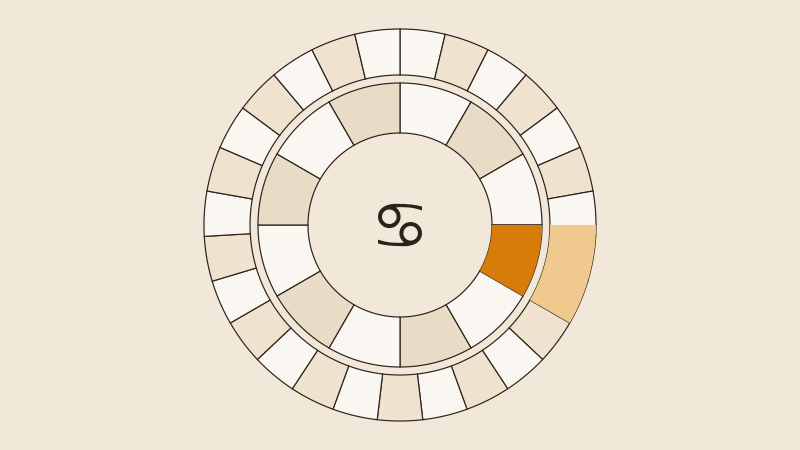
The four padas — quarters of 3°20′ — are how a nakshatra reading gets specific; each pada belongs to one navamsa sign, the ninth divisional chart, read for what is inward and for marriage. Rohini's padas run Aries, Taurus, Gemini, Cancer, and the second is vargottama.
| Pada | Degrees | Navamsa | Reading |
|---|---|---|---|
| 1 | 10°00′ Taurus – 13°20′ Taurus | Aries | Aries navamsa: the active Rohini — the farmer who also fights for the field, the artist with drive. Initiative inside the mansion's patience; the most restless pada, and the most likely to leave home to make its fortune. |
| 2 | 13°20′ Taurus – 16°40′ Taurus | Taurus | Taurus navamsa: vargottama — Taurus in both the rashi and the navamsa. The purest Rohini: beauty, wealth, comfort, fertility, possessiveness, all at full strength. The tradition's favourite pada for the Moon and for Venus. |
| 3 | 16°40′ Taurus – 20°00′ Taurus | Gemini | Gemini navamsa: the clever Rohini — the mind added to the body. Trade, writing, speech, the merchant of beautiful things; the most sociable pada and the least attached. |
| 4 | 20°00′ Taurus – 23°20′ Taurus | Cancer | Cancer navamsa: the Moon's own navamsa in the Moon's own mansion. The most nurturing, most emotional, most home-bound pada; the mother, the cook, the one who feeds everyone. Deeply attached; easily wounded. |
The second pada, being vargottama, is where Rohini's gifts and its possessiveness are both least diluted. The fourth is the one to read for the mother and for the native's emotional health, since Cancer doubles the Moon's hold on the mind.
Moon in Rohini: the janma nakshatra
The janma nakshatra — the Moon's mansion at the moment of birth — is where the mind is read and the dasha is counted from. A Moon in Rohini produces a mind that receives and holds. These are people who take in beauty, food, affection and money and keep them; who are attractive, often physically striking, with a fullness to the face and figure the old texts describe as the Moon's own; whose creativity is the maker's — gardens, children, businesses, art — and who are steady to the point of immovable once settled. The tradition credits them with truthfulness, purity, sweetness of speech, a clear mind, wealth, and the love of others.
The deeper trait comes from the story: they are preferred, and they know it. A Rohini Moon expects to be loved, usually is, and suffers more than most when it is not. The possessiveness that follows — of partners, of children, of things — is the mansion's whole shadow, and its whole work is to learn what the Moon learned: that what waxes must wane, and comes back.
The strength of the placement is real. A Rohini Moon has resources — emotional, physical, material — that other Moons envy, and it is the Moon the tradition credits to people who build lasting things.
Rohini nakshatra female and male natives
Readers search for the female and the male native separately, so the classical pair of portraits is given, with the caution that a chart is not a sex.
For a woman, the tradition gives Rohini beauty, a graceful figure, a sweet voice, artistic taste and a warm heart; it describes her as a devoted partner and mother, fond of dress and ornament, a good manager of a household, and jealous. The old texts' caution is exactly that — the jealousy of the story — and about being easily led by affection.
For a man, the tradition gives Rohini an attractive appearance, a gentle manner, a taste for comfort and for the company of women, a talent for making money grow, and a stubbornness that shows once he has decided. He is described as generous to those he loves and slow to forgive those who slight him. The caution is about indulgence — of appetite, and of the people he indulges.
With both, the Moon's phase matters more than in most nakshatras: a bright Rohini Moon is the description at full strength; a dark one — near the new moon — turns the receptivity inward and the possessiveness into anxiety.
Career, money and health
Work. Everything that grows and everything that is beautiful. Agriculture, horticulture, dairy, cattle — the ox-cart's trades; food, restaurants, hospitality; fashion, cosmetics, jewellery, luxury goods; the arts, especially music and the decorative arts; real estate, banking, and the management of wealth; fertility medicine, midwifery, childcare. Rohini is also strong in the Venus trades of pleasure — perfume, wine, entertainment — and in anything where being liked is the job.
Money. Comes steadily and stays. Rohini is one of the wealth nakshatras of the tradition, and its natives accumulate; the risk is not loss but over-attachment, the hoarding of what should circulate. The Taurus pada holds most; the Gemini pada trades.
Health. The face, neck and throat are Taurus's parts of the body, and Rohini adds the reproductive system and the mind's own weather — the Moon's domain. Complaints of the throat, the thyroid, the womb, and the appetite are classical, and the tradition notes that a Rohini native's health follows their emotional state more closely than most.
The other planets in Rohini
Put a planet in Rohini and it takes the mansion's fertility and the Moon's receptivity, and adds itself to that.
Sun in Rohini. In an enemy's sign but in a warm, fertile mansion. Authority through wealth or land; a father who provided; a self that wants to be loved as much as obeyed. The Sun's heat is cooled here, which softens the ego and sometimes the will.
Moon in Rohini. As set out above. Exalted, in its own mansion — the strongest Moon of the twenty-seven.
Mars in Rohini. In a neutral sign and a soft mansion. Force turned to building and to desire: the farmer, the builder, the lover. Passion is strong and possessive; the classical caution is about jealousy turning to violence.
Mercury in Rohini. In a friend's sign and the Moon's mansion — though Mercury and the Moon are not friends. A mind that thinks in images and in tastes; the merchant, the poet, the designer. Speech is sweet and persuasive.
Jupiter in Rohini. In an enemy's sign but a fertile mansion. Wealth, children, and a philosophy of abundance; the teacher who feeds. Jupiter here gives many of the mansion's gifts and adds generosity to them.
Venus in Rohini. In its own sign, in the Moon's beloved mansion. The tradition's placement of the artist, the beauty, and the lover: taste, charm, sensuality, wealth through pleasure. Almost every gift Venus can give is here; the caution is excess.
Saturn in Rohini. In a friend's sign, and a strong placement for the long game: slow wealth, land held for generations, a patient hand on the harvest. In the Moon's mansion it can chill the emotional life — the person who has everything and cannot enjoy it.
Rahu in Rohini. Appetite without a ceiling in the mansion of appetite. Sudden wealth, sudden fame, foreign luxury; the hunger for more of everything Rohini offers. Often the placement of the person who becomes what others want.
Ketu in Rohini. Detachment from the mansion's gifts: the renunciate in the star of abundance, or the loss — of a beloved, of wealth, of a child — that teaches the Moon's own lesson. Often the placement of a great sensitivity to beauty with no wish to own it.
Lagna in Rohini. A full, attractive frame; large, soft eyes; a manner that draws people. The lagna lord Venus's placement decides whether the beauty is enjoyed or merely displayed.
A Moon placement is never one story. A Sun in Rohini under the Venus sub and a Sun in Rohini under the Saturn sub are two different fathers, two different careers, two different men — and the Moon rules two other mansions besides this one, each with its own nine subs. That is why a chart is read planet by planet at this level, and why a page can only give you the outline. The nakshatra report takes your own chart and reads every planet in it to the pada and the sub-lord — which mansion, which quarter, whose sub — and says what each placement promises and in which dasha it delivers.
The sub-lords of Rohini
This is the level at which the Krishnamurti method (KP) reads a chart: each nakshatra is cut into nine unequal parts in the proportion of the Vimshottari years, and the lord of the part — the sub-lord — decides what a planet here actually delivers. Two planets in Rohini with different sub-lords give different results. It is the step at which two charts that look alike come apart — where real astrology begins.
| Sub-lord | From | To |
|---|---|---|
| Moon | 10°00′ Taurus | 11°06′40″ Taurus |
| Mars | 11°06′40″ Taurus | 11°53′20″ Taurus |
| Rahu | 11°53′20″ Taurus | 13°53′20″ Taurus |
| Jupiter | 13°53′20″ Taurus | 15°40′ Taurus |
| Saturn | 15°40′ Taurus | 17°46′40″ Taurus |
| Mercury | 17°46′40″ Taurus | 19°40′ Taurus |
| Ketu | 19°40′ Taurus | 20°26′40″ Taurus |
| Venus | 20°26′40″ Taurus | 22°40′ Taurus |
| Sun | 22°40′ Taurus | 23°20′ Taurus |
Rohini's sub-lords: the three that change a reading. The Moon sub at the start (10°00′ to 11°06′40″) is the Moon's mansion with the Moon's sub, in the Moon's sign of exaltation — the most receptive, most emotional degrees of the whole zodiac, and the most easily flooded. The Jupiter sub (13°53′20″ to 15°40′) sits inside the vargottama pada and is where the mansion's abundance is most protected: a planet here grows and keeps what it grows. The Venus sub (20°26′40″ to 22°40′) is Venus in its own sign in the Moon's mansion — the pleasure degrees, where the mansion's sensuality is strongest and its restraint weakest.
The dasha the Moon here gives
A Moon in Rohini starts life in the Moon mahadasha (10 years), and the balance left at birth is the fraction of Rohini the Moon has still to cross, times 10: a Moon exactly halfway through Rohini has 5 years of Moon left. The order after that is fixed — Mars → Rahu → Jupiter → Saturn → Mercury → Ketu → Venus → Sun — and it is the same for everyone born with the Moon here; what differs is where in it a life is standing at any moment. A Rohini life begins in the ten-year Moon mahadasha, and since most Rohini Moons are born partway through the mansion, the Moon period usually ends in childhood — a childhood the tradition expects to be comfortable and close to the mother. Then the seven-year Mars, then the eighteen-year Rahu, which typically covers the twenties and thirties: the period of ambition, movement and reinvention that sits oddly on a mansion that would rather stay home, and often takes it abroad. Jupiter's sixteen years usually arrive in the forties and bring the harvest.
Rohini nakshatra compatibility and marriage life
Compatibility by nakshatra is read from the yoni (the animal), the gana (the temperament) and the nadi (the constitution, which must differ). Rohini is serpent yoni, manushya gana, antya nadi.
Best matches by yoni — the serpent, whose other mansion is Mrigashira (full marks); then the horse (Ashwini, Shatabhisha), the elephant (Bharani, Revati) and the sheep (Krittika, Pushya), each scoring three with the serpent. Most difficult by yoni — the mongoose (Uttara Ashadha), the serpent's enemy, scoring nothing; the cat, rat, cow and buffalo score one.
By gana — Rohini is manushya, which matches deva and manushya well and rakshasa with difficulty. Rohini with Bharani, Ardra, Purva and Uttara Phalguni, Purva and Uttara Ashadha, Purva and Uttara Bhadrapada is manushya to manushya.
By nadi — Rohini is antya nadi. Rohini with Krittika, Ashlesha, Magha, Swati, Vishakha, Uttara Ashadha, Shravana or Revati carries the classical nadi dosha.
Beyond the koota count: a Rohini native needs a partner who can be adored without being owned, and who will not mistake the possessiveness for a lack of trust — it is the opposite.
Which pada of Rohini is best, and which is difficult?
Rohini does not have a bad pada; the tradition ranks it among the most fortunate mansions and every quarter of it is strong for the Moon. The second pada, vargottama, is the best for the Moon and for Venus and the one most quoted for beauty and wealth. The fourth, in Cancer, is the most emotional and the one to watch for the mother's health and the native's own moods. The first, in Aries, is the most restless and the most likely to strike out on its own. The third, in Gemini, is the cleverest and the least attached — which, in Rohini, is a relief.
The sky for Rohini Moons in 2026–27
Swiss Ephemeris, Lahiri, true node — computed, as every dated claim on this site is. Saturn is in the eleventh house from your Moon until 3 June 2027, then in the twelfth (with a return to the eleventh from 20 October 2027 to 23 February 2028). Jupiter, exalted, is in the third house from your Moon until 31 October 2026, previews the fourth from 31 October to 25 January 2027, returns to the third until 26 June 2027, and then settles in the fourth. Rahu is in the tenth and Ketu in the fourth until 25 November 2026; after that Rahu is in the ninth and Ketu in the third for eighteen months. What that means: a Rohini Moon is not in sade sati. Saturn is in the eleventh from the Moon until June 2027 — the house the tradition names as Saturn's best transit, for gains and for friends — and then moves into the twelfth, where the opening phase of the next sade sati begins. Jupiter is in the third from the Moon for most of the coming year, which is a working house rather than a fortunate one, and its preview of the fourth from 31 October to 25 January is the window the mansion cares about: home, property, the mother, vehicles. Mars enters Leo, the fourth from your Moon, on 12 November and meets Jupiter and Ketu there — energy under the roof in the week of 12 to 16 November.
→ Sade Sati · Mars Meets Jupiter in Leo
Remedy and mantra
The classical remedy for an afflicted Rohini placement is worship of the Moon and of Brahma as the mansion's deity — in practice, the Moon's mantra Om Chandraya Namah, or Om Som Somaya Namah, on Monday, which is Rohini's day; and offerings of milk, white flowers and white sweets. Krishna, who was born under Rohini in the tradition, is worshipped for the mansion's grace. The plainest remedy, and the first, is the mother: honour her, and the Moon steadies. A remedy — a puja, a gemstone, a rudraksha, a yantra — is prescribed to the chart, not to the nakshatra, and the chart decides which; so we do not name a gemstone here without it.
Questions we are asked
What is Rohini nakshatra? The fourth of the 27 nakshatras, 10°00′ to 23°20′ Taurus, ruled by the Moon, with Brahma as deity and an ox-cart as symbol. In the sky it is Aldebaran. It stands for growth, beauty, fertility, wealth, and attachment.
Rohini nakshatra is which rashi? Taurus (Vrishabha, or Vrishabh rashi). The whole nakshatra lies inside Taurus, so a Rohini Moon is a Taurus Moon — and an exalted one.
Who is the lord of Rohini nakshatra? The Moon. The dasha for a Moon here begins with the Moon's ten years, then Mars's seven.
What are the Rohini nakshatra characteristics? Attractive, steady, sensual, creative, fertile, wealthy, nurturing; possessive of what it loves; slow to move and hard to move once settled.
Which pada of Rohini is best? The second, in the Taurus navamsa, is vargottama and the strongest for the Moon and Venus. None is bad; the fourth is the most emotional.
What is the Rohini nakshatra symbol? An ox-cart — the vehicle that carries the harvest home, slowly and surely.
Is Rohini nakshatra good for marriage? Among the best, by the tradition's ranking: loyal, warm, physical partners. Match by yoni (serpent), gana (manushya) and nadi (antya); the serpent–mongoose pairing is the match the table rates worst.
Is the Moon exalted in Rohini? Yes. The Moon is exalted throughout Taurus, and Rohini is also its own mansion — the double strength that makes this the strongest Moon of the twenty-seven.
What does 2026 hold for Rohini nakshatra? Saturn in the eleventh from the Moon until June 2027, then the twelfth; Jupiter in the third with a preview of the fourth from 31 October; Mars, Jupiter and Ketu together in the fourth in mid-November. The computed sky is above.
Educational only; not medical, legal or financial advice. A nakshatra is one thread of a chart, not the cloth.
If Rohini holds your Moon or your lagna, the sub-lords and the dasha are read together in a consultation — and read against the year you are in.
→ Book a private consultation · Reading the Nakshatra, Not the Sign · Paper C, Nakshatras · ← Krittika · Mrigashira →