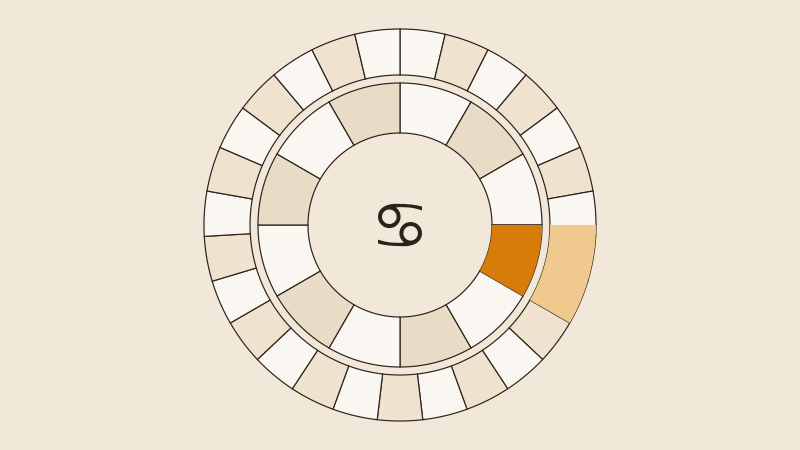
Ashlesha (also called Ayilyam in Tamil, Ashlesha in Telugu, Ayilyam in Malayalam, also written Aslesha) — 16°40′ Cancer to 0°00′ Leo, in Cancer; lord Mercury; deity the Nagas. Lahiri sidereal.
Ashlesha nakshatra is the ninth lunar mansion, the last 13°20′ of Cancer, and the most feared and least understood of the twenty-seven. Its deities are the Nagas, the serpent kings who hold the treasures under the earth; its symbol is a coiled serpent; its lord is Mercury. The name means "the embrace", "the entwining", and the mansion is the serpent's whole nature: coiled, patient, hypnotic, poisonous when threatened, and the guardian of a wisdom the daylight gods do not have. A person with the Moon here is perceptive, private, magnetic and hard to read, and their whole life is about what they do with power over others.
This is Ashlesha, read in the Institute's order: the span and the sign, the four padas and the navamsa each reaches — including the pada everyone asks about — the Moon and every other planet here, the sub-lords of the Krishnamurti method, the dasha a birth here begins, and the computed sky this Moon is under in 2026–27. Each Sanskrit word is explained the first time it is used.
Ashlesha nakshatra at a glance
| Span | 16°40′ Cancer to 0°00′ Leo |
| Sign (rashi) | Cancer |
| Lord (star-lord) | Mercury |
| Deity | the Nagas |
| Symbol | a coiled serpent |
| Gana (temperament) | Rakshasa |
| Nature (for muhurta) | Tikshna (sharp) |
| Yoni (animal, for matching) | cat (male) |
| Nadi | Antya |
| Name syllables (pada 1–4) | Di, Du, De, Do |
| Also called | Ayilyam (Tamil), Ashlesha (Telugu), Ayilyam (Malayalam) |
| Dasha the Moon here begins | Mercury, 17 years |
The story and the symbol
The Nagas are the serpent people of Patala, the world beneath — Vasuki, who was the rope when the ocean was churned; Shesha, on whom Vishnu sleeps; Takshaka, whose bite killed a king. They hold the gems, they know the medicines, they guard the water; they are honoured and they are dangerous, and the old cults of India propitiated them before the Vedic gods arrived. Ashlesha is their mansion, and it carries everything the serpent means in the tradition: kundalini, the coiled force at the base of the spine; poison and its antidote, which are the same substance; the hypnotic gaze; the sloughing of the skin — the ability to shed a whole self and be new.
Mercury as lord gives the intelligence. Ashlesha people are clever in the serpent's way — perceptive, strategic, quick to read a room and slow to be read — and the tradition's harshest descriptions of them (cunning, ungrateful, deceitful) are the daylight world's fear of what it cannot see. The kinder reading is the truer one: these are people who understand power, and who have to choose, over and over, whether to use it to heal or to bind.
The mansion ends the sign of Cancer and the whole water trine, and its last 0°48′ is a gandanta — the knot where water ends and fire begins — the tradition's most delicate degrees. A planet at the end of Ashlesha is a serpent at the mouth of its hole.
Which rashi is Ashlesha nakshatra? (Ashlesha nakshatra rasi)
Ashlesha lies entirely inside Cancer (Karka or Kark rashi), from 16°40′ to 30°00′ — the last third of the Moon's own sign. An Ashlesha Moon is a Cancer Moon, in its own sign: emotional, protective, attached, intuitive. What Ashlesha adds is the serpent's guard. Pushya before it is the open hand; Ashlesha is the hand that holds something back. Mercury, the star-lord, and the Moon, the sign-lord, are on uneasy terms — Mercury treats the Moon as an enemy — and the unease is the mansion's signature: the feeling heart under the calculating mind, each suspicious of the other. The mansion holds Mars's deepest debilitation at 28°00′, in its fourth pada.
The four padas of Ashlesha
The four padas — quarters of 3°20′ — are how a nakshatra reading gets specific; each pada belongs to one navamsa sign, the ninth divisional chart, read for what is inward and for marriage. Ashlesha's padas run Sagittarius, Capricorn, Aquarius, Pisces, and the fourth is the one the question "which pada is bad" is about.
| Pada | Degrees | Navamsa | Reading |
|---|---|---|---|
| 1 | 16°40′ Cancer – 20°00′ Cancer | Sagittarius | Sagittarius navamsa: the philosophical serpent — the healer, the counsellor, the one who uses the mansion's perception to teach. The most open pada, and the tradition's favourite of the four. |
| 2 | 20°00′ Cancer – 23°20′ Cancer | Capricorn | Capricorn navamsa: the working serpent — ambitious, strategic, patient. The politician, the manager, the one who plays the long game. Strong for career; the pada in which the mansion's cunning is most useful and most visible. |
| 3 | 23°20′ Cancer – 26°40′ Cancer | Aquarius | Aquarius navamsa: the reforming serpent — the mansion's power turned on society: the investigator, the occultist, the one who exposes. Original and unsettling; the least conventional pada. |
| 4 | 26°40′ Cancer – 0°00′ Leo | Pisces | Pisces navamsa: the deep serpent — intuitive, secretive, self-sacrificing or self-destroying. Holds Mars's deepest fall at 28°00′ and ends in the gandanta at 29°12′ to 30°00′. The pada the tradition marks as difficult, for the reasons set out below. |
No pada of Ashlesha is vargottama. The fourth pada carries two of the zodiac's sensitive points at once — Mars's exact debilitation and the water-fire gandanta — which is why it is singled out; the first pada is the one the texts read most kindly.
Moon in Ashlesha: the janma nakshatra
The janma nakshatra — the Moon's mansion at the moment of birth — is where the mind is read and the dasha is counted from. A Moon in Ashlesha produces a mind that watches. These are people who see what others are hiding and hide what they themselves feel; who are magnetic without trying; who are loyal to a very few and wary of the rest; and who have, under the wariness, the Cancer Moon's tenderness, which almost no one is allowed to see. The tradition credits them with a hard-to-read manner, cleverness, a capacity for deception, ingratitude, and — in the same lists — wisdom, wealth, and the power to heal.
The signature underneath is the coil. An Ashlesha Moon holds its force in reserve; it does not strike first, and it does not forget. This is the mansion of the strategist, the psychologist, the hypnotist, the healer who works with poisons, and of the person who can end a relationship in a sentence and never look back. The classical warning is about how the power is used: the serpent that binds, that manipulates, that poisons — and the tradition is clear that the same native can be the one who removes the poison instead. Their lesson is the serpent's own: to shed the skin, to let the old self go, to use the gaze to see rather than to hold.
Mercury's lordship over the Moon's sign gives them an intelligence that is felt as much as thought — the intuition that arrives as a certainty about a person. It is usually right. It is not always kind.
Ashlesha nakshatra female and male natives
Readers search for the female and the male native separately, so the classical pair of portraits is given, with the caution that a chart is not a sex — and, for Ashlesha, that the old texts are harsh and the harshness describes a fear, not a person.
For a woman, the tradition gives Ashlesha a magnetic presence, penetrating eyes, a private nature, strong intuition, and an ability to manage people that the texts call cunning and a modern reader would call skill. It describes her as devoted where she chooses to be and unforgiving where she does not, and adds cautions about the marriage — that she may dominate it, or that the in-laws will be a struggle. The Ashlesha woman of the texts is one who does not submit, written by men who expected her to.
For a man, the tradition gives Ashlesha a lean, watchful frame, a quiet manner, sharp intelligence, a talent for strategy and for secrets, and a way of getting what he wants without seeming to try. He is described as loyal to few, difficult to know, and capable of both great healing and great harm. The caution is about the use of power, and about a bitterness that grows in the coil.
With both, the first pada softens the description considerably; the fourth sharpens it.
Career, money and health
Work. The serpent's mansion gives medicine of the deep kind — pharmacology, toxicology, anaesthesia, psychiatry, and the traditional healing arts; it gives the professions of hidden knowledge — research, intelligence, investigation, the occult, tantra; it gives the professions of persuasion — politics, negotiation, law, sales, hypnotherapy; and it gives the trades of the earth's treasures — gems, mining, petroleum, snakes and reptiles. Ashlesha also does well in yoga and the disciplines of the body's hidden force, and in any field where seeing what is hidden is the job.
Money. Comes through cleverness and through what others do not see, and is kept close. The Capricorn pada earns most; the Pisces pada gives it away or loses it in a crisis. The Nagas' treasure is the mansion's promise — wealth from under the ground, or from under the table — and the tradition warns that money gained by the serpent's cunning has a bite in it.
Health. Cancer governs the chest and the stomach; Ashlesha adds the nervous system and the joints, and the tradition names poisoning — literal and figurative — and illnesses of the mind as its complaints. Kundalini practice is both its remedy and, mishandled, its risk.
The other planets in Ashlesha
Put a planet in Ashlesha and it takes the mansion's coil and Mercury's cunning, and adds itself to that.
Sun in Ashlesha. In a friend's sign, in a mansion of hidden power. A self that leads from behind; a father who was controlling, secretive, or a healer; authority that others feel before they see it. Strong for the strategist, hard for the person who wants to be liked.
Moon in Ashlesha. As set out above. In its own sign.
Mars in Ashlesha. Debilitated, and at its deepest debilitation at 28°00′ in the fourth pada. Force with no clean outlet: the anger that coils, the fight that is fought with words or poison instead of hands, the courage that shows only in a crisis. Neecha bhanga through Jupiter or the Moon lifts it; in the first pada the fall is far from its bottom and the Mars is more usable.
Mercury in Ashlesha. In its own mansion, in an enemy's sign. The serpent's mind at full strength: perceptive, strategic, hypnotic in speech, capable of the exact sentence that binds or frees. The tradition's placement for the diplomat and the manipulator, who are often the same person.
Jupiter in Ashlesha. Exalted in Cancer, past its deepest degree in Pushya, but in Mercury's mansion, which is not Jupiter's friend. Wisdom about power; the guru who knows the hidden teachings; grace that works through the occult. Strong, and stranger than a Pushya Jupiter.
Venus in Ashlesha. In an enemy's sign and a serpentine mansion. Love that binds; attraction that is hypnotic; jealousy; the affair that is kept hidden. Also the healer's Venus — the one who soothes the poison. Not an easy Venus, but a powerful one.
Saturn in Ashlesha. In an enemy's sign, in Mercury's mansion, with which Saturn works well. The patient serpent: the long strategy, the institution controlled from behind, the slow poison or the slow cure. Saturn here disciplines the mansion's cunning and can freeze its heart.
Rahu in Ashlesha. The serpent's head in the serpent's mansion — Rahu is a Naga himself. Obsession with hidden power, with the occult, with control; the foreign healer, the hacker, the spy. The most Ashlesha of all placements, for good and ill.
Ketu in Ashlesha. The serpent's tail in the serpent's mansion — Ketu too is of the Nagas. Detachment from the mansion's power: the renunciate who has shed the skin, the mystic with the kundalini already risen. Often a spiritual placement, and often one that begins with a wounding.
Lagna in Ashlesha. A lean, watchful body, deep-set or hypnotic eyes, a manner that is quiet and hard to read. The lagna lord is the Moon, and its placement decides whether the serpent guards a warm heart or a cold one.
Notice how much turns on the lord. A planet in one of Mercury's three mansions carries Mercury's signature, but Ashlesha is not the other two, and inside Ashlesha the nine sub-lords divide it again. This is the level at which a reading stops being a description of a type and becomes a description of a person. The nakshatra report does that work for your own chart: each planet placed to its pada and sub-lord, each placement read for what it promises and when the dasha lets it through.
The sub-lords of Ashlesha
This is the level at which the Krishnamurti method (KP) reads a chart: each nakshatra is cut into nine unequal parts in the proportion of the Vimshottari years, and the lord of the part — the sub-lord — decides what a planet here actually delivers. Two planets in Ashlesha with different sub-lords give different results. It is the step at which two charts that look alike come apart — where real astrology begins.
| Sub-lord | From | To |
|---|---|---|
| Mercury | 16°40′ Cancer | 18°33′20″ Cancer |
| Ketu | 18°33′20″ Cancer | 19°20′ Cancer |
| Venus | 19°20′ Cancer | 21°33′20″ Cancer |
| Sun | 21°33′20″ Cancer | 22°13′20″ Cancer |
| Moon | 22°13′20″ Cancer | 23°20′ Cancer |
| Mars | 23°20′ Cancer | 24°06′40″ Cancer |
| Rahu | 24°06′40″ Cancer | 26°06′40″ Cancer |
| Jupiter | 26°06′40″ Cancer | 27°53′20″ Cancer |
| Saturn | 27°53′20″ Cancer | 0°00′ Leo |
Ashlesha's sub-lords: the three that change a reading. The Mercury sub at the start (16°40′ to 18°33′20″) is Mercury in its own mansion and its own sub — the sharpest, most strategic degrees of the star, and the ones in which the tradition's word "cunning" is most earned. The Rahu sub (24°06′40″ to 26°06′40″) is the serpent's own head in the serpent's mansion; a planet there is Ashlesha at its most hypnotic and its most obsessive. The Saturn sub at the end (27°53′20″ to 30°00′) holds both Mars's deepest fall at 28°00′ and the gandanta from 29°12′; a planet there — and above all the Moon or the lagna — is at the zodiac's most guarded threshold, and is read with the care Paper C sets out.
The dasha the Moon here gives
A Moon in Ashlesha starts life in the Mercury mahadasha (17 years), and the balance left at birth is the fraction of Ashlesha the Moon has still to cross, times 17: a Moon exactly halfway through Ashlesha has 8.5 years of Mercury left. The order after that is fixed — Ketu → Venus → Sun → Moon → Mars → Rahu → Jupiter → Saturn — and it is the same for everyone born with the Moon here; what differs is where in it a life is standing at any moment. An Ashlesha life begins in the seventeen-year Mercury mahadasha, and since most Ashlesha Moons are born partway through the mansion, Mercury usually runs through childhood and into the teens — a clever, watchful childhood, often with a secret in it. Then the seven-year Ketu, which typically falls in the late teens or twenties and is the mansion's first shedding of skin; then the twenty-year Venus, which usually covers the thirties and forties and is where the serpent learns love, or learns to bind.
Ashlesha nakshatra compatibility and marriage life
Compatibility by nakshatra is read from the yoni (the animal), the gana (the temperament) and the nadi (the constitution, which must differ). Ashlesha is cat yoni, rakshasa gana, antya nadi.
Best matches by yoni — the cat, whose other mansion is Punarvasu (full marks); then the sheep (Krittika, Pushya) and the monkey (Purva Ashadha, Shravana), each scoring three with the cat. Most difficult by yoni — the rat (Magha, Purva Phalguni), the cat's enemy, scoring nothing; the serpent, tiger and lion score one.
By gana — Ashlesha is rakshasa, which matches rakshasa best (Krittika, Magha, Chitra, Vishakha, Jyeshta, Mula, Dhanishta, Shatabhisha) and manushya acceptably; rakshasa with deva is the classical mismatch.
By nadi — Ashlesha is antya nadi. Ashlesha with Krittika, Rohini, Magha, Swati, Vishakha, Uttara Ashadha, Shravana or Revati carries the classical nadi dosha.
Beyond the koota count: an Ashlesha native needs a partner who is not afraid of them, and who can tell the coil from the strike. The tradition's cautions about Ashlesha marriages are real and they are about power; a partner who does not compete for it is the one who stays.
Which pada of Ashlesha is best, and which is difficult?
This is the question Ashlesha is asked more than any other mansion, and the answer is the fourth pada — 26°40′ to 30°00′ Cancer, the Pisces navamsa — for two computed reasons, not for superstition. It holds Mars's deepest debilitation at 28°00′, so a Mars there is at the bottom of its fall; and its last 0°48′, from 29°12′, is the water-fire gandanta, the knot the tradition reads as a threshold with no floor, above all for the Moon and the lagna. A Moon in the fourth pada is the placement behind most of the mansion's reputation. The first pada, in Sagittarius, is the one the texts read most kindly — the healer and the teacher. The second is the strongest for career; the third the most original. The tradition also flags the whole mansion for the in-laws, and for a girl's birth in it as difficult for the husband's family — an old belief we record because readers will meet it elsewhere, and do not use: a chart is read, not a rumour.
The sky for Ashlesha Moons in 2026–27
Swiss Ephemeris, Lahiri, true node — computed, as every dated claim on this site is. Saturn is in the ninth house from your Moon until 3 June 2027, then in the tenth (with a return to the ninth from 20 October 2027 to 23 February 2028). Jupiter, exalted, is in the first house from your Moon until 31 October 2026, previews the second from 31 October to 25 January 2027, returns to the first until 26 June 2027, and then settles in the second. Rahu is in the eighth and Ketu in the second until 25 November 2026; after that Rahu is in the seventh and Ketu in the first for eighteen months. What that means: with Saturn in the ninth until June 2027 and the tenth after it, the year's weight falls on faith and then on work, not on the Moon itself. Jupiter, exalted, sits on the Moon itself until 31 October — and for an Ashlesha Moon that is Jupiter's passage through the mansion's own degrees from 19 August to 31 October, the guru moving through the serpent's house — and the mansion also carried this year's solar eclipse, 12 August 2026 at 25°48′ Cancer, in Ashlesha's third pada, a week before Jupiter entered the mansion on 19 August; a planet near that degree is read for what the eclipse touched. Jupiter then previews the second until 25 January and returns to the Moon until 26 June 2027. Ketu moves onto the Cancer Moon on 25 November for eighteen months, with Rahu in the seventh: the Nagas' own planets on the Nagas' mansion, which the tradition reads as a stretch of shedding — endings in partnership, deepening in the self. Mars enters Leo, the second from your Moon, on 12 November, leaving its debilitation in this very mansion, and meets Jupiter and Ketu there.
→ Sade Sati · Mars Meets Jupiter in Leo
Remedy and mantra
The classical remedy for an afflicted Ashlesha placement is worship of the Nagas — the Naga Panchami offerings, milk to the serpent stone, the Naga mantra — and of Mercury as the mansion's lord, with Om Budhaya Namah on Wednesday. Subrahmanya (Kartikeya), whose mount is the peacock, the serpent's enemy, is worshipped for the mansion's poison, and the tradition prescribes the Sarpa Dosha remedies where the chart shows them. The plainest remedy, and the first, is truthfulness — the serpent's affliction is the coil, and it is loosened by saying plainly what is wanted. A remedy — a puja, a gemstone, a rudraksha, a yantra — is prescribed to the chart, and the chart decides which.
Questions we are asked
What is Ashlesha nakshatra? The ninth of the 27 nakshatras, 16°40′ to 30°00′ Cancer, ruled by Mercury, with the Nagas as deities and a coiled serpent as symbol. It stands for hidden power, perception, healing and poison, and the shedding of the skin.
Ashlesha nakshatra is which rashi? Cancer (Karka, or Kark rashi). The whole nakshatra lies inside Cancer, the Moon's own sign.
Who is the lord of Ashlesha nakshatra? Mercury. The dasha for a Moon here begins with Mercury's seventeen years, then Ketu's seven.
Which pada of Ashlesha nakshatra is bad? The fourth, 26°40′ to 30°00′ Cancer: it holds Mars's deepest debilitation at 28° and ends in the water-fire gandanta. The first pada is the one the texts read most kindly.
What are the Ashlesha nakshatra characteristics? Perceptive, private, magnetic, strategic, loyal to few; capable of great healing and great harm; the one who sees what is hidden.
What is the Ashlesha nakshatra symbol? A coiled serpent — the kundalini, the guardian of treasure, the poison that is also the cure.
Is Ashlesha nakshatra good for marriage? Deep, binding partners, not easy ones; the tradition's cautions are about power in the marriage. Match by yoni (cat), gana (rakshasa) and nadi (antya); the cat–rat pairing is the match the table rates worst.
Why is Ashlesha nakshatra considered bad? Because its deities are the serpents, its lord is Mercury in the Moon's sign, its last pada holds Mars's fall and a gandanta, and the old texts described the fear rather than the person. The mansion's natives are powerful; what they do with it is the chart's question, not the star's.
Was there an eclipse in Ashlesha in 2026? Yes — the solar eclipse of 12 August 2026 fell at 25°48′ Cancer, in Ashlesha's third pada. A Moon or planet near that degree is read for what the eclipse touched.
What does 2026 hold for Ashlesha nakshatra? Exalted Jupiter on the Moon for most of the coming year — through Ashlesha's own degrees from 19 August to 31 October; Saturn in the ninth until June 2027, then the tenth; Ketu arriving on the Moon on 25 November. The computed sky is above.
Educational only; not medical, legal or financial advice. A nakshatra is one thread of a chart, not the cloth.
If Ashlesha holds your Moon or your lagna, the sub-lords and the dasha are read together in a consultation — and read against the year you are in.
→ Book a private consultation · Reading the Nakshatra, Not the Sign · Paper C, Nakshatras · ← Pushya · Magha →