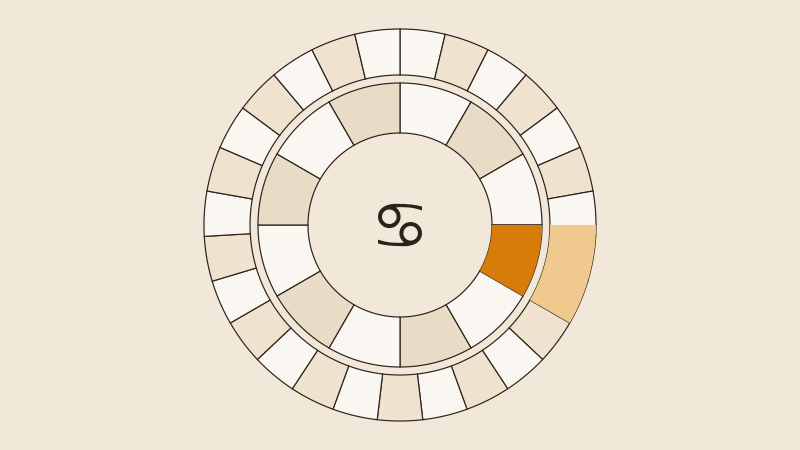
Swati (also called Swathi in Tamil, Swati in Telugu, Chothi in Malayalam, also written Swathi, and known in the sky as Arcturus) — 6°40′ Libra to 20°00′ Libra, in Libra; lord Rahu; deity Vayu. Lahiri sidereal.
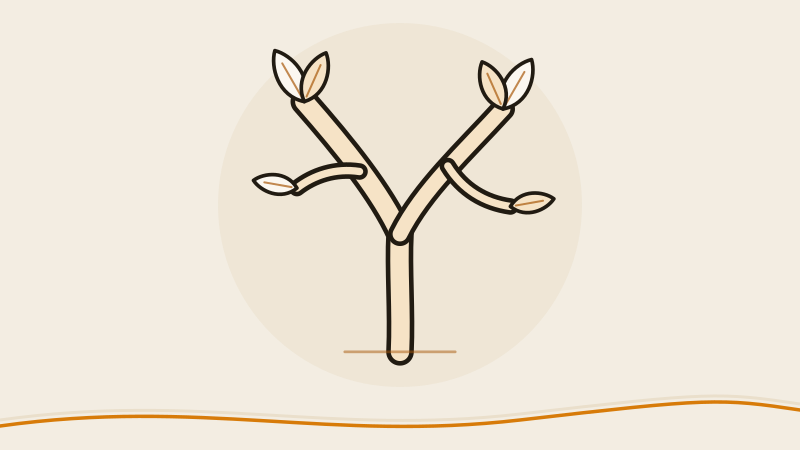
Swati nakshatra is the fifteenth lunar mansion, from 6°40′ to 20°00′ of Libra, and it is the star of the wind. Its deity is Vayu, the wind-god, breath and life-force; its symbol is a young shoot bending in the breeze — or a blade of grass, or coral; its lord is Rahu. In the sky it is Arcturus, one of the brightest stars there is, standing alone. The name means "the independent", "the sword", and the mansion is exactly the shoot in the wind: flexible, self-moving, unrooted, surviving by bending. It holds the deepest degree of the Sun's fall. A person with the Moon here is independent, restless, diplomatic and hard to pin down, the one who goes their own way and is liked for it.
The page walks Swati through in full: the span and the sign, the four padas and the navamsa each reaches, the Moon and every other planet here, the sub-lords of the Krishnamurti method, the dasha a birth here begins, and the computed sky this Moon is under in 2026–27. Terms in Sanskrit are explained where they arise.
Swati nakshatra at a glance
| Span | 6°40′ Libra to 20°00′ Libra |
| Sign (rashi) | Libra |
| Lord (star-lord) | Rahu |
| Deity | Vayu |
| Symbol | a young shoot bending in wind; coral |
| Gana (temperament) | Deva |
| Nature (for muhurta) | Chara (movable) |
| Yoni (animal, for matching) | buffalo (male) |
| Nadi | Antya |
| Name syllables (pada 1–4) | Ru, Re, Ro, Ta |
| Also called | Swathi (Tamil), Swati (Telugu), Chothi (Malayalam) |
| Dasha the Moon here begins | Rahu, 18 years |
The story and the symbol
Vayu is the wind and the breath — prana, the life that moves in and out of every body, the fastest of the gods, the one who goes everywhere and is held nowhere. He is Hanuman's father, and Bhima's, and the tradition gives him strength as well as speed: the wind that bends the shoot can also uproot the tree. Swati is his mansion, and the young shoot is its symbol because the shoot survives the storm that breaks the oak — by yielding, by moving with what moves it, by having no fixed position to defend.
Rahu as lord adds the restlessness and the reach. Rahu is the eclipse's head, the hunger for what is elsewhere; in Vayu's mansion it becomes the traveller, the trader, the one whose business is movement — of goods, of money, of ideas, of air itself. Swati natives are the tradition's merchants and diplomats, the people who make their living between fixed points and belong to none of them. Their shadow is the wind's: they scatter, they cannot be held to a position, and they can be blown by whatever is loudest.
The mansion holds the Sun's deepest fall at 10°00′ Libra, in its first pada. Where the king is weakest, the individual is freest; Swati is the tradition's star of self-made independence, and its brightest star, Arcturus, stands apart in the sky as its natives stand apart in a room.
Which rashi is Swati nakshatra? (Swati nakshatra rasi)
Swati lies entirely inside Libra (Tula rashi), from 6°40′ to 20°00′ — the middle of Venus's sign. A Swati Moon is a Libra Moon: balanced, relational, aesthetic, diplomatic, needing harmony and fair dealing. What Swati adds is the wind — the Libra balance kept by constant small adjustments rather than by standing still. Rahu, the star-lord, and Venus, the sign-lord, are on good terms in the tradition, and the ease is the Swati signature: the charm that is also a strategy, the balance that is also a way of never being pinned. The Sun reaches its deepest debilitation at 10°00′ Libra, in Swati's first pada, and Saturn its deepest exaltation at 20°00′, the mansion's last degree.
The four padas of Swati
Each pada is a quarter of the mansion, 3°20′, and carries the sign of the navamsa, the ninth division, in which the inner life and the marriage are read. Swati's padas run Sagittarius, Capricorn, Aquarius, Pisces.
| Pada | Degrees | Navamsa | Reading |
|---|---|---|---|
| 1 | 6°40′ Libra – 10°00′ Libra | Sagittarius | Sagittarius navamsa: the questing wind — the traveller, the philosopher of independence, the one who goes furthest. The most restless pada. Holds the Sun's deepest fall at 10°00′. |
| 2 | 10°00′ Libra – 13°20′ Libra | Capricorn | Capricorn navamsa: the working wind — the trader, the negotiator, the one whose movement makes money. The most practical pada and the tradition's favourite for business. |
| 3 | 13°20′ Libra – 16°40′ Libra | Aquarius | Aquarius navamsa: Rahu's own navamsa in Rahu's mansion — the reforming wind, the free thinker, the one who belongs to no party. The most independent pada and the most original. |
| 4 | 16°40′ Libra – 20°00′ Libra | Pisces | Pisces navamsa: the yielding wind — the diplomat, the mediator, the one who bends furthest and is hardest to break. The most sensitive pada, and the most easily scattered. |
No pada of Swati is vargottama. The first pada, holding the Sun's exact fall, is where the mansion's independence costs the most standing; the second is where it earns the most.
Moon in Swati: the janma nakshatra
A birth is dated by its janma nakshatra, the Moon's mansion; the mind takes its colour from it and the dasha its starting point. A Moon in Swati gives a mind that moves. These are people of independence and adaptability, who dislike being told and dislike telling; who are diplomatic, sociable, fair-minded and hard to hold to a fixed view; who make their own way, often in trade or travel, and are liked wherever they land. In the classical descriptions they have modesty, skill in trade, kindness, a slow-burning intelligence, and a life that prospers late.
The deeper current is Vayu's: they survive by bending. A Swati Moon does not confront; it adjusts, and the adjustment is so smooth that others mistake it for agreement. What the texts warn of is exactly that — a lack of fixed position that becomes unreliability, and a scattering of effort that Rahu's hunger makes worse. The native's work is to choose a direction and hold it long enough for the wind to fill a sail.
Rahu in Venus's sign gives them their charm and their appetite. Swati Moons want the world, and they want it pleasantly; they are the tradition's self-made people, prosperous through their own movement and owing their standing to no one — which is the mansion's pride and, at the Sun's fall, its loneliness.
Swati nakshatra female and male natives
The texts split the description by sex; both halves are kept, as readers want them, with the caution that a chart is not a sex.
For a woman, the tradition gives Swati grace, a pleasant manner, independence of mind, a talent for trade and for social life, and a dislike of confinement; it describes her as kind, popular, fair, and as someone who will not be governed and does not govern. The old texts add a caution about restlessness in marriage, and about a home that is a base rather than a nest.
For a man, the tradition gives Swati a slim, mobile frame, courtesy, business sense, a love of travel and of company, and a self-made prosperity that arrives in the thirties or later. He is described as generous, easy-going, slow to anger, and — in the caution — as someone who can be blown off course by the last person he spoke to, and who scatters what he earns.
For both, Saturn's condition in the chart decides whether the wind has a direction.
Career, money and health
Work. Vayu's mansion under Rahu gives the professions of movement: trade and commerce of every kind, import–export, transport, aviation, shipping, logistics; travel and tourism; diplomacy, negotiation, brokerage, sales; finance in its mobile forms — currency, markets, the wind of money. The breath gives music, especially wind instruments and singing, and yoga, especially pranayama. Rahu gives the foreign and the unconventional — the expatriate career, the freelancer, the entrepreneur who belongs to no firm. Swati also does well in law as advocacy, in public relations, and in any work done between parties rather than for one.
Money. Comes late and through the native's own movement — the tradition marks Swati as self-made, prospering after thirty — and it comes and goes with the wind unless Saturn or the Capricorn pada holds it. Trade is the mansion's classical source; speculation its classical loss.
Health. Libra governs the kidneys, the lower back and the skin, and Swati adds the breath — the lungs, the airways — and the wind in the body, which the tradition reads as the nervous system and the digestion's gas. Complaints of the kidneys, of the lungs and of flatulence are classical, along with restlessness that will not let the body rest. The oldest prescription for it is pranayama.
The other planets in Swati
A planet in Swati takes on the mansion's independence and Rahu's reach, and then does what that planet does.
Sun in Swati. Debilitated, and at its deepest debilitation at 10°00′ in the first pada — the weakest Sun in the zodiac by dignity. A self that does not command and does not want to; a father absent, weak, or the native's opposite; standing that has to be made rather than inherited. Neecha bhanga through Saturn or Venus lifts it, and many of the tradition's self-made lives have it.
Moon in Swati. See above.
Mars in Swati. In a neutral sign, in Rahu's mansion — and Mars and Rahu together are a volatile pair. Force that moves: the athlete of speed, the trader who fights for the deal, the soldier abroad. Courage without stability; the classical caution is the sudden quarrel and the accident in transit.
Mercury in Swati. In a friend's sign, in a mansion that is Mercury-like in its quickness. The trader's mind, the negotiator's, the traveller's — quick, adaptable, persuasive. One of Mercury's better placements for commerce.
Jupiter in Swati. In an enemy's sign and Rahu's mansion, which is a hard place for the planet of fixed faith. Wisdom that travels; the teacher abroad; belief that changes with the wind, or a philosophy of freedom. Good for foreign fortune; uneven for settled learning.
Venus in Swati. In its own sign, in Rahu's mansion. Love that is free and charming and hard to hold; beauty in motion; art that travels; the romance abroad. A pleasant Venus and an unattached one.
Saturn in Swati. Exalted in Libra, rising toward its deepest exaltation at 20°00′, the mansion's last degree. The wind given a direction: the disciplined trader, the diplomat of the long game, the self-made person who built something that stays. One of Saturn's finest placements, and the one that steadies the mansion most.
Rahu in Swati. Rahu in its own mansion — the hunger at full reach in the wind. The great traveller, the trader across every border, the foreigner who prospers, the person who cannot stay. Also the most scattered of Swati placements.
Ketu in Swati. The wind's tail: detachment from movement — the traveller who stops, the trader who gives it up, the breath turned inward in meditation. Often a placement of pranayama and of a late-found stillness.
Lagna in Swati. A slim, graceful, mobile frame, a pleasant face, a manner that is courteous and slightly elusive. The lagna lord is Venus, and its placement decides whether the charm has a home.
Notice how much turns on the lord. A planet in one of Rahu's three mansions carries Rahu's signature, but Swati is not the other two, and inside Swati the nine sub-lords divide it again. This is the level at which a reading stops being a description of a type and becomes a description of a person. The nakshatra report does that work for your own chart: each planet placed to its pada and sub-lord, each placement read for what it promises and when the dasha lets it through.
The sub-lords of Swati
This is the level at which the Krishnamurti method (KP) reads a chart: each nakshatra is cut into nine unequal parts in the proportion of the Vimshottari years, and the lord of the part — the sub-lord — decides what a planet here actually delivers. Two planets in Swati with different sub-lords give different results. It is the step at which two charts that look alike come apart — where real astrology begins.
| Sub-lord | From | To |
|---|---|---|
| Rahu | 6°40′ Libra | 8°40′ Libra |
| Jupiter | 8°40′ Libra | 10°26′40″ Libra |
| Saturn | 10°26′40″ Libra | 12°33′20″ Libra |
| Mercury | 12°33′20″ Libra | 14°26′40″ Libra |
| Ketu | 14°26′40″ Libra | 15°13′20″ Libra |
| Venus | 15°13′20″ Libra | 17°26′40″ Libra |
| Sun | 17°26′40″ Libra | 18°06′40″ Libra |
| Moon | 18°06′40″ Libra | 19°13′20″ Libra |
| Mars | 19°13′20″ Libra | 20°00′ Libra |
Three sub-lords of Swati to read first. The Rahu sub at the start (6°40′ to 8°40′) is Rahu in its own mansion and its own sub — the most restless, most hungry degrees of the star, and the purest Swati. The Jupiter sub (8°40′ to 10°26′40″) holds the Sun's deepest fall at 10°00′; a Sun there is at the bottom of its dignity with Jupiter's grace by sub, which is the tradition's picture of the humble man who is honoured. The Mars sub at the end (19°13′20″ to 20°00′) ends on Saturn's deepest exaltation, and a Saturn there is at the top of its dignity with Mars's drive by sub — the builder who fights for the building.
The dasha the Moon here gives
A Moon in Swati starts life in the Rahu mahadasha (18 years), and the balance left at birth is the fraction of Swati the Moon has still to cross, times 18: a Moon exactly halfway through Swati has 9 years of Rahu left. The order after that is fixed — Jupiter → Saturn → Mercury → Ketu → Venus → Sun → Moon → Mars — and it is the same for everyone born with the Moon here; what differs is where in it a life is standing at any moment. A Swati life begins in the eighteen-year Rahu mahadasha, and since most Swati Moons are born partway through the mansion, Rahu usually runs through childhood and into the teens — a childhood the tradition expects to be mobile: moves, travel, a foreign element, or a family that was itself in motion. Then the sixteen-year Jupiter, which typically covers the twenties and thirties and is where the wind finds a faith or a field; then the nineteen-year Saturn, which is where the self-made prosperity the mansion promises is built and kept.
Swati nakshatra compatibility and marriage life
The match is made on three counts: the yoni (the animal), the gana (the temperament) and the nadi (the constitution, which must differ). Swati is buffalo yoni, deva gana, antya nadi.
Best matches by yoni — the buffalo, whose other mansion is Hasta (full marks); then the elephant (Bharani, Revati), the sheep (Krittika, Pushya) and the cow (Uttara Phalguni, Uttara Bhadrapada), each scoring three with the buffalo. Most difficult by yoni — the horse (Ashwini, Shatabhisha), the buffalo's enemy, scoring nothing; the serpent, tiger and lion score one.
By gana — Swati is deva, which matches deva and manushya well; deva with rakshasa is the classical mismatch. Swati with Ashwini, Mrigashira, Punarvasu, Pushya, Hasta, Anuradha, Shravana and Revati is deva to deva.
By nadi — Swati is antya nadi. Swati with Krittika, Rohini, Ashlesha, Magha, Vishakha, Uttara Ashadha, Shravana or Revati is what the tradition calls nadi dosha.
After the tables comes the part that matters: a Swati native is an easy, courteous, undemanding partner who needs room to move, and needs one who can be the fixed point the wind returns to — without becoming the wall it breaks against.
Which pada of Swati is best, and which is difficult?
No quarter of Swati is a bad one; the tradition ranks it a fortunate, if late-blooming, mansion. The first pada carries the Sun's deepest fall and is the one to read for the father and for standing; a Sun or a Moon there begins with the least support. The second, in Capricorn, is the most prosperous. The third, in Aquarius, is the most independent. The fourth, in Pisces, is the gentlest and the most easily scattered, and is the one to watch, because its bending can become drift.
The sky for Swati Moons in 2026–27
Dates computed, not remembered: Swiss Ephemeris, Lahiri ayanamsa, true node. Saturn is in the sixth house from your Moon until 3 June 2027, then in the seventh (with a return to the sixth from 20 October 2027 to 23 February 2028). Jupiter, exalted, is in the tenth house from your Moon until 31 October 2026, previews the eleventh from 31 October to 25 January 2027, returns to the tenth until 26 June 2027, and then settles in the eleventh. Rahu is in the fifth and Ketu in the eleventh until 25 November 2026; after that Rahu is in the fourth and Ketu in the tenth for eighteen months. To say it directly: a Swati Moon is not in sade sati. Saturn, exalted in Libra's own dignity, is in the sixth from the Moon until June 2027 — the house where Saturn's transit clears debts and rivals — and then in the seventh, partnership. Jupiter's year is spent in the house of work, with gains previewed over the winter; Rahu, the mansion's own lord, moves from the fifth to the fourth on 25 November. And Venus, the sign's lord, is retrograde on the Libra Moon from 3 October to 6 November — stationing at 14°15′ Libra, inside Swati's third pada, on 3 October, and walking back through the whole mansion before leaving it on 24 October: for a Swati Moon, the month to sign nothing and promise nothing. Mars enters Leo, the eleventh from your Moon, on 12 November and meets Jupiter and Ketu there.
→ Sade Sati · Mars Meets Jupiter in Leo
Remedy and mantra
The classical remedy for an afflicted Swati placement is worship of Vayu — through Hanuman, his son, with the Hanuman Chalisa on Tuesday or Saturday — and of Rahu as the mansion's lord, with Om Rahave Namah on Saturday and the worship of Durga for Rahu's periods. Pranayama, the discipline of the breath, is the mansion's own practice and its best remedy. Before the mantra comes a fixed hour — the mansion's affliction is the scattering, and one kept appointment a day gathers the wind. A remedy — a puja, a gemstone, a rudraksha, a yantra — is prescribed to the chart, and the chart decides which.
Questions we are asked
What is Swati nakshatra? The fifteenth of the 27 nakshatras, 6°40′ to 20°00′ Libra, ruled by Rahu, with Vayu — the wind — as deity and a young shoot bending in the breeze as symbol. In the sky it is Arcturus. It stands for independence, movement, trade, and survival by bending.
Swati nakshatra is which rashi? Libra (Tula). The whole nakshatra lies inside Libra, Venus's sign.
Who is the lord of Swati nakshatra? Rahu. The dasha for a Moon here begins with Rahu's eighteen years, then Jupiter's sixteen.
What are the Swati nakshatra characteristics? Independent, adaptable, diplomatic, sociable, restless; a trader and a traveller; self-made and late to prosper; hard to hold to a fixed position.
Which pada of Swati is best? The second, in Capricorn, is the most prosperous; the third, in Aquarius, the most independent. None is bad; the first holds the Sun's deepest fall.
What is the Swati nakshatra symbol? A young shoot bending in the wind — the thing that survives the storm by yielding — and, in some texts, coral or a sword.
Is Swati nakshatra good for marriage? Easy, courteous partners who need room. Match by yoni (buffalo), gana (deva) and nadi (antya); the buffalo–horse pairing is the pair the yoni count marks at nothing.
Is the Sun debilitated in Swati? Yes — the Sun's fall is Libra, and its deepest point, 10°00′, is in Swati's first pada. Saturn's deepest exaltation, at 20°00′, is the mansion's last degree.
What does 2026 hold for Swati nakshatra? Saturn in the sixth from the Moon until June 2027, then the seventh; Jupiter in the tenth; Venus retrograde through the whole mansion from 3 to 24 October. The computed sky is above.
This page teaches; it does not advise on health, law or money. A nakshatra is one line in a chart, not the chart.
The reading of your own Swati — Moon, lagna, sub-lord and dasha at once — is a consultation, not a page, and it comes with the remedy if one is called for.
→ Book a private consultation · Reading the Nakshatra, Not the Sign · Paper C, Nakshatras · ← Chitra · Vishakha →