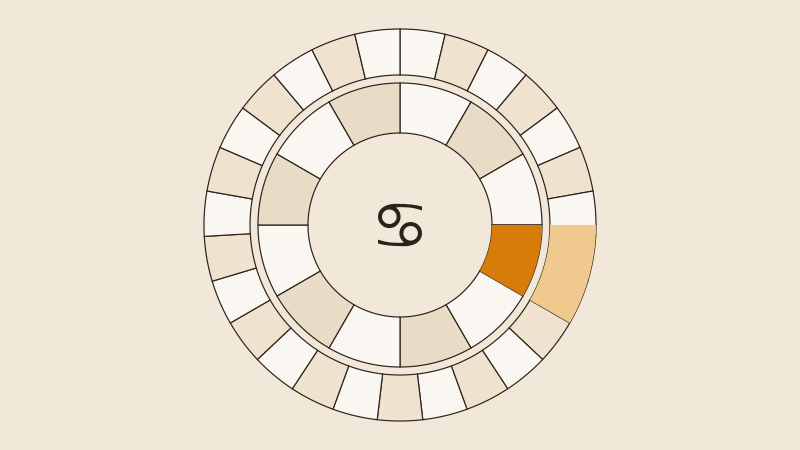
Hasta (also called Hastham in Tamil, Hasta in Telugu, Atham in Malayalam) — 10°00′ Virgo to 23°20′ Virgo, in Virgo; lord Moon; deity Savitar. Lahiri sidereal.
Hasta nakshatra is the thirteenth lunar mansion, from 10°00′ to 23°20′ of Virgo, and it is the star of the hand. Its deity is Savitar, the Sun as the golden-handed inspirer who sets all things in motion each morning; its symbol is an open hand, or a closed fist; its lord is the Moon. The name simply means "hand", and the mansion is everything the hand can do: make, heal, write, hold, steal, bless. It holds the deepest degree of Mercury's exaltation. A person with the Moon here is clever, skilful, quick, humorous and industrious, the one who can fix anything — and whose life is about what the hand reaches for.
Below, Hasta from the ground up: the span and the sign, the four padas and the navamsa each reaches, the Moon and every other planet here, the sub-lords of the Krishnamurti method, the dasha a birth here begins, and the computed sky this Moon is under in 2026–27. The Sanskrit is glossed as we go.
Hasta nakshatra at a glance
| Span | 10°00′ Virgo to 23°20′ Virgo |
| Sign (rashi) | Virgo |
| Lord (star-lord) | Moon |
| Deity | Savitar |
| Symbol | a hand |
| Gana (temperament) | Deva |
| Nature (for muhurta) | Laghu (light, swift) |
| Yoni (animal, for matching) | buffalo (female) |
| Nadi | Adi |
| Name syllables (pada 1–4) | Pu, Sha, Na, Tha |
| Also called | Hastham (Tamil), Hasta (Telugu), Atham (Malayalam) |
| Dasha the Moon here begins | Moon, 10 years |
The story and the symbol
Savitar is the Sun in its morning aspect — not the disc but the impulse, the one who "stimulates", whose golden hands stretch out at dawn and set the whole world to its work. The Gayatri mantra is addressed to him. Hasta is his mansion, and the hand is his hand: the instrument by which intention becomes action, the tool that makes tools. Every craft in the tradition — the potter's, the weaver's, the physician's, the scribe's — is Hasta's, and so is the palm that is read, the gesture that blesses, and the sleight that steals.
The Moon as lord is the surprise, and the point. The Moon is the mind and the mood; Hasta is the mind in the hand — the skill that is felt rather than thought, the craftsman who does not know how he knows. Moon-ruled Hasta in Mercury's sign gives the mansion its quickness, its humour, its cleverness, and its changeability; Hasta people are light on their feet and light in their attachments, and the classical caution is that the hand that makes is also the hand that takes.
Mercury reaches its deepest exaltation at 15°00′ Virgo, inside Hasta's second pada. The mansion is where intelligence is most practical — not the scholar's but the maker's — and its natives are the tradition's artisans, healers and clerks, the people the world runs on.
Which rashi is Hasta nakshatra? (Hasta nakshatra rasi)
Hasta lies entirely inside Virgo (Kanya rashi), from 10°00′ to 23°20′ — the middle of Mercury's sign. A Hasta Moon is a Virgo Moon: exact, analytical, serving, health-minded, critical of self and others. What Hasta adds is the hand — the Virgo precision made physical. The Moon, the star-lord, and Mercury, the sign-lord, are on uneasy terms in the Parashari table (Mercury treats the Moon as an enemy), and the unease is the Hasta signature: the feeling mind inside the exact one, the craftsman who is also anxious, the humorist who is also a critic. The mansion holds Mercury's deepest exaltation at 15°00′, which makes it the strongest place in the zodiac for the planet of skill.
The four padas of Hasta
Every mansion is cut into four quarters, the padas, each 3°20′ wide and each tied to a navamsa sign — the ninth harmonic, the chart of the inner life and the partner. Hasta's padas run Aries, Taurus, Gemini, Cancer.
| Pada | Degrees | Navamsa | Reading |
|---|---|---|---|
| 1 | 10°00′ Virgo – 13°20′ Virgo | Aries | Aries navamsa: the active hand — the surgeon, the soldier, the mechanic. Quick, decisive, competitive; the most physical pada and the most impatient. |
| 2 | 13°20′ Virgo – 16°40′ Virgo | Taurus | Taurus navamsa: the making hand — the craftsman, the artist, the one whose skill becomes wealth. Holds Mercury's deepest exaltation at 15°00′. The most productive and prosperous pada. |
| 3 | 16°40′ Virgo – 20°00′ Virgo | Gemini | Gemini navamsa: the clever hand — the writer, the trader, the juggler, the one with a trick. The wittiest pada and the least constant; the classical placement of the light-fingered. |
| 4 | 20°00′ Virgo – 23°20′ Virgo | Cancer | Cancer navamsa: the healing hand — the nurse, the masseur, the cook, the mother. The Moon's own navamsa in the Moon's own mansion: the most caring pada and the most easily wounded. |
No pada of Hasta is vargottama. The second pada, holding Mercury's deepest exaltation, is the one the tradition singles out for skill and for wealth from skill; the fourth, in Cancer, is where the Moon's lordship is felt most.
Moon in Hasta: the janma nakshatra
Of all the placements, the Moon's nakshatra at birth — the janma nakshatra — is the one that shapes the mind and fixes where the dasha begins. With the Moon in Hasta, the mind is one that works with its hands — often literally, and always in that it thinks by doing. These are the people of skill, industry and humour, quick to learn any craft, quick with a joke, restless when idle, and good in a crisis because they act. They are clever in a practical way, sociable, and inclined to serve; the classical texts give them industriousness, intelligence, shamelessness, drunkenness, and — in the same lists — wealth, mercy, and the ability to make others laugh.
The trait that explains the others is the hand's ambivalence. A Hasta Moon can make and can take; the same dexterity that heals can pick a pocket, and the tradition's harsher lines are about the second hand. The caution in the texts is a lightness — of attachment, of scruple, of mood — that the Moon's lordship gives and Virgo's anxiety complicates. What they have to learn is Savitar's: to let the hand be the instrument of an intention worth having.
The Moon in Mercury's sign gives them changeability. Hasta people are many-skilled and many-mooded, and are happiest when both are used — the craftsman with three trades, the healer who also writes.
Hasta nakshatra female and male natives
The tradition wrote two portraits, one for each sex; they are kept because they are asked for, with the caution that a chart is not a sex.
For a woman, the tradition gives Hasta skill in every domestic and artistic craft, quick intelligence, a sense of humour, modesty, and a capacity for hard work; it describes her as a good manager, devoted to family, and as someone whose hands are never still. The old texts add a caution about restlessness in marriage, and about shyness that reads as coldness.
For a man, the tradition gives Hasta a lean, agile frame, clever hands, a quick tongue, a talent for trade and for craft, and an eye for the opportunity; it describes him as prosperous through work, generous, humorous, and — in the harsher lines — capable of sharp practice. The caution is the light hand, and drink.
Either way, the second pada gives the skill its fullest expression, and Mercury's condition in the chart decides whether the hand serves or takes.
Career, money and health
Work. The hand's mansion gives every craft and trade: carpentry, pottery, weaving, tailoring, jewellery-making, mechanics, engineering of the hands-on kind; the healing arts that use the hands — surgery, massage, physiotherapy, dentistry, the palmist's and the healer's touch; writing, calligraphy, illustration, and every clerical and administrative skill; magic, conjuring and the performing arts of dexterity; and commerce — the merchant's hand that counts. Hasta also does well in agriculture and horticulture, in cooking, and in any work where doing is the qualification.
Money. Comes through skill and work, and comes reliably; the tradition marks Hasta as a mansion of steady rather than sudden wealth. The Taurus pada holds most and earns most; the Gemini pada trades and gambles. The caution is the hand that takes — money by sharp practice is the mansion's classical fall.
Health. Virgo governs the digestion, the intestines and the nervous system, and Hasta adds the hands, arms and fingers. Complaints of the stomach and the nerves are classical, along with injuries to the hands and the illnesses of overwork; the tradition names drink as the mansion's danger. Its first prescription is rest for the hands.
The other planets in Hasta
Any planet in Hasta picks up the mansion's skill and the Moon's changeability, and only then its own nature.
Sun in Hasta. In a neutral sign, in the Moon's mansion. A self that leads by doing; a father who was a craftsman, a clerk or a healer; authority earned through skill. Savitar's own mansion suits the Sun, and this is a competent, industrious placement.
Moon in Hasta. Covered above. In its own mansion.
Mars in Hasta. In an enemy's sign, in a mansion of the hand. Force in the fingers: the surgeon, the mechanic, the martial artist, the soldier who is also an engineer. Quick temper, quick hands; the classical caution is injury.
Mercury in Hasta. Exalted, at its deepest exaltation at 15°00′ in the second pada — the strongest Mercury in the zodiac. Skill, intelligence, speech, trade and craft all at full strength; the tradition's placement for the master artisan, the great physician, the writer whose hand is sure.
Jupiter in Hasta. In an enemy's sign, in the Moon's mansion. Wisdom that is practical; the teacher of crafts, the guru who works with his hands; grace that shows as competence. Not Jupiter's most comfortable placement, but a useful one.
Venus in Hasta. Debilitated in Virgo; the deepest degree of the fall, 27°, is ahead in Chitra, so here the fall is partial. Love expressed as service and craft — the partner who fixes things, the artist of the useful. Beauty in the well-made object rather than the ornament.
Saturn in Hasta. In a friend's sign, in the Moon's mansion. The patient craftsman: the long apprenticeship, the skill mastered over decades, the worker who is honoured late. Saturn steadies the mansion's lightness and can make the hand heavy.
Rahu in Hasta. The hand that wants more: the ambitious artisan, the foreign trade, the sleight of hand at scale. Rahu here is the inventor and the con man, sometimes in one career.
Ketu in Hasta. The hand that has already mastered — skill from before, detachment from its reward. The healer who does not charge; the craftsman with no interest in fame; sometimes the hand that is injured or withdrawn.
Lagna in Hasta. A lean, quick body, expressive hands, a manner that is friendly, humorous and slightly nervous. The lagna lord is Mercury, and its placement decides whether the hand's cleverness is trusted.
A Moon placement is never one story. A Sun in Hasta under the Venus sub and a Sun in Hasta under the Saturn sub are two different fathers, two different careers, two different men — and the Moon rules two other mansions besides this one, each with its own nine subs. That is why a chart is read planet by planet at this level, and why a page can only give you the outline. The nakshatra report takes your own chart and reads every planet in it to the pada and the sub-lord — which mansion, which quarter, whose sub — and says what each placement promises and in which dasha it delivers.
The sub-lords of Hasta
This is the level at which the Krishnamurti method (KP) reads a chart: each nakshatra is cut into nine unequal parts in the proportion of the Vimshottari years, and the lord of the part — the sub-lord — decides what a planet here actually delivers. Two planets in Hasta with different sub-lords give different results. It is the step at which two charts that look alike come apart — where real astrology begins.
| Sub-lord | From | To |
|---|---|---|
| Moon | 10°00′ Virgo | 11°06′40″ Virgo |
| Mars | 11°06′40″ Virgo | 11°53′20″ Virgo |
| Rahu | 11°53′20″ Virgo | 13°53′20″ Virgo |
| Jupiter | 13°53′20″ Virgo | 15°40′ Virgo |
| Saturn | 15°40′ Virgo | 17°46′40″ Virgo |
| Mercury | 17°46′40″ Virgo | 19°40′ Virgo |
| Ketu | 19°40′ Virgo | 20°26′40″ Virgo |
| Venus | 20°26′40″ Virgo | 22°40′ Virgo |
| Sun | 22°40′ Virgo | 23°20′ Virgo |
The sub-lords of Hasta, three of them in particular. The Moon sub at the start (10°00′ to 11°06′40″) is the Moon in its own mansion and its own sub — the most intuitive, most changeable degrees of the star; the hand that knows without thinking. The Jupiter sub (13°53′20″ to 15°40′) holds Mercury's deepest exaltation at 15°00′, and a Mercury there is at the top of the zodiac by dignity under Jupiter's grace by sub — the master's degrees. The Mercury sub (17°46′40″ to 19°40′) is where the mansion's cleverness is most verbal and most commercial, and where the classical "sharp practice" is most likely.
The dasha the Moon here gives
A Moon in Hasta starts life in the Moon mahadasha (10 years), and the balance left at birth is the fraction of Hasta the Moon has still to cross, times 10: a Moon exactly halfway through Hasta has 5 years of Moon left. The order after that is fixed — Mars → Rahu → Jupiter → Saturn → Mercury → Ketu → Venus → Sun — and it is the same for everyone born with the Moon here; what differs is where in it a life is standing at any moment. A Hasta life begins in the ten-year Moon mahadasha, and since most Hasta Moons are born partway through the mansion, the Moon period usually ends in childhood — a changeable, busy childhood, often close to the mother and to the making of things. Then the seven-year Mars, then the eighteen-year Rahu, which typically covers the teens and twenties and is where the hand reaches furthest — ambition, travel, the trade learned abroad. Jupiter's sixteen years usually arrive in the thirties or forties and bring the mastery.
Hasta nakshatra compatibility and marriage life
Three tables decide a nakshatra match: the yoni (the animal), the gana (the temperament) and the nadi (the constitution, which must differ). Hasta is buffalo yoni, deva gana, adi nadi.
Best matches by yoni — the buffalo, whose other mansion is Swati (full marks); then the elephant (Bharani, Revati), the sheep (Krittika, Pushya) and the cow (Uttara Phalguni, Uttara Bhadrapada), each scoring three with the buffalo. Most difficult by yoni — the horse (Ashwini, Shatabhisha), the buffalo's enemy, scoring nothing; the serpent, tiger and lion score one.
By gana — Hasta is deva, which matches deva and manushya well; deva with rakshasa is the classical mismatch. Hasta with Ashwini, Mrigashira, Punarvasu, Pushya, Swati, Anuradha, Shravana and Revati is deva to deva.
By nadi — Hasta is adi nadi. Hasta with Ashwini, Ardra, Punarvasu, Uttara Phalguni, Jyeshta, Mula, Shatabhisha or Purva Bhadrapada is the nadi clash the texts name.
What no table shows: a Hasta native is a useful, humorous, attentive partner who shows love by fixing things, and needs one who does not mistake the lightness for shallowness — and who can sit still beside a person who cannot.
Which pada of Hasta is best, and which is difficult?
None of Hasta's padas is bad; the tradition ranks it a fortunate, skilful mansion. The second pada, in Taurus, holds Mercury's deepest exaltation and is the strongest for skill and wealth. The fourth, in Cancer, is the most caring and the most easily hurt. The first is the quickest and the most accident-prone. The third, in Gemini, is the one the tradition watches — the clever hand, the trick, the placement behind the old lines about sharp practice — and is the one to watch, because its skill needs a conscience.
The sky for Hasta Moons in 2026–27
The figures are computed, Lahiri sidereal, true node; nothing here is quoted from a panchang. Saturn is in the seventh house from your Moon until 3 June 2027, then in the eighth (with a return to the seventh from 20 October 2027 to 23 February 2028) — a dhaiya, the small panoti, for the whole of that stretch. Jupiter, exalted, is in the eleventh house from your Moon until 31 October 2026, previews the twelfth from 31 October to 25 January 2027, returns to the eleventh until 26 June 2027, and then settles in the twelfth. Rahu is in the sixth and Ketu in the twelfth until 25 November 2026; after that Rahu is in the fifth and Ketu in the eleventh for eighteen months. Plainly: a Hasta Moon is not in sade sati, but it is on the edge of the small panoti — partnerships and contracts under Saturn's weight until June 2027, and then the eighth, where the ashtama Shani begins. Jupiter's year is in the house of gains. Venus is retrograde in Virgo — on the Hasta Moon's sign — from 6 to 22 November, turning direct at 28°38′ on the 14th. Mercury, the sign's lord and the mansion's exalted planet, passes through Virgo from 7 to 26 September and then spends its retrograde, 24 October to 13 November, in Libra, the second from your Moon. Mars enters Leo, the twelfth from your Moon, on 12 November and meets Jupiter and Ketu there.
→ Sade Sati · Mars Meets Jupiter in Leo
Remedy and mantra
The classical remedy for an afflicted Hasta placement is worship of Savitar — the Gayatri mantra at dawn is his — and of the Moon as the mansion's lord, with Om Chandraya Namah on Monday; Surya Namaskar, the salutation to the Sun, is the mansion's own practice. Hanuman is worshipped for the hand's strength. The remedy the tradition puts before all others is a craft — the mansion's affliction is the idle hand, or the light one. A remedy — a puja, a gemstone, a rudraksha, a yantra — is prescribed to the chart, and the chart decides which.
Questions we are asked
What is Hasta nakshatra? The thirteenth of the 27 nakshatras, 10°00′ to 23°20′ Virgo, ruled by the Moon, with Savitar as deity and a hand as symbol. It stands for skill, craft, healing, humour and industry.
Hasta nakshatra is which rashi? Virgo (Kanya). The whole nakshatra lies inside Virgo, Mercury's sign.
Who is the lord of Hasta nakshatra? The Moon. The dasha for a Moon here begins with the Moon's ten years, then Mars's seven.
What are the Hasta nakshatra characteristics? Skilful, clever, quick, humorous, industrious, serving, changeable; the one who can fix anything; the hand that makes and, in the old texts, the hand that takes.
Which pada of Hasta is best? The second, in Taurus, holds Mercury's deepest exaltation and is the strongest for skill and wealth. None is bad; the third needs a conscience.
What is the Hasta nakshatra symbol? An open hand — or a closed fist — the instrument of every craft, and the palm that is read.
Is Hasta nakshatra good for marriage? Useful, attentive, humorous partners. Match by yoni (buffalo), gana (deva) and nadi (adi); the buffalo–horse pairing is the pairing the table puts at zero.
Is Mercury exalted in Hasta? Yes — Mercury's exaltation is Virgo, and its deepest point, 15°00′, is in Hasta's second pada. Mercury in Hasta is the strongest Mercury in the zodiac.
What does 2026 hold for Hasta nakshatra? Saturn in the seventh from the Moon until June 2027, then the eighth; Jupiter in the eleventh; Venus retrograde in Virgo from 6 to 22 November. The computed sky is above.
Read this as education. It is not medical, legal or financial advice, and no single nakshatra is a chart.
A page can map Hasta; only a consultation can read your Moon, lagna, sub-lords and dasha in it together, with the questions you actually have.
→ Book a private consultation · Reading the Nakshatra, Not the Sign · Paper C, Nakshatras · ← Uttara Phalguni · Chitra →