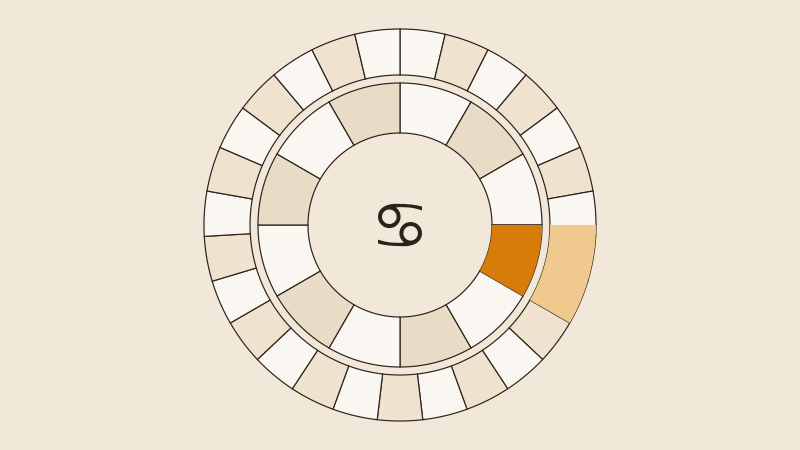
Anuradha (also called Anusham in Tamil, Anuradha in Telugu, Anizham in Malayalam, also written Anusham) — 3°20′ Scorpio to 16°40′ Scorpio, in Scorpio; lord Saturn; deity Mitra. Lahiri sidereal.
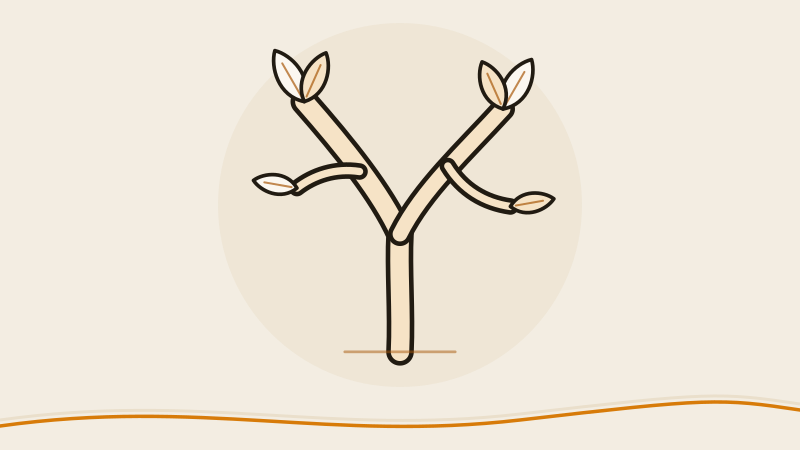
Anuradha nakshatra is the seventeenth lunar mansion, from 3°20′ to 16°40′ of Scorpio, and it is the star of the friend. Its deity is Mitra, the god of friendship, alliance and the kept agreement, Varuna's gentle twin; its symbol is a lotus, or an archway of victory; its lord is Saturn. The name means "following Radha", "the one after the success" — Radha being another name for Vishakha, the mansion before it — and Anuradha is what comes after the goal: the alliance, the devotion, the loyalty that outlasts the triumph. A person with the Moon here is loyal, devoted, disciplined and warm under a serious surface, the friend who stays when the arch has been passed.
What follows is our reading of Anuradha: the span and the sign, the four padas and the navamsa each reaches, the Moon and every other planet here, the sub-lords of the Krishnamurti method, the dasha a birth here begins, and the computed sky this Moon is under in 2026–27. Sanskrit terms are explained on first use.
Anuradha nakshatra at a glance
| Span | 3°20′ Scorpio to 16°40′ Scorpio |
| Sign (rashi) | Scorpio |
| Lord (star-lord) | Saturn |
| Deity | Mitra |
| Symbol | a lotus; an archway of victory |
| Gana (temperament) | Deva |
| Nature (for muhurta) | Mridu (soft) |
| Yoni (animal, for matching) | deer (female) |
| Nadi | Madhya |
| Name syllables (pada 1–4) | Na, Ni, Nu, Ne |
| Also called | Anusham (Tamil), Anuradha (Telugu), Anizham (Malayalam) |
| Dasha the Moon here begins | Saturn, 19 years |
The story and the symbol
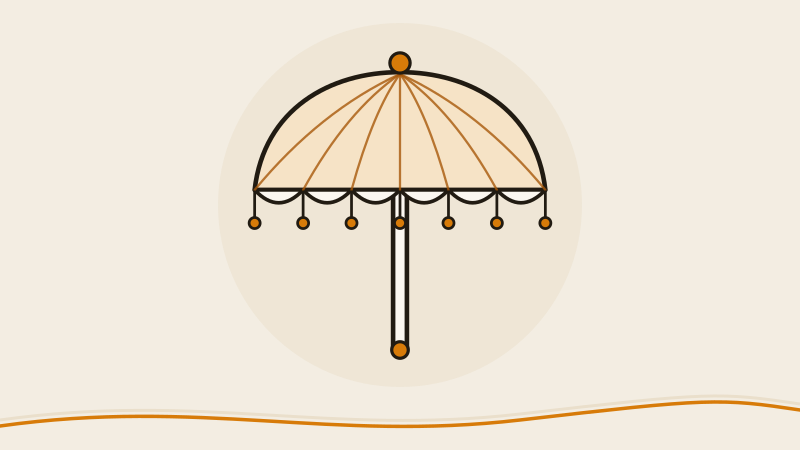
Mitra is one of the Adityas and the oldest of the gods of the bond — his name is the word for friend, and the treaties of the ancient world were sworn by him. Where Varuna, his twin, is the law that binds by fear, Mitra is the agreement that binds by affection: the alliance freely kept, the loyalty that is not enforced. Anuradha is his mansion, and the lotus is its symbol because the lotus opens in mud and stays clean — devotion that grows in a difficult place. The archway of victory is the other symbol, and the tradition reads it as Vishakha's arch seen from the far side: the goal is behind; what remains is who walked through it with you.
Saturn as lord is the discipline in the devotion. Saturn is duty, endurance, the long haul; in Mitra's mansion it becomes the loyalty that is kept for decades, the friendship that survives distance and disagreement, the alliance that does the work. Anuradha natives are the tradition's organisers and devotees — the people who build the group, keep the temple, hold the team together — and their shadow is Saturn's: the loyalty that becomes servitude, the devotion that cannot leave.
The mansion lies in Scorpio, where the Moon falls, and it is the tradition's answer to the fall: a debilitated Moon in Anuradha, under Saturn and Mitra, is the tradition's picture of the heart that suffers and stays faithful. The fourth pada is vargottama, and the texts read it as the mansion's purest form.
Which rashi is Anuradha nakshatra? (Anuradha nakshatra rasi)
Anuradha lies entirely inside Scorpio (Vrishchika or Vrishchik rashi), from 3°20′ to 16°40′ — the middle of Mars's fixed sign. An Anuradha Moon is a Scorpio Moon: intense, private, loyal, transformative, and debilitated — the Moon's fall is Scorpio, though its deepest degree, 3°00′, is just behind this mansion in Vishakha. What Anuradha adds is Mitra's warmth and Saturn's discipline to the Scorpio depth: the intensity turned to devotion, the privacy turned to loyalty. Saturn, the star-lord, and Mars, the sign-lord, are enemies in the Parashari table — the two malefics, the slow and the fast — and the friction is the Anuradha signature: the passion held under discipline, the fighter who serves, the friend who is also a soldier.
The four padas of Anuradha
Four padas of 3°20′ make up every nakshatra; each one maps to a navamsa sign, the ninth division of the chart, where the inner life and the marriage are read. Anuradha's padas run Leo, Virgo, Libra, Scorpio, and the fourth is vargottama.
| Pada | Degrees | Navamsa | Reading |
|---|---|---|---|
| 1 | 3°20′ Scorpio – 6°40′ Scorpio | Leo | Leo navamsa: the leading friend — the organiser, the one who holds the group by warmth and by standing. The most confident pada; the captain of the alliance. |
| 2 | 6°40′ Scorpio – 10°00′ Scorpio | Virgo | Virgo navamsa: the serving friend — the devotee who does the work, keeps the accounts, tends the temple. The most disciplined pada and the most reliable. |
| 3 | 10°00′ Scorpio – 13°20′ Scorpio | Libra | Libra navamsa: the diplomatic friend — the maker of alliances, the peacemaker between allies, the partner. The most relational pada; the one most drawn to marriage as the great friendship. |
| 4 | 13°20′ Scorpio – 16°40′ Scorpio | Scorpio | Scorpio navamsa: vargottama — Scorpio in both the rashi and the navamsa. The purest Anuradha: loyalty at full depth, devotion at full intensity, the friend who would go into the fire. The strongest pada and the most demanding. |
The fourth pada, being vargottama, is where Anuradha's devotion and its intensity are both least diluted — and where the debilitated Moon, doubled by the navamsa, feels most. The second is the mansion's workroom.
Moon in Anuradha: the janma nakshatra
Janma nakshatra means the mansion the Moon occupied at birth: the mind's own star, and the start of the dasha count. A Moon in Anuradha is a mind that keeps faith. The natives are people of loyalty and devotion, who build and hold groups — the team, the order, the circle of friends, the family — and who are trusted because they do not leave; who are disciplined, hard-working and serious on the surface and warm beneath it; who can live abroad and make a home there; and who feel deeply and show it late. The texts assign them wealth, a life in a foreign land, an inability to bear hunger, and a fondness for travel — along with devotion to the gods and to friends.
The deeper mark is Mitra's: the alliance freely kept. An Anuradha Moon chooses its people and stays with them, and its intensity — the Scorpio Moon's — goes into the staying. The tradition's warning is Saturn's: the loyalty that becomes bondage, the devotion that will not see the beloved's faults, the friend who is used because they will not go. The work of the placement is discernment — Mitra's bond is between equals, and the mansion's people have to learn to require it.
The debilitated Moon gives the mansion its suffering and its depth. Anuradha Moons have often been through something — a loss, a betrayal, a long trial — and it made them the reliable ones. For them the lotus in the mud is not a metaphor; it is a description.
Anuradha nakshatra female and male natives
Because the queries ask for it, the texts' separate portraits of the woman and the man of this star are kept, with the caution that a chart is not a sex.
For a woman, the tradition gives Anuradha a serious, devoted nature, loyalty to family and friends, a capacity for hard work, religious feeling, and a warmth that shows itself in acts rather than words; it describes her as a faithful partner, a good organiser of others, and as someone who suffers in silence and stays. The old texts add a caution about the in-laws and about a marriage that asks more than it gives.
For a man, the tradition gives Anuradha a strong, compact frame, a disciplined manner, courage, prosperity through effort and often abroad, and a loyalty that makes him the friend everyone calls; it describes him as devoted to his group and its leader, slow to trust and slower to leave. The caution is the servant's — the loyalty that is exploited — and a melancholy that Saturn on a fallen Moon gives.
In each case, the fourth pada deepens every line, since the vargottama Scorpio doubles the Moon's fall and its devotion together.
Career, money and health
Work. Mitra's mansion under Saturn gives the professions of the group and the bond: organisation and management, especially of teams and institutions; the armed forces and the police — the disciplined alliance; diplomacy and foreign service — the tradition names a life abroad as Anuradha's own; religious orders, ashrams, devotional service; counselling and social work — the friend as profession; and the occult sciences, which Scorpio adds. The lotus gives the professions of growth in difficulty — psychology, rehabilitation, the work of the mud. Anuradha also does well in mining and in any work that is done underground or in secret for a cause.
Money. Comes through effort, loyalty and often through the foreign — the tradition marks Anuradha as prosperous abroad — and is kept with Saturn's care. The Virgo pada holds most. The caution is the money given to the group, the order, the friend, past what was wise.
Health. Scorpio governs the reproductive organs, the excretory system and the nose; Anuradha adds the mind's weather — the debilitated Moon's. Complaints of the lower abdomen, of the nose and throat, and of depression under Saturn's weight are classical; the texts' "inability to bear hunger" is read as a digestion that needs regular feeding. The first prescription, in the old texts, is company — the mansion's remedy is its own deity.
The other planets in Anuradha
A planet placed in Anuradha inherits the mansion's loyalty and Saturn's endurance, before its own nature shows.
Sun in Anuradha. In a friend's sign, in the mansion of its enemy Saturn. A self that leads by loyalty; a father who was disciplined, distant, or abroad; authority earned through the group. The Sun and Saturn are father and son and do not agree, and this Sun is respected rather than loved.
Moon in Anuradha. Read above, under the janma nakshatra. Debilitated, past its deepest degree.
Mars in Anuradha. In its own sign, in the mansion of its enemy Saturn. The soldier's Mars — force under discipline, courage in the alliance's cause, the fighter who serves. Strong, and held; the classical caution is the anger that is kept too long.
Mercury in Anuradha. In a neutral sign, in Saturn's mansion, with which Mercury works well. The organiser's mind: careful, loyal, good with the group's accounts and its secrets. Speech that is measured and trusted.
Jupiter in Anuradha. In a friend's sign, in the mansion of its enemy Saturn. Wisdom as devotion; the teacher of an order, the guru of the faithful; faith kept through difficulty. Uneven for ease, strong for depth.
Venus in Anuradha. In a neutral sign, in the mansion of its friend Saturn. Love as loyalty: the long marriage, the friend who becomes the partner, the affection that does not show off. A faithful Venus with a Scorpio depth; the classical caution is jealousy held quietly.
Saturn in Anuradha. In its own mansion, in the sign of its enemy Mars. Endurance at full strength in a hard place: the devotee of decades, the soldier of the long war, the builder of the order. Saturn here is the mansion's own weight, and it holds.
Rahu in Anuradha. The bond with the foreign: the alliance abroad, the group that is not one's own, the devotion to an unconventional cause. Rahu in Saturn's mansion is disciplined by it and drawn to the strange.
Ketu in Anuradha. Detachment from the bond: the friend who withdraws, the devotee who has already given everything, the renunciate of the order. Often a placement of solitary devotion.
Lagna in Anuradha. A compact, strong frame, a serious face, a manner that is reserved and dependable. The lagna lord is Mars, and its placement decides whether the loyalty is a strength or a chain.
Two people with the Moon in Anuradha can have nothing else in common: one has it in the first pada under the Saturn sub, the other in the fourth under Mercury's, and the same star gives them different minds, different dashas, different marriages. The paragraphs above are the mansion; the person is the combination. A nakshatra report reads that combination for your chart — every planet's nakshatra, pada and sub-lord, and the dasha the Moon starts — so that what this page says in general becomes what is true of you.
The sub-lords of Anuradha
This is the level at which the Krishnamurti method (KP) reads a chart: each nakshatra is cut into nine unequal parts in the proportion of the Vimshottari years, and the lord of the part — the sub-lord — decides what a planet here actually delivers. Two planets in Anuradha with different sub-lords give different results. It is the step at which two charts that look alike come apart — where real astrology begins.
| Sub-lord | From | To |
|---|---|---|
| Saturn | 3°20′ Scorpio | 5°26′40″ Scorpio |
| Mercury | 5°26′40″ Scorpio | 7°20′ Scorpio |
| Ketu | 7°20′ Scorpio | 8°06′40″ Scorpio |
| Venus | 8°06′40″ Scorpio | 10°20′ Scorpio |
| Sun | 10°20′ Scorpio | 11°00′ Scorpio |
| Moon | 11°00′ Scorpio | 12°06′40″ Scorpio |
| Mars | 12°06′40″ Scorpio | 12°53′20″ Scorpio |
| Rahu | 12°53′20″ Scorpio | 14°53′20″ Scorpio |
| Jupiter | 14°53′20″ Scorpio | 16°40′ Scorpio |
Three places in Anuradha's sub-lord table matter more than the rest. The Saturn sub at the start (3°20′ to 5°26′40″) is Saturn in its own mansion and its own sub, just past the Moon's deepest fall: the most enduring, most burdened degrees of the star — the devotee who carries the temple. The Venus sub (8°06′40″ to 10°20′) is where Mitra's warmth is most felt; a planet there loves openly, which the mansion otherwise does not. The Jupiter sub at the end (14°53′20″ to 16°40′) sits inside the vargottama fourth pada, and a planet there has the mansion's devotion at full depth under the guru's grace — the tradition's picture of the disciple who is also blessed.
The dasha the Moon here gives
A Moon in Anuradha starts life in the Saturn mahadasha (19 years), and the balance left at birth is the fraction of Anuradha the Moon has still to cross, times 19: a Moon exactly halfway through Anuradha has 9.5 years of Saturn left. The order after that is fixed — Mercury → Ketu → Venus → Sun → Moon → Mars → Rahu → Jupiter — and it is the same for everyone born with the Moon here; what differs is where in it a life is standing at any moment. An Anuradha life begins in the nineteen-year Saturn mahadasha, and since most Anuradha Moons are born partway through the mansion, Saturn usually runs through childhood and into the teens — a serious, sometimes hard childhood, with duty in it early and often a distance from home. Then the seventeen-year Mercury, which typically covers the twenties and thirties: the working years, the organising, the life abroad the texts promise. Ketu's seven and Venus's twenty usually arrive in the forties and fifties, and the Venus period is where the mansion's loyalty is returned.
Anuradha nakshatra compatibility and marriage life
The tradition matches by three tables — the yoni (the animal), the gana (the temperament) and the nadi (the constitution, which must differ). Anuradha is deer yoni, deva gana, madhya nadi.
Best matches by yoni — the deer, whose other mansion is Jyeshta (full marks); no other animal scores three with the deer, and the elephant, sheep, serpent, cat, rat, cow, buffalo, monkey and mongoose score two. Most difficult by yoni — the dog (Ardra, Mula), the deer's enemy, scoring nothing; the horse, tiger and lion score one.
By gana — Anuradha is deva, which matches deva and manushya well; deva with rakshasa is the classical mismatch. Anuradha with Ashwini, Mrigashira, Punarvasu, Pushya, Hasta, Swati, Shravana and Revati is deva to deva.
By nadi — Anuradha is madhya nadi. Anuradha with Bharani, Mrigashira, Pushya, Purva Phalguni, Chitra, Purva Ashadha, Dhanishta or Uttara Bhadrapada is nadi dosha in the classical count.
Off the tables: this is Mitra's star, the friend's, and its natives are the tradition's most loyal partners — the marriage that is a friendship first. They need a partner who returns the loyalty in kind, and who can see when it has become a burden before they do.
Which pada of Anuradha is best, and which is difficult?
Anuradha has no bad pada; the tradition ranks it among the gentler mansions — mridu, soft, by nature — and reads every quarter kindly. The fourth pada, vargottama, is the strongest and the most intense: the purest devotion, and the deepest feeling, since the fallen Moon is doubled there. The second, in Virgo, is the most dependable. The third, in Libra, is the best for marriage. The first, in Leo, is the most confident. If the question is "which pada needs care", it is the fourth, for the weight it can carry; if it is "which is best", the same answer.
The sky for Anuradha Moons in 2026–27
Every date below was calculated with the Swiss Ephemeris (Lahiri, true node), not recalled. Saturn is in the fifth house from your Moon until 3 June 2027, then in the sixth (with a return to the fifth from 20 October 2027 to 23 February 2028). Jupiter, exalted, is in the ninth house from your Moon until 31 October 2026, previews the tenth from 31 October to 25 January 2027, returns to the ninth until 26 June 2027, and then settles in the tenth. Rahu is in the fourth and Ketu in the tenth until 25 November 2026; after that Rahu is in the third and Ketu in the ninth for eighteen months. In everyday terms: an Anuradha Moon is not in sade sati, and this is a steady year. Saturn, the mansion's own lord, is in the fifth from the Moon until June 2027 — children, intelligence, the heart's projects, under Saturn's discipline — and then in the sixth, where Saturn's transit clears debts and rivals. Jupiter's year is in the ninth — fortune and faith, one of its best transits — with work previewed over the winter; Rahu moves from the fourth to the third on 25 November. Mars, the sign's lord, enters Leo — the tenth from your Moon, the house of work — on 12 November and meets Jupiter and Ketu there: a good week for the alliance's business, and the mansion's own theme.
→ Sade Sati · Mars Meets Jupiter in Leo
Remedy and mantra
The classical remedy for an afflicted Anuradha placement is worship of Mitra — through the Sun at dawn, since Mitra is the morning Sun, with the Aditya Hridayam or the Mitra hymns — and of Saturn as the mansion's lord, with Om Shanaishcharaya Namah on Saturday and the Hanuman Chalisa, which the tradition holds to soften Saturn. Radha–Krishna are worshipped for the mansion's devotion. Before any rite the tradition prescribes a friendship tended — the mansion's affliction is the bond neglected or the bond that has become a burden, and both are mended by the same act. A remedy — a puja, a gemstone, a rudraksha, a yantra — is prescribed to the chart, and the chart decides which.
Questions we are asked
What is Anuradha nakshatra? The seventeenth of the 27 nakshatras, 3°20′ to 16°40′ Scorpio, ruled by Saturn, with Mitra — the god of friendship — as deity and a lotus, or an archway of victory, as symbol. It stands for loyalty, devotion, alliance, and the friendship that follows the goal.
Anuradha nakshatra is which rashi? Scorpio (Vrishchika, or Vrishchik rashi). The whole nakshatra lies inside Scorpio, Mars's fixed sign.
Who is the lord of Anuradha nakshatra? Saturn. The dasha for a Moon here begins with Saturn's nineteen years, then Mercury's seventeen.
What are the Anuradha nakshatra characteristics? Loyal, devoted, disciplined, hard-working, private, warm beneath a serious surface; prosperous abroad; the friend who stays.
Which pada of Anuradha is best? The fourth, in Scorpio, is vargottama and the strongest — and the most intense. None is bad; the second is the most dependable, the third the best for marriage.
What is the Anuradha nakshatra symbol? A lotus — devotion that grows clean out of mud — or an archway of victory, Vishakha's arch seen from the far side.
Is Anuradha nakshatra good for marriage? Among the most loyal, by the tradition's ranking — the marriage that is a friendship first. Match by yoni (deer), gana (deva) and nadi (madhya); the deer–dog pairing is the one the table scores lowest.
Is the Moon debilitated in Anuradha? Yes — the Moon's fall is Scorpio, and Anuradha is in Scorpio; the deepest point, 3°00′, is just before the mansion in Vishakha. The tradition reads Anuradha as the fallen Moon's most faithful form.
What does 2026 hold for Anuradha nakshatra? Saturn, the lord, in the fifth from the Moon until June 2027, then the sixth; Jupiter in the ninth for most of the year; Mars, Jupiter and Ketu together in the tenth in mid-November. The computed sky is above.
This is teaching, not advice — not medical, legal or financial — and a nakshatra is one line of a chart, never the whole of it.
To have your Anuradha placements read as one chart — the Moon, the lagna, the sub-lords, the dasha — is what a private consultation is for.
→ Book a private consultation · Reading the Nakshatra, Not the Sign · Paper C, Nakshatras · ← Vishakha · Jyeshta →