Dhanishta (also called Avittam in Tamil, Dhanishta in Telugu, Avittam in Malayalam, also written Dhanishtha or Avittam) — 23°20′ Capricorn to 6°40′ Aquarius, in Capricorn and Aquarius; lord Mars; deity the eight Vasus. Lahiri sidereal.
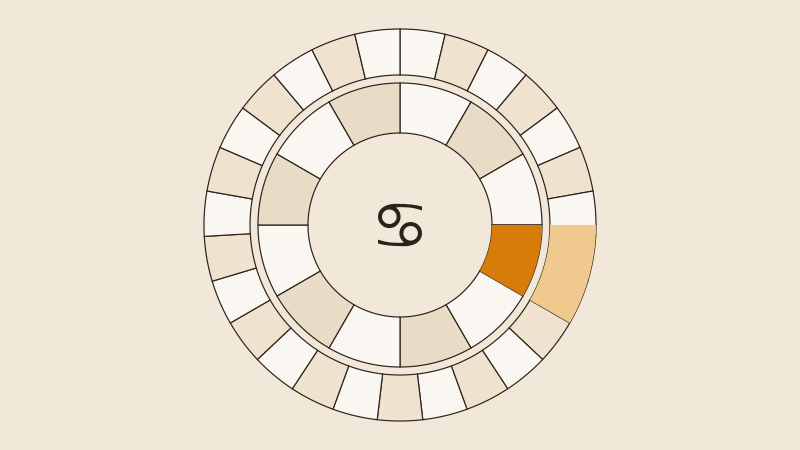
Dhanishta nakshatra (also written Dhanishtha) is the twenty-third lunar mansion, from 23°20′ Capricorn to 6°40′ Aquarius — the eighth of the nine that straddle two signs. Its deities are the eight Vasus, the gods of the elements who attend Indra and give the world its substance; its symbol is a drum, or a flute; its lord is Mars. The name means "the wealthiest", "the most bountiful", and the mansion is wealth in the Vasus' sense — the substance of things, the rhythm that holds them together, the music that is made by keeping time. It holds the deepest degree of Mars's exaltation. A person with the Moon here is capable, rhythmic, generous, ambitious and a little hollow at the centre, like the drum — the one who provides, performs and keeps the beat, and whose lesson is what the beat is for.
Below, Dhanishta from the ground up: the two-sign span, the four padas and the navamsa each reaches, the Moon and every other planet here, the sub-lords of the Krishnamurti method, the dasha a birth here begins, and the computed sky this Moon is under in 2026–27. The Sanskrit is glossed as we go.
Dhanishta nakshatra at a glance
| Span | 23°20′ Capricorn to 6°40′ Aquarius |
| Sign (rashi) | Capricorn and Aquarius |
| Lord (star-lord) | Mars |
| Deity | the eight Vasus |
| Symbol | a drum; a flute |
| Gana (temperament) | Rakshasa |
| Nature (for muhurta) | Chara (movable) |
| Yoni (animal, for matching) | lion (female) |
| Nadi | Madhya |
| Name syllables (pada 1–4) | Ga, Gi, Gu, Ge |
| Also called | Avittam (Tamil), Dhanishta (Telugu), Avittam (Malayalam) |
| Dasha the Moon here begins | Mars, 7 years |
The story and the symbol
The eight Vasus are the gods of the world's substance: earth, water, fire, air, sky, the Moon, the Sun and the stars, in the Puranic list — the "dwellers", the things that abide. They attend Indra, they give the sacrifice its material, and in the Mahabharata they are cursed to be born as men, the last of them as Bhishma, the grandfather of the epic, who kept his vow for a lifetime and chose the hour of his own death. Dhanishta is the Vasus' mansion, and its wealth is theirs: not gold alone but the material of a life — property, position, the body's strength, the skill that earns. The drum is the symbol because a drum is hollow, and the hollowness is where the sound comes from; the flute is the other, for the same reason. Its people make music by being empty in the right place.
Mars as lord gives the beat and the drive. Mars is force, rhythm, the pulse; in the Vasus' mansion it becomes the athlete's timing, the musician's tempo, the entrepreneur's push. Dhanishta natives are the tradition's performers, providers and soldiers of fortune, and their shadow is the drum's: the hollowness felt as loneliness, the wealth that does not fill, the beat kept for others and never for themselves.
The mansion straddles Capricorn and Aquarius, Saturn's two signs, and holds Mars's deepest exaltation at 28°00′ Capricorn in its first pada — force at its most disciplined and most effective, the general in Saturn's army. The tradition also marks Dhanishta as the mansion that once held the winter solstice, when the Vedic year began here: the drum that started the count.
Which rashi is Dhanishta nakshatra? (Dhanishta nakshatra rasi)
Dhanishta straddles two signs, both Saturn's. Its first and second padas are in Capricorn (Makara or Makar rashi), 23°20′ to 30°00′, and its third and fourth padas are in Aquarius (Kumbha or Kumbh rashi), 0°00′ to 6°40′. So a Dhanishta Moon in the first two padas is a Capricorn Moon — earthy, cardinal, disciplined, ambitious — with Mars as star-lord giving the discipline a drive: this is the Dhanishta that builds a fortune. A Dhanishta Moon in the last two padas is an Aquarius Moon — airy, fixed, humanitarian, detached — with Mars giving the detachment a cause: this is the Dhanishta that plays for the crowd. Mars and Saturn, the star-lord and the sign-lord throughout, are enemies in the Parashari table — the fast and the slow, the fire and the weight — and the friction is the Dhanishta signature: the drive held to a rhythm, the ambition that keeps time. The mansion holds Mars's deepest exaltation at 28°00′ Capricorn.
The four padas of Dhanishta
Every mansion is cut into four quarters, the padas, each 3°20′ wide and each tied to a navamsa sign — the ninth harmonic, the chart of the inner life and the partner. Dhanishta's padas run Leo, Virgo, Libra, Scorpio, with the sign boundary between the second and third.
| Pada | Degrees | Navamsa | Reading |
|---|---|---|---|
| 1 | 23°20′ Capricorn – 26°40′ Capricorn | Leo | Leo navamsa, in Capricorn: the royal drum — the performer, the provider who is also the head of the table. Holds Mars's deepest exaltation at 28°00′. The most commanding pada and the most generous. |
| 2 | 26°40′ Capricorn – 0°00′ Aquarius | Virgo | Virgo navamsa, in Capricorn: the working drum — the musician who practises, the athlete who trains, the wealth made by exactness. The most disciplined pada and the tradition's favourite for money. |
| 3 | 0°00′ Aquarius – 3°20′ Aquarius | Libra | Libra navamsa, in Aquarius: the ensemble drum — the player in the band, the partner in the firm, the beat kept with others. The most relational pada and the most sociable. |
| 4 | 3°20′ Aquarius – 6°40′ Aquarius | Scorpio | Scorpio navamsa, in Aquarius: the hidden drum — the rhythm kept in secret, the wealth from the unseen, the performer with a private grief. The most intense pada and the one the tradition watches for the hollowness. |
No pada of Dhanishta is vargottama. The first pada holds Mars's exact exaltation and is the mansion's seat of power; the fourth is where the drum's emptiness is most felt.
Moon in Dhanishta: the janma nakshatra
Of all the placements, the Moon's nakshatra at birth — the janma nakshatra — is the one that shapes the mind and fixes where the dasha begins. With the Moon in Dhanishta, the mind is one that keeps time. These are the people of capability and rhythm — musicians, often; athletes; providers; the ones who run the household's economy or the firm's — who are generous with what they earn and ambitious for more, who are brave, and who have a gift for timing in every field. They are sociable in the performer's way and private underneath it. The classical lists give them wealth, generosity, a love of music, courage, and — in the caution — greed, and a coldness to their own family.
The trait that explains the others is the drum's: the hollowness. A Dhanishta Moon provides and performs and keeps everyone's beat, and can come home to an empty centre — the tradition's harsher lines about marital difficulty and family distance belong here. The caution in the texts is exactly that: the wealth gathered to fill the hollow, the beat kept to avoid the silence. What they have to learn is the flute's: to let the emptiness be the place the music comes from, rather than the thing to be filled.
Mars in Saturn's signs gives the mansion's people their discipline and their drive together — the athlete's Mars, the exalted Mars of the first pada. Dhanishta Moons are the tradition's late and substantial earners, and its natural performers.
Dhanishta nakshatra female and male natives
The tradition wrote two portraits, one for each sex; they are kept because they are asked for, with the caution that a chart is not a sex — and, for Dhanishta, that the old texts' lines about marriage describe the drum's hollowness, not a fate.
For a woman, the tradition gives Dhanishta capability, ambition, a talent for music or dance, generosity, and a manner that is sociable in public and reserved at home; it describes her as a good earner and manager, brave, and as someone whose marriage may be delayed or tested by her own drive. The caution is greed, and a distance from the family she provides for.
For a man, the tradition gives Dhanishta a strong, athletic frame, a love of music and of rhythm, courage, generosity, and a wealth that comes through his own timing — in business, in sport, in the arts; it describes him as a natural performer, an ambitious provider, and as someone who is admired more than he is known. The caution is the hollowness — the man who fills the house and is absent from it.
Either way, the Capricorn padas give Saturn's discipline to the drive and the Aquarius padas give it a crowd.
Career, money and health
Work. The Vasus' mansion under Mars gives the professions of rhythm and substance: music, especially percussion and every instrument that keeps time; dance; sport, above all the timed and the team sports; the military — the drum is the army's; and wealth-making of the substantial kind — real estate, construction, mining, the material trades. Mars adds engineering, surgery, and the professions of force; Saturn's signs add management and the long build. Dhanishta also does well in finance, in performance of every kind, and in any work where timing is the skill.
Money. Comes substantially and through the native's own drive and timing; the tradition names Dhanishta "the wealthiest" and reads its natives as prosperous in the second half of life. The Virgo pada keeps most; the Leo pada earns most and spends on display. The caution is the mansion's classical word, greed — the drum beaten to fill itself.
Health. The Capricorn padas govern the knees and the bones; the Aquarius padas the ankles, the calves and the circulation. Complaints of the knees and ankles from the athlete's use, of the bones under Saturn, and of the blood under Mars are classical, along with the injuries of force. Before any medicine the tradition orders rest between performances.
The other planets in Dhanishta
Any planet in Dhanishta picks up the mansion's rhythm and Mars's drive, then Saturn's weight from the signs, then its own nature. The sign changes the reading at the second-pada boundary.
Sun in Dhanishta. In the signs of its enemy Saturn throughout, in the mansion of its friend Mars. A self that performs its authority; a father who was a provider, a soldier, or a musician; standing earned by timing against a heavy sign. Strong for leadership in the arts and in sport.
Moon in Dhanishta. Covered above.
Mars in Dhanishta. In its own mansion, exalted in the Capricorn padas — and at its deepest exaltation at 28°00′ in the first pada, the strongest Mars in the zodiac. The general, the champion, the master drummer: force disciplined to perfect timing. In the Aquarius padas, in a neutral sign, the force is for the crowd and the cause.
Mercury in Dhanishta. In a neutral sign throughout, in Mars's mansion. The composer's mind, the strategist's, the accountant of the fortune: quick, rhythmic, exact. Good for music, for trade and for the professions of timing.
Jupiter in Dhanishta. Debilitated in the Capricorn padas, past its deepest degree; in a neutral sign in Aquarius; in the mansion of its friend Mars. Wisdom that provides; the teacher of music, the guru of the material; faith earned through work. Uneven for ease, useful for wealth.
Venus in Dhanishta. In a friend's sign throughout, in Mars's mansion. Love with a beat: the marriage of performers, the romance with a rhythm to it; beauty in music and in strength. A passionate Venus; the classical caution is the hollow behind the show.
Saturn in Dhanishta. In its own sign throughout, in the mansion of its enemy Mars. Discipline at full strength on the drive: the athlete of decades, the musician who practised for forty years, the fortune built by keeping time. Saturn here is the drum's tension, and it holds.
Rahu in Dhanishta. The hunger for substance: the fortune without a ceiling, the fame from performance, the foreign wealth. Rahu in Mars's mansion in Saturn's signs is ambitious, disciplined and never full.
Ketu in Dhanishta. The drum set down: detachment from wealth and from performance, the musician who plays alone, the provider who has stopped needing to be thanked. Often a placement of the hollow accepted.
Lagna in Dhanishta. A strong, athletic, well-proportioned frame, a confident face, a manner that is generous in company and reserved in private. In the Capricorn padas the lagna lord is Saturn, and so it is in Aquarius — the difference is the co-lordship of Rahu in the Aquarius padas, which adds the crowd.
Two people with the Moon in Dhanishta can have nothing else in common: one has it in the first pada under the Mars sub, the other in the fourth under Mercury's, and the same star gives them different minds, different dashas, different marriages. The paragraphs above are the mansion; the person is the combination. A nakshatra report reads that combination for your chart — every planet's nakshatra, pada and sub-lord, and the dasha the Moon starts — so that what this page says in general becomes what is true of you.
The sub-lords of Dhanishta
This is the level at which the Krishnamurti method (KP) reads a chart: each nakshatra is cut into nine unequal parts in the proportion of the Vimshottari years, and the lord of the part — the sub-lord — decides what a planet here actually delivers. Two planets in Dhanishta with different sub-lords give different results. It is the step at which two charts that look alike come apart — where real astrology begins.
| Sub-lord | From | To |
|---|---|---|
| Mars | 23°20′ Capricorn | 24°06′40″ Capricorn |
| Rahu | 24°06′40″ Capricorn | 26°06′40″ Capricorn |
| Jupiter | 26°06′40″ Capricorn | 27°53′20″ Capricorn |
| Saturn | 27°53′20″ Capricorn | 0°00′ Aquarius |
| Mercury | 0°00′ Aquarius | 1°53′20″ Aquarius |
| Ketu | 1°53′20″ Aquarius | 2°40′ Aquarius |
| Venus | 2°40′ Aquarius | 4°53′20″ Aquarius |
| Sun | 4°53′20″ Aquarius | 5°33′20″ Aquarius |
| Moon | 5°33′20″ Aquarius | 6°40′ Aquarius |
The sub-lords of Dhanishta, three of them in particular. The Mars sub at the start (23°20′ to 24°06′40″ Capricorn) is Mars in its own mansion and its own sub in the sign of its exaltation — the most forceful, most disciplined degrees of the star. The Saturn sub (27°53′20″ Capricorn to 0°00′ Aquarius) holds Mars's deepest exaltation at 28°00′ and ends on the sign boundary; a Mars there is at the top of the zodiac by dignity under Saturn's discipline by sub — the tradition's picture of the general who keeps time, and the mansion's strongest degrees. The Venus sub (2°40′ to 4°53′20″ Aquarius) is where the drum becomes the flute: the mansion's most musical and most sociable degrees.
The dasha the Moon here gives
A Moon in Dhanishta starts life in the Mars mahadasha (7 years), and the balance left at birth is the fraction of Dhanishta the Moon has still to cross, times 7: a Moon exactly halfway through Dhanishta has 3.5 years of Mars left. The order after that is fixed — Rahu → Jupiter → Saturn → Mercury → Ketu → Venus → Sun → Moon — and it is the same for everyone born with the Moon here; what differs is where in it a life is standing at any moment. A Dhanishta life begins in the seven-year Mars mahadasha, and since most Dhanishta Moons are born partway through the mansion, Mars usually ends in early childhood — an active, competitive beginning, sometimes with an injury or a loss in it. Then the eighteen-year Rahu, which typically covers the school years and the twenties: the long ambition, the training, the hunger for substance, often abroad. Jupiter's sixteen years usually arrive in the thirties and bring the wealth the mansion is named for.
Dhanishta nakshatra compatibility and marriage life
Three tables decide a nakshatra match: the yoni (the animal), the gana (the temperament) and the nadi (the constitution, which must differ). Dhanishta is lion yoni, rakshasa gana, madhya nadi.
Best matches by yoni — the lion, whose other mansion is Purva Bhadrapada (full marks); the serpent (Rohini, Mrigashira), the rat (Magha, Purva Phalguni), the monkey (Purva Ashadha, Shravana) and the mongoose (Uttara Ashadha) score two with the lion, and every other animal scores one. Most difficult by yoni — the elephant (Bharani, Revati), the lion's enemy, scoring nothing.
By gana — Dhanishta is rakshasa, which matches rakshasa best (Krittika, Ashlesha, Magha, Chitra, Vishakha, Jyeshta, Mula, Shatabhisha) and manushya acceptably; rakshasa with deva is the classical mismatch.
By nadi — Dhanishta is madhya nadi. Dhanishta with Bharani, Mrigashira, Pushya, Purva Phalguni, Chitra, Anuradha, Purva Ashadha or Uttara Bhadrapada is the nadi clash the texts name.
What no table shows: the old texts are hard on Dhanishta marriages, and the reason is the drum — the provider who performs and is not present. Its natives are generous, capable, exciting partners who need one who will ask for the silence between the beats, and stay for it.
Which pada of Dhanishta is best, and which is difficult?
"Which pada is bad" is usually a question about where the trouble sits. For Dhanishta the tradition's answer is the fourth pada, in the Scorpio navamsa — not for any computed point but because the drum's hollowness is felt there most, and the old lines about marital distance attach to it. The first pada holds Mars's deepest exaltation and is the most powerful — the strongest place in the zodiac for Mars, and the mansion's seat. The second, in Virgo, is the best for wealth. The third, in Libra, is the most sociable and the best for marriage. No pada of Dhanishta is bad for everyone; the fourth is the one that needs the rest of the chart to fill it.
The sky for Dhanishta Moons in 2026–27
The figures are computed, Lahiri sidereal, true node; nothing here is quoted from a panchang. Plainly: a Dhanishta Moon in the Capricorn padas has Saturn — the sign's own lord — in the third from the Moon until June 2027, one of Saturn's kindest transits, and then in the fourth, where the ardhashtama Shani, the small panoti, begins; Jupiter in the seventh from that Moon until 31 October, previewing the eighth until 25 January and returning to the seventh until June 2027; Rahu in the second and Ketu in the eighth until 25 November, and then Rahu in the Moon's own sign, Capricorn, for eighteen months, with Ketu in the seventh. A Dhanishta Moon in the Aquarius padas is in the closing phase of sade sati — Saturn in the second from the Moon until 3 June 2027, with a return between 20 October 2027 and 23 February 2028; Jupiter in the sixth from that Moon until 31 October, previewing the seventh until 25 January and returning to the sixth until June 2027; and Rahu on the Aquarius Moon itself until 25 November — Rahu sits at 0°55′ Aquarius on 16 November, inside Dhanishta's own third pada — with Ketu in the seventh, after which Rahu moves to the twelfth and Ketu to the sixth. Mars, the mansion's lord, enters Leo on 12 November: the eighth from a Capricorn Moon, the seventh from an Aquarius one, where it meets Jupiter and Ketu.
→ Sade Sati · Mars Meets Jupiter in Leo
Remedy and mantra
The classical remedy for an afflicted Dhanishta placement is worship of the eight Vasus — the Vasu hymns, and the honouring of the elements: earth, water, fire, air — and of Mars as the mansion's lord, with Om Angarakaya Namah on Tuesday and the Hanuman Chalisa. Music itself is the mansion's remedy — the drum played for the gods rather than the crowd — and the tradition names the recitation of the Bhishma story, the last of the Vasus, for the mansion's vows. The remedy the tradition puts before all others is the silence between the beats: an hour a day with nothing to provide. A remedy — a puja, a gemstone, a rudraksha, a yantra — is prescribed to the chart, and the chart decides which.
Questions we are asked
What is Dhanishta nakshatra? The twenty-third of the 27 nakshatras, from 23°20′ Capricorn to 6°40′ Aquarius, ruled by Mars, with the eight Vasus as deities and a drum, or a flute, as symbol. It stands for wealth as substance, rhythm, timing, performance, and the hollow the music comes from.
Dhanishta nakshatra is which rashi? Two. The first and second padas are in Capricorn (Makara or Makar); the third and fourth are in Aquarius (Kumbha or Kumbh). Both signs are Saturn's.
Who is the lord of Dhanishta nakshatra? Mars. The dasha for a Moon here begins with Mars's seven years, then Rahu's eighteen.
What are the Dhanishta nakshatra characteristics? Capable, rhythmic, generous, ambitious, brave, musical; a provider and a performer; prosperous late; private under a sociable surface.
Which pada of Dhanishta is bad? None for everyone. The fourth, in Scorpio, carries the drum's hollowness and the old lines about marriage; the first holds Mars's deepest exaltation and is the most powerful.
What is the Dhanishta nakshatra symbol? A drum — hollow, and sounding because it is hollow — or a flute.
Is Dhanishta nakshatra good for marriage? The old texts are cautious, for the reason above. Its natives are generous, exciting partners who need to be met in the silence. Match by yoni (lion), gana (rakshasa) and nadi (madhya); the lion–elephant pairing is the pairing the table puts at zero.
Is Mars exalted in Dhanishta? Yes — Mars's exaltation is Capricorn, and its deepest point, 28°00′, is in Dhanishta's first pada. Mars there is the strongest Mars in the zodiac.
What does 2026 hold for Dhanishta nakshatra? It depends on the pada. Capricorn-pada Moons have Saturn in the third and Rahu entering the Moon's sign on 25 November; Aquarius-pada Moons are in the closing phase of sade sati with Rahu on the Moon until 25 November. The computed sky for both is above.
Read this as education. It is not medical, legal or financial advice, and no single nakshatra is a chart.
A page can map Dhanishta; only a consultation can read your Moon, lagna, sub-lords and dasha in it together, with the questions you actually have.
→ Book a private consultation · Reading the Nakshatra, Not the Sign · Paper C, Nakshatras · ← Shravana · Shatabhisha →