Jyeshta (also called Kettai in Tamil, Jyeshta in Telugu, Thrikketta in Malayalam, also written Jyeshtha or Jyestha, and known in the sky as Antares) — 16°40′ Scorpio to 0°00′ Sagittarius, in Scorpio; lord Mercury; deity Indra. Lahiri sidereal.
Jyeshta nakshatra (also written Jyeshtha) is the eighteenth lunar mansion, the last 13°20′ of Scorpio, and it is the star of the eldest. Its deity is Indra, the king of the gods, alone this time, without Agni's fire; its symbol is a circular amulet, or an earring, or an umbrella — the emblems of rank; its lord is Mercury. In the sky it is Antares, the red heart of the Scorpion, the rival of Mars. The name means "the eldest", "the chief", "the most excellent", and the mansion is the eldest child's whole condition: responsibility before it was wanted, authority that protects, and the loneliness of being the one others depend on. A person with the Moon here is capable, protective, proud and secretive, the one who carries the family — and has to learn to be carried.
Below, Jyeshta from the ground up: the span and the sign, the four padas and the navamsa each reaches, the gandanta at its end, the Moon and every other planet here, the sub-lords of the Krishnamurti method, the dasha a birth here begins, and the computed sky this Moon is under in 2026–27. The Sanskrit is glossed as we go.
Jyeshta nakshatra at a glance
| Span | 16°40′ Scorpio to 0°00′ Sagittarius |
| Sign (rashi) | Scorpio |
| Lord (star-lord) | Mercury |
| Deity | Indra |
| Symbol | a circular amulet; an earring; an umbrella |
| Gana (temperament) | Rakshasa |
| Nature (for muhurta) | Tikshna (sharp) |
| Yoni (animal, for matching) | deer (male) |
| Nadi | Adi |
| Name syllables (pada 1–4) | No, Ya, Yi, Yu |
| Also called | Kettai (Tamil), Jyeshta (Telugu), Thrikketta (Malayalam) |
| Dasha the Moon here begins | Mercury, 17 years |
The story and the symbol
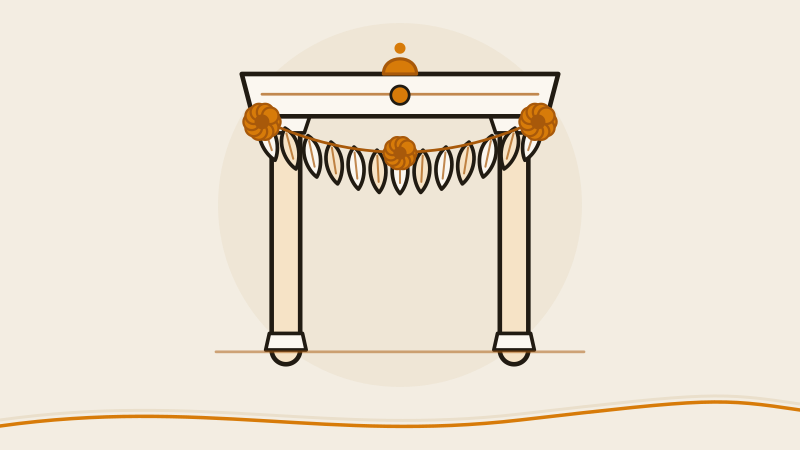
Indra is the eldest of the gods in the sense that matters — the chief, the one who leads them to war, whose thunderbolt is the weapon that ends the drought. He is also, in the later stories, the anxious king: forever afraid of losing his throne to a sage's austerity or a demon's boon, forever sending apsaras to break a rival's meditation. Jyeshta is his mansion, and its symbols are his rank: the amulet that protects, the earring that marks the chief, the umbrella held over the king's head. The mansion is authority and its cost — the protection one owes and the fear of losing the standing that lets one give it.
Mercury as lord gives the intelligence and the secrecy. Mercury is the mind and the messenger; in Indra's mansion it becomes strategy, the eldest's calculation, the knowledge of who owes what to whom and the keeping of that knowledge close. Jyeshta natives are the tradition's protectors and its schemers — the elder sibling who runs the family and the courtier who runs the king — and they are often the same person.
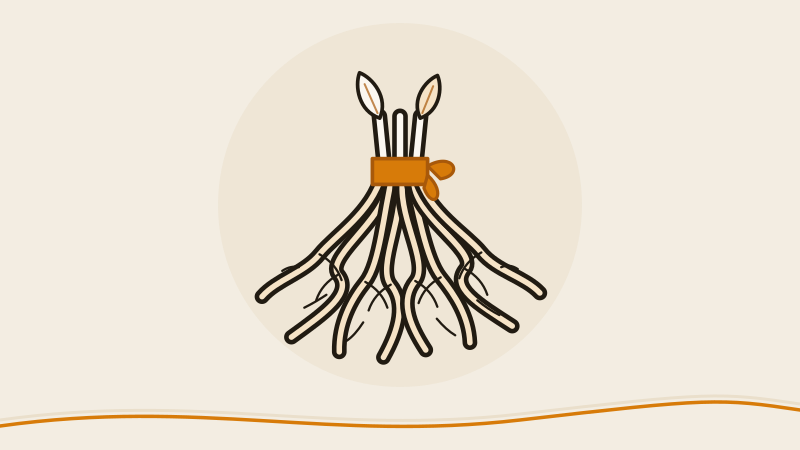
The mansion ends the sign of Scorpio and the whole water trine, and its last 0°48′ is a gandanta, the knot between water and fire, the tradition's most delicate degrees. Jyeshta also holds, in its old reputation, the caution of the eldest born under it — the texts speak of a first child in Jyeshta as heavy for the elder relatives — which we record because readers will meet it elsewhere, and read as what it is: a description of a burden, not a curse.
Which rashi is Jyeshta nakshatra? (Jyeshta nakshatra rasi)
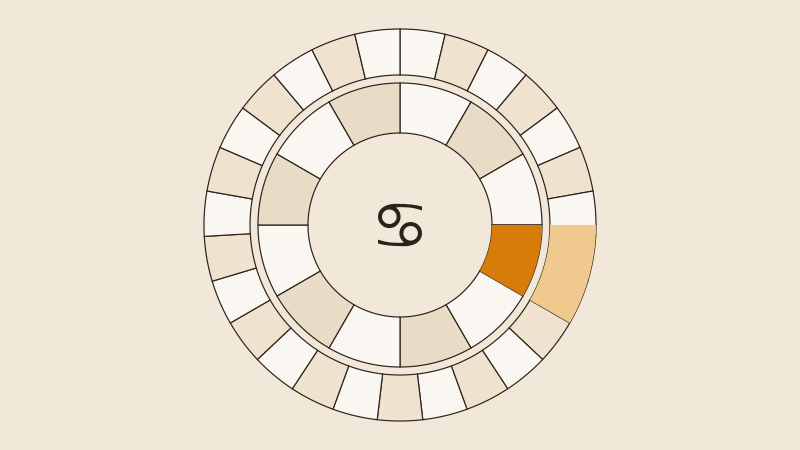
Jyeshta lies entirely inside Scorpio (Vrishchika or Vrishchik rashi), from 16°40′ to 30°00′ — the last third of Mars's fixed sign. A Jyeshta Moon is a Scorpio Moon: intense, private, fixed, transformative, and debilitated — the Moon's fall is Scorpio, its deepest degree far back at 3°00′ in Vishakha. What Jyeshta adds is Indra's rank and Mercury's mind to the Scorpio depth: the intensity turned to responsibility, the privacy turned to strategy. Mercury, the star-lord, and Mars, the sign-lord, are enemies in the Parashari table — the clever and the forceful — and the friction is the Jyeshta signature: the protector who plans, the fighter who would rather outthink than strike, the elder whose authority is in what they know.
The four padas of Jyeshta
Every mansion is cut into four quarters, the padas, each 3°20′ wide and each tied to a navamsa sign — the ninth harmonic, the chart of the inner life and the partner. Jyeshta's padas run Sagittarius, Capricorn, Aquarius, Pisces, and the fourth ends in the gandanta.
| Pada | Degrees | Navamsa | Reading |
|---|---|---|---|
| 1 | 16°40′ Scorpio – 20°00′ Scorpio | Sagittarius | Sagittarius navamsa: the righteous elder — authority with a philosophy, protection as a principle. The most generous pada and the most open; the judge, the head of the family who is also its teacher. |
| 2 | 20°00′ Scorpio – 23°20′ Scorpio | Capricorn | Capricorn navamsa: the working elder — responsibility as labour, the eldest who runs the business. The most disciplined pada and the most capable; the tradition's favourite for career. |
| 3 | 23°20′ Scorpio – 26°40′ Scorpio | Aquarius | Aquarius navamsa: the reforming elder — the chief who changes the rules, the protector of the many. The most unconventional pada; the one that carries the family and questions it. |
| 4 | 26°40′ Scorpio – 0°00′ Sagittarius | Pisces | Pisces navamsa: the sacrificing elder — protection as self-giving, the eldest who gives everything away. Ends in the gandanta at 29°12′ to 30°00′. The most emotional pada and the one the tradition watches. |
No pada of Jyeshta is vargottama. The fourth pada carries the water-fire gandanta in its last 0°48′, and a Moon or lagna there is at the knot — the tradition reads it as the eldest's burden at its heaviest, and as the threshold of a life that begins with something to untie.
Moon in Jyeshta: the janma nakshatra
Of all the placements, the Moon's nakshatra at birth — the janma nakshatra — is the one that shapes the mind and fixes where the dasha begins. With the Moon in Jyeshta, the mind is one that takes charge. These are the people of capability and responsibility, often literally the eldest or the one who acted as eldest; who protect their own with real force and expect to be respected for it; who are private, strategic, and hard to know; who hold rank — in the family, the firm, the group — and hold it seriously. The classical lists give them few friends, contentment, virtue, a quick temper, and authority over others — and, in the harsher lines, a secretive and cunning nature.
The trait that explains the others is Indra's anxiety. A Jyeshta Moon is the one others lean on, and underneath the competence is the fear of the throne lost — of not being needed, of being surpassed, of the responsibility they carry being taken as nothing. The caution in the texts is exactly that: the elder who cannot delegate, who resents the dependents they protect, who keeps secrets to keep power. What they have to learn is the eldest's hardest: to let the younger ones grow up, and to be, for once, the one who is looked after.
Mercury on the fallen Moon gives the mansion's people a sharp, private intelligence and a way of feeling through thinking. They are the strategists of the zodiac, and they are lonelier than they let on.
Jyeshta nakshatra female and male natives
The tradition wrote two portraits, one for each sex; they are kept because they are asked for, with the caution that a chart is not a sex — and, for Jyeshta, that the old texts carry a superstition about the eldest that we record and do not use.
For a woman, the tradition gives Jyeshta capability, a protective nature, strong will, a sharp intelligence, and a reserve that others find formidable; it describes her as the one who runs the family, devoted to her own and demanding of them, and as someone who carries more than her share. The old texts add cautions about the marriage and the in-laws — the elder daughter's classical burden — and about a temper that is quick because it is tired.
For a man, the tradition gives Jyeshta a strong, commanding presence, courage, authority, a talent for strategy, and a sense of responsibility that arrives early and stays; it describes him as the protector, the head of the family or the firm, respected and a little feared. The caution is the eldest's pride, and the secrecy that isolates him.
Either way, the fourth pada deepens every line, and Mercury's condition in the chart decides whether the strategy serves the protection or replaces it.
Career, money and health
Work. Indra's mansion under Mercury gives the professions of rank and protection: senior management, the head of any organisation; the military and the police at command level; government, especially the executive; the family business in the hands of the eldest; and the professions of strategy — intelligence, consulting, law, politics behind the scenes. Mercury adds the mind's trades — research, analysis, the occult sciences, which Scorpio favours. Jyeshta also does well in guardianship of every kind — the trustee, the warden, the protector of the vulnerable — and in any work where the buck stops.
Money. Comes through position and responsibility and is kept close; the tradition marks Jyeshta as prosperous through authority rather than fortune. The Capricorn pada earns most. The caution is the money spent on dependents, and the secret hoard that is the anxious king's.
Health. Scorpio governs the reproductive organs, the excretory system and the nose; Jyeshta adds the shoulders and the neck — where the burden sits — and the mind's weather under the fallen Moon. Complaints of the lower abdomen, of the neck and shoulders, and of the illnesses of long responsibility are classical, along with, in the fourth pada, the sensitivity of the gandanta. Before any medicine, the tradition's first order is the burden put down for an hour a day.
The other planets in Jyeshta
Any planet in Jyeshta picks up the mansion's rank and Mercury's strategy, and only then its own nature.
Sun in Jyeshta. In a friend's sign, in the mansion of its friend Mercury. The king at full rank: authority, protection, the father as the head of the line; a self that leads because it must. Strong, and heavy; the Sun here is respected before it is loved.
Moon in Jyeshta. Covered above. Debilitated, past its deepest degree.
Mars in Jyeshta. In its own sign, in the mansion of its enemy Mercury. Force with a strategy: the general, the enforcer of the elder's will, courage that plans. Strong; the classical caution is the quarrel over rank.
Mercury in Jyeshta. In its own mansion, in the sign of its enemy Mars. The strategist's mind at full strength in a hard place: the counsellor to the king, the keeper of secrets, the analyst of the hidden. Sharp, private, sometimes cunning.
Jupiter in Jyeshta. In a friend's sign, in the mansion of Mercury, with whom Jupiter does not agree. Wisdom as authority: the elder's counsel, the judge, the teacher who protects. Good for standing; uneven for ease.
Venus in Jyeshta. In a neutral sign, in the mansion of its friend Mercury. Love as protection: the partner who takes charge, the affection that shows as responsibility; beauty in rank. A capable Venus, not a soft one; the classical caution is jealousy over the throne.
Saturn in Jyeshta. In the sign of its enemy Mars, in Mercury's mansion, with which Saturn works well. The elder's burden carried for decades: the long responsibility, the institution held, the family kept. Saturn here is the eldest's weight made permanent, and it holds.
Rahu in Jyeshta. The hunger for rank one was not born to: the outsider who becomes the head, the ambition for the throne, the foreign authority. Rahu in Mercury's mansion is the schemer and the self-made chief.
Ketu in Jyeshta. Rank renounced: the eldest who gives up the seat, the protector who withdraws, the detachment from authority. Often a spiritual placement; often one that begins with the loss of standing.
Lagna in Jyeshta. A strong, commanding frame, a serious face, a manner that expects to be obeyed. The lagna lord is Mars, and its placement decides whether the authority protects or dominates.
Notice how much turns on the lord. A planet in one of Mercury's three mansions carries Mercury's signature, but Jyeshta is not the other two, and inside Jyeshta the nine sub-lords divide it again. This is the level at which a reading stops being a description of a type and becomes a description of a person. The nakshatra report does that work for your own chart: each planet placed to its pada and sub-lord, each placement read for what it promises and when the dasha lets it through.
The sub-lords of Jyeshta
This is the level at which the Krishnamurti method (KP) reads a chart: each nakshatra is cut into nine unequal parts in the proportion of the Vimshottari years, and the lord of the part — the sub-lord — decides what a planet here actually delivers. Two planets in Jyeshta with different sub-lords give different results. It is the step at which two charts that look alike come apart — where real astrology begins.
| Sub-lord | From | To |
|---|---|---|
| Mercury | 16°40′ Scorpio | 18°33′20″ Scorpio |
| Ketu | 18°33′20″ Scorpio | 19°20′ Scorpio |
| Venus | 19°20′ Scorpio | 21°33′20″ Scorpio |
| Sun | 21°33′20″ Scorpio | 22°13′20″ Scorpio |
| Moon | 22°13′20″ Scorpio | 23°20′ Scorpio |
| Mars | 23°20′ Scorpio | 24°06′40″ Scorpio |
| Rahu | 24°06′40″ Scorpio | 26°06′40″ Scorpio |
| Jupiter | 26°06′40″ Scorpio | 27°53′20″ Scorpio |
| Saturn | 27°53′20″ Scorpio | 0°00′ Sagittarius |
The sub-lords of Jyeshta, three of them in particular. The Mercury sub at the start (16°40′ to 18°33′20″) is Mercury in its own mansion and its own sub — the most strategic, most secretive degrees of the star; a planet there is the counsellor behind the throne. The Rahu sub (24°06′40″ to 26°06′40″) is where the mansion's ambition for rank is strongest and least satisfied. The Saturn sub at the end (27°53′20″ to 30°00′) holds the gandanta from 29°12′; a planet there — and above all the Moon or the lagna — carries the eldest's burden at the zodiac's knot, and is read with the care Paper C sets out.
The dasha the Moon here gives
A Moon in Jyeshta starts life in the Mercury mahadasha (17 years), and the balance left at birth is the fraction of Jyeshta the Moon has still to cross, times 17: a Moon exactly halfway through Jyeshta has 8.5 years of Mercury left. The order after that is fixed — Ketu → Venus → Sun → Moon → Mars → Rahu → Jupiter → Saturn — and it is the same for everyone born with the Moon here; what differs is where in it a life is standing at any moment. A Jyeshta life begins in the seventeen-year Mercury mahadasha, and since most Jyeshta Moons are born partway through the mansion, Mercury usually runs through childhood and into the teens — a childhood of early responsibility, often as the eldest or in the eldest's role. Then the seven-year Ketu, which typically falls in the late teens or twenties and is the mansion's first release from rank; then the twenty-year Venus, which usually covers the thirties and forties and is where the eldest, if they let it, is finally cared for.
Jyeshta nakshatra compatibility and marriage life
Three tables decide a nakshatra match: the yoni (the animal), the gana (the temperament) and the nadi (the constitution, which must differ). Jyeshta is deer yoni, rakshasa gana, adi nadi.
Best matches by yoni — the deer, whose other mansion is Anuradha (full marks); no other animal scores three with the deer, and the elephant, sheep, serpent, cat, rat, cow, buffalo, monkey and mongoose score two. Most difficult by yoni — the dog (Ardra, Mula), the deer's enemy, scoring nothing; the horse, tiger and lion score one.
By gana — Jyeshta is rakshasa, which matches rakshasa best (Krittika, Ashlesha, Magha, Chitra, Vishakha, Mula, Dhanishta, Shatabhisha) and manushya acceptably; rakshasa with deva is the classical mismatch.
By nadi — Jyeshta is adi nadi. Jyeshta with Ashwini, Ardra, Punarvasu, Uttara Phalguni, Hasta, Mula, Shatabhisha or Purva Bhadrapada is the nadi clash the texts name.
What no table shows: a Jyeshta native is a protective, capable, private partner who takes charge of the household and needs to be allowed to — and needs one who will, sometimes, take charge of them.
Which pada of Jyeshta is best, and which is difficult?
"Which pada is bad" is usually a question about where the trouble sits. For Jyeshta the tradition's answer is the fourth pada, in Pisces — for a computed reason: its last 0°48′, from 29°12′ Scorpio, is the water-fire gandanta, and a Moon or lagna there is at the knot, with the fallen Moon's sensitivity doubled by the Pisces navamsa. The second pada, in Capricorn, is the strongest for career and the most capable. The first, in Sagittarius, is the most generous and the one the texts read most kindly. The third is the most reforming. The old caution about Jyeshta and the eldest relatives attaches to the whole mansion in folklore; in practice it is the fourth pada, and the gandanta, that the chart is read for.
The sky for Jyeshta Moons in 2026–27
The figures are computed, Lahiri sidereal, true node; nothing here is quoted from a panchang. Saturn is in the fifth house from your Moon until 3 June 2027, then in the sixth (with a return to the fifth from 20 October 2027 to 23 February 2028). Jupiter, exalted, is in the ninth house from your Moon until 31 October 2026, previews the tenth from 31 October to 25 January 2027, returns to the ninth until 26 June 2027, and then settles in the tenth. Rahu is in the fourth and Ketu in the tenth until 25 November 2026; after that Rahu is in the third and Ketu in the ninth for eighteen months. Plainly: a Jyeshta Moon is not in sade sati, and this is a steady year. Saturn is in the fifth from the Moon until June 2027 — the heart's projects, children, under Saturn's discipline — then in the sixth, where Saturn's transit clears debts and rivals. Jupiter's year is in the ninth — fortune, one of its best transits — with rank previewed over the winter; Rahu moves from the fourth to the third on 25 November. Mars, the sign's lord, enters Leo — the tenth from your Moon, the house of rank — on 12 November and meets Jupiter and Ketu there: the week of 12 to 16 November is the eldest's week, for a title taken up or handed on.
→ Sade Sati · Mars Meets Jupiter in Leo
Remedy and mantra
The classical remedy for an afflicted Jyeshta placement is worship of Indra — the Indra hymns, and the offering of water, which Indra releases — and of Mercury as the mansion's lord, with Om Budhaya Namah on Wednesday and the worship of Vishnu for Mercury's periods. Hanuman is worshipped for the mansion's protective strength, and the tradition prescribes the gandanta remedies where the chart shows them. The remedy the tradition puts before all others is delegation — the mansion's affliction is the burden that will not be shared, and the eldest is healed by handing one thing to the next in line. A remedy — a puja, a gemstone, a rudraksha, a yantra — is prescribed to the chart, and the chart decides which.
Questions we are asked
What is Jyeshta nakshatra? The eighteenth of the 27 nakshatras, 16°40′ to 30°00′ Scorpio, ruled by Mercury, with Indra as deity and a circular amulet — or an earring, or an umbrella — as symbol. In the sky it is Antares. It stands for the eldest: responsibility, protection, rank, and their loneliness.
Jyeshta nakshatra is which rashi? Scorpio (Vrishchika, or Vrishchik rashi). The whole nakshatra lies inside Scorpio, Mars's fixed sign.
Who is the lord of Jyeshta nakshatra? Mercury. The dasha for a Moon here begins with Mercury's seventeen years, then Ketu's seven.
What are the Jyeshta nakshatra characteristics? Capable, protective, proud, private, strategic; the eldest or the one who acts as eldest; authority that carries and a temper that is tired.
Which pada of Jyeshta is bad? The fourth, in Pisces, ends in the water-fire gandanta from 29°12′ Scorpio and is the one to read with care for the Moon and the lagna; the second, in Capricorn, is the strongest for career.
What is the Jyeshta nakshatra symbol? A circular amulet, an earring, or an umbrella — the emblems of the chief's rank and the protection they promise.
Is Jyeshta nakshatra good for marriage? Protective, capable partners who take charge. Match by yoni (deer), gana (rakshasa) and nadi (adi); the deer–dog pairing is the pairing the table puts at zero.
Why is Jyeshta nakshatra considered inauspicious? Because its deity is the anxious king, its last degrees are a gandanta, its Moon is debilitated, and the old texts carry a caution about the eldest born under it. The mansion's natives are the ones others depend on; the difficulty is the burden, and it is real and it is not a curse.
What does 2026 hold for Jyeshta nakshatra? Saturn in the fifth from the Moon until June 2027, then the sixth; Jupiter in the ninth for most of the year; Mars, Jupiter and Ketu together in the tenth — rank — in mid-November. The computed sky is above.
Read this as education. It is not medical, legal or financial advice, and no single nakshatra is a chart.
A page can map Jyeshta; only a consultation can read your Moon, lagna, sub-lords and dasha in it together, with the questions you actually have.
→ Book a private consultation · Reading the Nakshatra, Not the Sign · Paper C, Nakshatras · ← Anuradha · Mula →