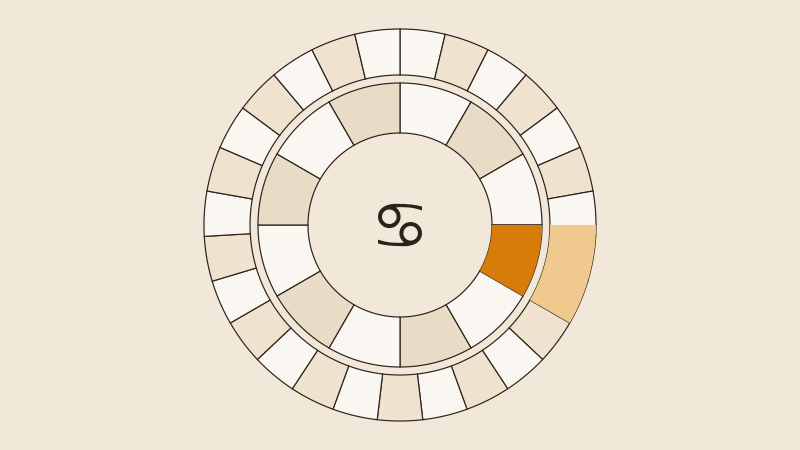
Shatabhisha (also called Sadayam in Tamil, Satabhisha in Telugu, Chathayam in Malayalam, also written Satabhisha or Shatabhishak) — 6°40′ Aquarius to 20°00′ Aquarius, in Aquarius; lord Rahu; deity Varuna. Lahiri sidereal.
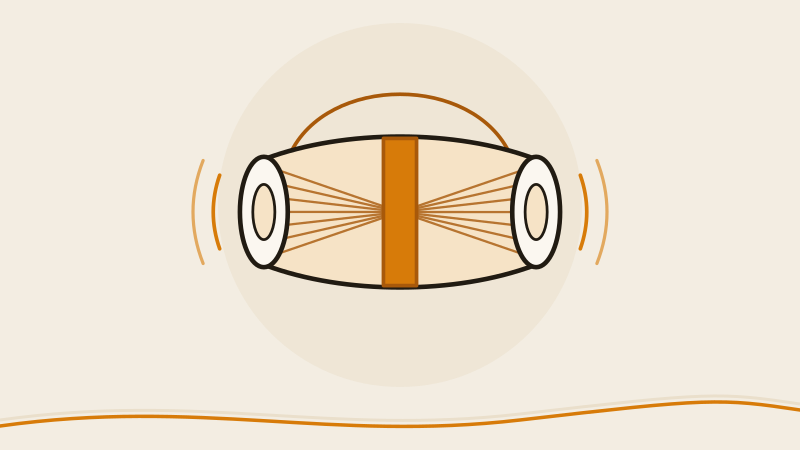
Shatabhisha nakshatra (also written Satabhisha) is the twenty-fourth lunar mansion, from 6°40′ to 20°00′ of Aquarius, and it is the star of the hundred healers. Its deity is Varuna, the god of the cosmic waters and the cosmic law, who sees every secret and binds the guilty with his noose; its symbol is an empty circle, or a hundred flowers, or a hundred stars; its lord is Rahu. The name means "the hundred physicians", and the mansion is the medicine that works because it is hidden — the secret remedy, the veiled knowledge, the healing that the healer cannot explain. A person with the Moon here is private, perceptive, unconventional and healing by nature, the one who sees what is wrong and treats it from behind a veil — and whose lesson is to let themselves be seen.
This is Shatabhisha, read in the Institute's order: the span and the sign, the four padas and the navamsa each reaches — including the vargottama third — the Moon and every other planet here, the sub-lords of the Krishnamurti method, the dasha a birth here begins, and the computed sky this Moon is under in 2026–27, which for this mansion includes the eclipse of last August. Each Sanskrit word is explained the first time it is used.
Shatabhisha nakshatra at a glance
| Span | 6°40′ Aquarius to 20°00′ Aquarius |
| Sign (rashi) | Aquarius |
| Lord (star-lord) | Rahu |
| Deity | Varuna |
| Symbol | an empty circle; a hundred flowers |
| Gana (temperament) | Rakshasa |
| Nature (for muhurta) | Chara (movable) |
| Yoni (animal, for matching) | horse (female) |
| Nadi | Adi |
| Name syllables (pada 1–4) | Go, Sa, Si, Su |
| Also called | Sadayam (Tamil), Satabhisha (Telugu), Chathayam (Malayalam) |
| Dasha the Moon here begins | Rahu, 18 years |
The story and the symbol
Varuna is the oldest of the great Vedic gods — before Indra, the sky itself was his — and he is the keeper of rita, the cosmic order, who sees every act from his thousand-eyed house and binds those who break the law with the noose he carries. He is also the lord of the waters, and later of the ocean and of medicine, since the waters heal. Shatabhisha is his mansion, and the hundred healers are his physicians — or, in another reading, the hundred stars the mansion covers, or the hundred flowers of the remedy. The empty circle is the deepest symbol: the veil, the enclosure, the space within which the secret is kept and the healing done.
Rahu as lord gives the mansion its strangeness and its reach. Rahu is the eclipse's head, the hunger for what is foreign and hidden; in Varuna's mansion it becomes the search for the remedy nobody knows, the science at the edge, the medicine from abroad, the astrologer who sees what the chart is hiding. Shatabhisha natives are the tradition's physicians of the unusual, its researchers, its astrologers and its mystics — and their shadow is the circle's: isolation, secrecy for its own sake, and the loneliness of the one who heals everyone and admits no one.
The mansion is entirely in Aquarius, the sign Saturn shares with Rahu in the later tradition, and Rahu is strong here; the third pada is vargottama. It held the lunar eclipse of 28 August 2026, at 10°37′ Aquarius — Varuna's circle, drawn on the sky.
Which rashi is Shatabhisha nakshatra? (Shatabhisha nakshatra rasi)
Shatabhisha lies entirely inside Aquarius (Kumbha or Kumbh rashi), from 6°40′ to 20°00′ — the middle of Saturn's air sign, with Rahu as the sign's co-lord in the later tradition. A Shatabhisha Moon is an Aquarius Moon: detached, humanitarian, unconventional, fixed in its views and loose in its attachments. What the mansion adds is the veil — the Aquarius detachment made into privacy, the humanitarianism made into healing. Rahu, the star-lord, and Saturn, the sign-lord, are allies in the tradition, and the ease is the Shatabhisha signature: the strangeness that is disciplined, the secret that is kept for a reason. It is a strong placement for the sciences and the occult, and a lonely one.
The four padas of Shatabhisha
The four padas — quarters of 3°20′ — are how a nakshatra reading gets specific; each pada belongs to one navamsa sign, the ninth divisional chart, read for what is inward and for marriage. Shatabhisha's padas run Sagittarius, Capricorn, Aquarius, Pisces, and the third is vargottama.
| Pada | Degrees | Navamsa | Reading |
|---|---|---|---|
| 1 | 6°40′ Aquarius – 10°00′ Aquarius | Sagittarius | Sagittarius navamsa: the searching healer — the physician who travels, the researcher with a philosophy, the one who seeks the remedy abroad. The most expansive pada and the least secretive. |
| 2 | 10°00′ Aquarius – 13°20′ Aquarius | Capricorn | Capricorn navamsa: the working healer — the doctor with a practice, the scientist with a method, the astrologer with a system. The most disciplined pada and the tradition's favourite for a profession. Holds the eclipse degree of 28 August 2026 at 10°37′. |
| 3 | 13°20′ Aquarius – 16°40′ Aquarius | Aquarius | Aquarius navamsa: vargottama — Aquarius in both the rashi and the navamsa. The pure Shatabhisha: the veil at full depth, the unconventional mind at full strength, the healer who is also the mystic. The strongest pada and the most isolated. |
| 4 | 16°40′ Aquarius – 20°00′ Aquarius | Pisces | Pisces navamsa: the feeling healer — the remedy given with compassion, the circle opened to let one person in. The most receptive pada and the most easily drained. |
The third pada, being vargottama, is where Shatabhisha's secrecy, its strangeness and its healing power are all least diluted. The second pada carried the August 2026 lunar eclipse, and a Moon or planet there was under it.
Moon in Shatabhisha: the janma nakshatra
The janma nakshatra — the Moon's mansion at the moment of birth — is where the mind is read and the dasha is counted from. A Moon in Shatabhisha produces a mind that keeps a veil. Here are people of privacy and perception, who see what others miss and say little of what they see; who are drawn to medicine, the sciences, astrology and the occult; who are unconventional in thought and reserved in manner; who heal — friends, patients, systems — and do not easily let themselves be healed. The tradition credits them with truthfulness, a hard-won victory over enemies, a taste for solitude, and — in the caution — harsh speech, and a stubbornness that will not be treated.
The signature underneath is Varuna's: they see the law under things. A Shatabhisha Moon notices the pattern, the cause, the secret, and its detachment is the detachment of someone who has seen too much to be surprised. The classical warning is the circle closed: isolation, the secret kept past its usefulness, the healer who cannot be reached. Their lesson is the hundred flowers': to let the remedy be shared, and to let one of the hundred be for themselves.
Rahu in Saturn's sign gives the mansion's people their strangeness and their discipline together. Shatabhisha Moons are the tradition's astrologers — Varuna's mansion is the astrologer's own — and its physicians of the difficult case.
Shatabhisha nakshatra female and male natives
Readers search for the female and the male native separately, so the classical pair of portraits is given, with the caution that a chart is not a sex.
For a woman, the tradition gives Shatabhisha intelligence, perception, a healing nature, independence, religious or mystical feeling, and a reserve that others find hard to read; it describes her as truthful, capable in medicine and the sciences, devoted to a few, and as someone whose marriage may come late or ask for a great deal of privacy. The caution is the veil — the isolation, and a sharpness in speech that keeps others at the circle's edge.
For a man, the tradition gives Shatabhisha a lean, thoughtful frame, an unusual mind, a talent for the sciences and the hidden arts, honesty, a preference for solitude, and a success that comes after long secret effort; it describes him as a healer of some kind, unconventional in belief, and as someone who is respected at a distance. The caution is the closed circle, and a bitterness that grows in it.
With both, the vargottama third pada deepens every line, and Saturn's condition in the chart decides whether the solitude is chosen or imposed.
Career, money and health
Work. Varuna's mansion under Rahu gives the professions of the hidden remedy: medicine, above all the unconventional — alternative medicine, research into new treatments, pharmacology, the sciences of the invisible: radiology, microbiology, virology; astrology and the occult sciences, which the tradition names as this mansion's own; the water professions — the sea, shipping, water treatment, the ocean's medicine; and the technologies of the veil — electronics, encryption, the sciences of what cannot be seen. Rahu adds the foreign and the new; Aquarius adds humanitarian work and the large system. Shatabhisha also does well in psychiatry and in any work where seeing the hidden cause is the cure.
Money. Comes through specialised knowledge and after long secret effort; the tradition marks Shatabhisha as prosperous in middle life through a skill few others have. The Capricorn pada earns most. The caution is the circle — the wealth kept as privately as everything else, and spent on the search.
Health. Aquarius governs the ankles, the calves, the circulation and the nervous system, and Shatabhisha adds the hidden illnesses — the ones with a hundred possible causes — and the mind's isolation. Complaints of the circulation, of the nerves, and of conditions that are hard to diagnose are classical, along with the heart under Rahu's strain. What the tradition prescribes before medicine is the circle opened: to be treated by someone else.
The other planets in Shatabhisha
Put a planet in Shatabhisha and it takes the mansion's veil and Rahu's reach, then Saturn's discipline from the sign, then its own nature.
Sun in Shatabhisha. In the sign of its enemy Saturn, in the mansion of Rahu, which eclipses it. A self that is known for what it knows and not for who it is; a father who was distant, unusual, or a healer; authority at a remove. Strong for science and for the hidden arts; hard for the ego.
Moon in Shatabhisha. As set out above.
Mars in Shatabhisha. In a neutral sign, in Rahu's mansion — a volatile pair. Force behind the veil: the surgeon of the hidden, the soldier of intelligence, the fighter who does not show the fight. Courage in secret; the classical caution is the sudden strike.
Mercury in Shatabhisha. In a neutral sign, in a mansion that suits its curiosity. The researcher's mind, the diagnostician's, the astrologer's: original, exact, private. One of Mercury's better placements for the sciences and the occult.
Jupiter in Shatabhisha. In a neutral sign, in Rahu's mansion, which is hard for the planet of open faith. Wisdom kept behind a veil; the teacher of a secret tradition; belief that is unconventional and hard-won. Uneven for ease, strong for depth.
Venus in Shatabhisha. In a friend's sign, in Rahu's mansion. Love that is private and unusual: the affair kept secret, the marriage that others do not understand, the partner who heals; beauty in the strange. A loyal Venus and a hidden one.
Saturn in Shatabhisha. In its own sign, in the mansion of its ally Rahu. Discipline at full strength on the veil: the researcher of decades, the astrologer who mastered the system, the healer who kept the secret and used it well. One of Saturn's stronger placements, and one of the loneliest.
Rahu in Shatabhisha. Rahu in its own mansion, in a sign where it is strong: the hunger for the hidden at full reach. The scientist at the edge, the occultist, the physician of the impossible case; also the most isolated and most obsessive Shatabhisha placement.
Ketu in Shatabhisha. The veil that has already been lifted: detachment from the search, the healer who no longer needs the remedy, the mystic who has seen behind the circle. Often a deeply spiritual placement.
Lagna in Shatabhisha. A lean, sometimes tall frame, a watchful and reserved face, a manner that is courteous and hard to read. The lagna lord is Saturn, with Rahu as co-lord, and their placements decide whether the veil is wisdom or a wall.
Notice how much turns on the lord. A planet in one of Rahu's three mansions carries Rahu's signature, but Shatabhisha is not the other two, and inside Shatabhisha the nine sub-lords divide it again. This is the level at which a reading stops being a description of a type and becomes a description of a person. The nakshatra report does that work for your own chart: each planet placed to its pada and sub-lord, each placement read for what it promises and when the dasha lets it through.
The sub-lords of Shatabhisha
This is the level at which the Krishnamurti method (KP) reads a chart: each nakshatra is cut into nine unequal parts in the proportion of the Vimshottari years, and the lord of the part — the sub-lord — decides what a planet here actually delivers. Two planets in Shatabhisha with different sub-lords give different results. It is the step at which two charts that look alike come apart — where real astrology begins.
| Sub-lord | From | To |
|---|---|---|
| Rahu | 6°40′ Aquarius | 8°40′ Aquarius |
| Jupiter | 8°40′ Aquarius | 10°26′40″ Aquarius |
| Saturn | 10°26′40″ Aquarius | 12°33′20″ Aquarius |
| Mercury | 12°33′20″ Aquarius | 14°26′40″ Aquarius |
| Ketu | 14°26′40″ Aquarius | 15°13′20″ Aquarius |
| Venus | 15°13′20″ Aquarius | 17°26′40″ Aquarius |
| Sun | 17°26′40″ Aquarius | 18°06′40″ Aquarius |
| Moon | 18°06′40″ Aquarius | 19°13′20″ Aquarius |
| Mars | 19°13′20″ Aquarius | 20°00′ Aquarius |
Shatabhisha's sub-lords: the three that change a reading. The Rahu sub at the start (6°40′ to 8°40′) is Rahu in its own mansion and its own sub in a sign where it is strong — the most veiled, most hungry, most unconventional degrees of the star. The Jupiter sub (8°40′ to 10°26′40″) ends just before the eclipse degree of 28 August 2026 at 10°37′, which fell in the Saturn sub (10°26′40″ to 12°33′20″); a planet in that Saturn sub was under Varuna's circle last August and is read for what the eclipse touched. The Ketu sub (14°26′40″ to 15°13′20″) sits inside the vargottama third pada and is where the mansion's secrecy is most spiritual — the mystic's degrees.
The dasha the Moon here gives
A Moon in Shatabhisha starts life in the Rahu mahadasha (18 years), and the balance left at birth is the fraction of Shatabhisha the Moon has still to cross, times 18: a Moon exactly halfway through Shatabhisha has 9 years of Rahu left. The order after that is fixed — Jupiter → Saturn → Mercury → Ketu → Venus → Sun → Moon → Mars — and it is the same for everyone born with the Moon here; what differs is where in it a life is standing at any moment. A Shatabhisha life begins in the eighteen-year Rahu mahadasha, and since most Shatabhisha Moons are born partway through the mansion, Rahu usually runs through childhood and into the teens — an unusual, private, sometimes foreign childhood, with a secret or an illness in it. Then the sixteen-year Jupiter, which typically covers the twenties and thirties: the education in the hidden arts, the faith found or rebuilt. Saturn's nineteen years usually arrive in the forties and are the mastery the mansion promises — the long practice of the remedy.
Shatabhisha nakshatra compatibility and marriage life
Compatibility by nakshatra is read from the yoni (the animal), the gana (the temperament) and the nadi (the constitution, which must differ). Shatabhisha is horse yoni, rakshasa gana, adi nadi.
Best matches by yoni — the horse, whose other mansion is Ashwini (full marks); then the serpent (Rohini, Mrigashira) and the monkey (Purva Ashadha, Shravana), each scoring three with the horse. Most difficult by yoni — the buffalo (Hasta, Swati), the horse's enemy, scoring nothing; the cow, tiger, deer and lion score one.
By gana — Shatabhisha is rakshasa, which matches rakshasa best (Krittika, Ashlesha, Magha, Chitra, Vishakha, Jyeshta, Mula, Dhanishta) and manushya acceptably; rakshasa with deva is the classical mismatch.
By nadi — Shatabhisha is adi nadi. Shatabhisha with Ashwini, Ardra, Punarvasu, Uttara Phalguni, Hasta, Jyeshta, Mula or Purva Bhadrapada carries the classical nadi dosha.
Beyond the koota count: a Shatabhisha native is a private, loyal, healing partner who needs a great deal of room and a very small circle, and needs one who is content to be inside it — and who will insist, now and then, on being let further in.
Which pada of Shatabhisha is best, and which is difficult?
Shatabhisha has no bad pada in the sense the question usually means. The third pada, vargottama, is the strongest — and the most isolated; a Moon there is the mansion at full depth, for good and ill. The second, in Capricorn, is the best for a profession, and it is the pada that carried the lunar eclipse of 28 August 2026 at 10°37′ Aquarius — a computed point, and the one to read for a Moon or planet born there. The first, in Sagittarius, is the most open. The fourth, in Pisces, is the most compassionate and the most easily drained, and is the one to watch, because its healing can empty the healer.
The sky for Shatabhisha Moons in 2026–27
Swiss Ephemeris, Lahiri, true node — computed, as every dated claim on this site is. For an Aquarius Moon this is the closing phase of sade sati (Saturn in the second from your Moon) until 3 June 2027, with a short return between 20 October 2027 and 23 February 2028. Jupiter, exalted, is in the sixth house from your Moon until 31 October 2026, previews the seventh from 31 October to 25 January 2027, returns to the sixth until 26 June 2027, and then settles in the seventh. Rahu is in the first and Ketu in the seventh until 25 November 2026; after that Rahu is in the twelfth and Ketu in the sixth for eighteen months. What that means: the closing phase of sade sati is the money house under Saturn's weight, and it lifts in June 2027. Jupiter's year is in the sixth — service, health, the mansion's own work — with partnership previewed over the winter. Rahu, the mansion's lord, is on the Aquarius Moon itself until 25 November, with Ketu in the seventh; then Rahu moves to the twelfth and Ketu to the sixth. And the mansion carries the year's eclipse: the lunar eclipse of 28 August 2026 fell at 10°37′ Aquarius, in Shatabhisha's second pada, under Rahu's own lordship — for a Moon or a planet near that degree, the tradition reads the six months after an eclipse for what it touched. Mars enters Leo, the seventh from your Moon, on 12 November and meets Jupiter and Ketu there: partnership under force, grace and detachment at once, in the same week Rahu leaves your Moon.
→ Sade Sati · Mars Meets Jupiter in Leo
Remedy and mantra
The classical remedy for an afflicted Shatabhisha placement is worship of Varuna — the offering of water, the bath in the sea or a river, the Varuna hymns for those who keep them — and of Rahu as the mansion's lord, with Om Rahave Namah on Saturday and the worship of Durga for Rahu's periods. Shiva as Mrityunjaya, the conqueror of death, is worshipped for the mansion's healing, with the Maha Mrityunjaya mantra. The plainest remedy, and the first, is the circle opened — one person let in, one remedy accepted from another's hand. A remedy — a puja, a gemstone, a rudraksha, a yantra — is prescribed to the chart, and the chart decides which.
Questions we are asked
What is Shatabhisha nakshatra? The twenty-fourth of the 27 nakshatras, 6°40′ to 20°00′ Aquarius, ruled by Rahu, with Varuna as deity and an empty circle — or a hundred flowers, or a hundred stars — as symbol. It stands for the hidden remedy: healing, secrecy, the sciences of the invisible, and solitude.
Shatabhisha nakshatra is which rashi? Aquarius (Kumbha, or Kumbh rashi). The whole nakshatra lies inside Aquarius, Saturn's air sign.
Who is the lord of Shatabhisha nakshatra? Rahu. The dasha for a Moon here begins with Rahu's eighteen years, then Jupiter's sixteen.
What are the Shatabhisha nakshatra characteristics? Private, perceptive, unconventional, truthful, healing, solitary; drawn to medicine, science, astrology and the occult; hard to reach and harder to treat.
Which pada of Shatabhisha is best? The third, in Aquarius, is vargottama and the strongest; the second, in Capricorn, is the best for a profession. None is bad; the fourth is the most easily drained.
What is the Shatabhisha nakshatra symbol? An empty circle — the veil, the enclosure within which the secret is kept and the healing done — or a hundred flowers.
Is Shatabhisha nakshatra good for marriage? Private, loyal partners who need room. Match by yoni (horse), gana (rakshasa) and nadi (adi); the horse–buffalo pairing is the match the table rates worst.
Was there an eclipse in Shatabhisha in 2026? Yes — the lunar eclipse of 28 August 2026 fell at 10°37′ Aquarius, in Shatabhisha's second pada. A Moon or planet near that degree is read for what the eclipse touched.
What does 2026 hold for Shatabhisha nakshatra? The closing phase of sade sati until June 2027; Jupiter in the sixth; Rahu, the lord, on the Moon until 25 November; the August eclipse in the mansion's own degrees. The computed sky is above.
Educational only; not medical, legal or financial advice. A nakshatra is one thread of a chart, not the cloth.
If Shatabhisha holds your Moon or your lagna, the sub-lords and the dasha are read together in a consultation — and read against the year you are in.
→ Book a private consultation · Reading the Nakshatra, Not the Sign · Paper C, Nakshatras · ← Dhanishta · Purva Bhadrapada →