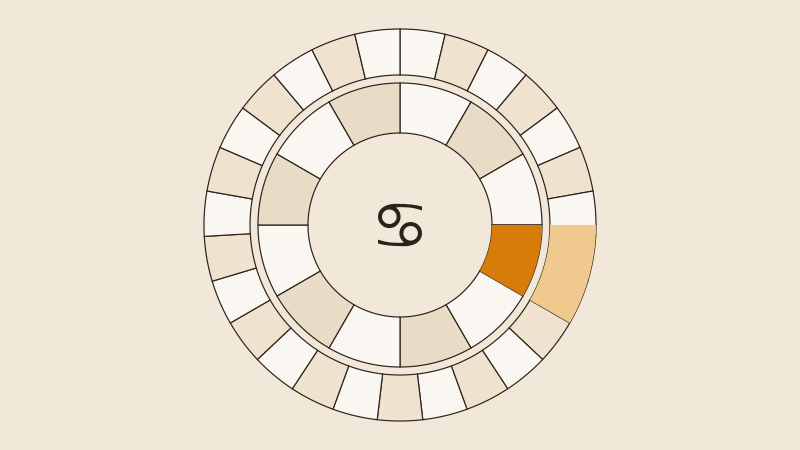
Punarvasu (also called Punarpoosam in Tamil, Punarvasu in Telugu, Punartham in Malayalam, and known in the sky as Castor and Pollux) — 20°00′ Gemini to 3°20′ Cancer, in Gemini and Cancer; lord Jupiter; deity Aditi. Lahiri sidereal.
Punarvasu nakshatra is the seventh lunar mansion, from 20°00′ Gemini to 3°20′ Cancer — the third of the nine that straddle two signs, and the one that ends in the sign of the Moon's own home. Its deity is Aditi, the boundless mother of the gods; its symbol is a quiver of arrows, and also a house; its lord is Jupiter. The name means "good again", "the return of the light", and the mansion is exactly that: what comes back after Ardra's storm. A person with the Moon here is generous, philosophical, forgiving, and hard to keep down — the one who starts again, and again, and is somehow never bitter about it.
What follows is our reading of Punarvasu: the two-sign span, the four padas and the navamsa each reaches, the Moon and every other planet here, the sub-lords of the Krishnamurti method, the dasha a birth here begins, and the computed sky this Moon is under in 2026–27. Sanskrit terms are explained on first use.
Punarvasu nakshatra at a glance
| Span | 20°00′ Gemini to 3°20′ Cancer |
| Sign (rashi) | Gemini and Cancer |
| Lord (star-lord) | Jupiter |
| Deity | Aditi |
| Symbol | a quiver of arrows; a house |
| Gana (temperament) | Deva |
| Nature (for muhurta) | Chara (movable) |
| Yoni (animal, for matching) | cat (female) |
| Nadi | Adi |
| Name syllables (pada 1–4) | Ke, Ko, Ha, Hi |
| Also called | Punarpoosam (Tamil), Punarvasu (Telugu), Punartham (Malayalam) |
| Dasha the Moon here begins | Jupiter, 16 years |
The story and the symbol
Aditi is the mother of the Adityas, the twelve solar gods, and her name means "the unbound", "the limitless" — the sky before it was divided, the freedom before any fence. She is the goddess to whom the Vedic hymns pray for release from every kind of bondage: debt, sin, sickness, the past. Punarvasu is her mansion, and its meaning is in its name — punar is "again", vasu is "good", "light", "wealth" — the light that comes back, the good that returns, the arrow that is shot and then recovered and shot again.
The quiver is the symbol because the arrows are Rudra's, loosed in Ardra and retrieved here. What was destroyed in the storm is picked up here and put to use. The house is the other symbol, and it is the same idea from the other side: Punarvasu is the homecoming, the return after the journey, the mansion of the person who left and came back better. Rama, in the tradition, was born under Punarvasu; his story is the mansion's — exile and return, loss and recovery, the kingdom given up and taken up again without complaint.
Jupiter as lord gives the philosophy that makes the return possible. Jupiter is grace, expansion, faith and the teacher; under Jupiter the loss is understood as a lesson and the second chance is taken gladly. Punarvasu people are optimists not because they have not suffered but because they have, and have come back, and know they can.
Which rashi is Punarvasu nakshatra? (Punarvasu nakshatra rasi)
Punarvasu straddles two signs. Its first three padas are in Gemini (Mithuna or Mithun rashi), 20°00′ to 30°00′, and its fourth pada is in Cancer (Karka or Kark rashi), 0°00′ to 3°20′. So most Punarvasu Moons are Gemini Moons — Mercury-ruled, airy, mutable, quick — with Jupiter as star-lord giving breadth and faith to the Gemini mind: this is the Punarvasu that teaches, travels and writes. A Moon in the fourth pada is a Cancer Moon, in the Moon's own sign, and vargottama, since the fourth pada's navamsa is also Cancer — one of the most protected Moon positions in the zodiac, the mansion's homecoming in its purest form. Jupiter and Mercury, the star-lord and the sign-lord of the Gemini half, are not friends, and the friction is the Gemini Punarvasu's restlessness; Jupiter and the Moon, for the Cancer pada, are close allies, and that pada is the quietest.
The four padas of Punarvasu
Four padas of 3°20′ make up every nakshatra; each one maps to a navamsa sign, the ninth division of the chart, where the inner life and the marriage are read. Punarvasu's padas run Aries, Taurus, Gemini, Cancer, and both the third and the fourth are vargottama — one of only three nakshatras with two (Chitra and Uttara Ashadha are the others).
| Pada | Degrees | Navamsa | Reading |
|---|---|---|---|
| 1 | 20°00′ Gemini – 23°20′ Gemini | Aries | Aries navamsa, in Gemini: the active return — the one who goes out again at once. Bold, restless, quick to recover; the pada of the traveller and the entrepreneur who fails forward. |
| 2 | 23°20′ Gemini – 26°40′ Gemini | Taurus | Taurus navamsa, in Gemini: the settled return — the good that comes back as comfort, property, and a table with food on it. The most material pada, and the steadiest. |
| 3 | 26°40′ Gemini – 0°00′ Cancer | Gemini | Gemini navamsa, in Gemini: vargottama — the pure Gemini Punarvasu. The mind at full stretch: teachers, writers, scholars, the ones who explain the return to others. Includes the Gemini–Cancer boundary at its end. |
| 4 | 0°00′ Cancer – 3°20′ Cancer | Cancer | Cancer navamsa, in Cancer: vargottama — the pure homecoming. The Moon in its own sign and its own navamsa in Jupiter's mansion: nurturing, protected, deeply emotional, the mother who takes everyone in. The first 0°48′ is the Gemini–Cancer sandhi but not a gandanta, which lies only between water and fire. |
Two vargottama padas make Punarvasu unusually strong across its second half. The fourth pada is the one the tradition singles out: a Moon there is in its own sign, its own navamsa, and Jupiter's mansion, and the texts read it as a placement of exceptional safety.
Moon in Punarvasu: the janma nakshatra
Janma nakshatra means the mansion the Moon occupied at birth: the mind's own star, and the start of the dasha count. A Moon in Punarvasu is a mind that recovers. These are people who are knocked down and get up, who lose and rebuild, who forgive because holding a grudge would stop the light from coming back. They are generous, philosophical, fond of travel and of teaching, content with what they have and able to be content with less. The texts assign them a good nature, patience, fame, simplicity, and a mind that is satisfied.
The deeper mark is Aditi's: freedom. A Punarvasu Moon does not like to be bound — by debt, by a rigid job, by a possessive partner — and will quietly arrange a life with room in it. They are not ambitious in the Rahu way; they want enough, and they want it to be theirs, and they want to be able to leave and come back. The tradition's warning is a certain lack of drive — the contentment that shades into complacency — and a tendency to start things over rather than see them through.
Jupiter's lordship gives them a teacher's temperament whether or not they teach. They explain, they encourage, they believe the best. In the Gemini padas the belief is spoken; in the Cancer pada it is felt.
Punarvasu nakshatra female and male natives
Because the queries ask for it, the texts' separate portraits of the woman and the man of this star are kept, with the caution that a chart is not a sex.
For a woman, the tradition gives Punarvasu a calm, kind manner, intelligence, a good name, and a home that people come to; it describes her as a devoted partner and a natural teacher, generous with her family and forgiving of it, and slow to anger. The old texts add a caution about being taken advantage of — the generosity that does not keep accounts.
For a man, the tradition gives Punarvasu a pleasant, open face, simplicity, learning, a love of travel and of home in equal measure, and a capacity to recover from setbacks that others find remarkable. He is described as contented, sometimes to the point of lacking push, and as someone who does well late — the return comes after the leaving. The caution is about starting over too readily.
In each case, the pada decides the register: the Gemini padas speak the mansion's qualities, the Cancer pada feels them.
Career, money and health
Work. Jupiter's mansion gives teaching first — schools, universities, religious instruction, coaching, counselling — and the professions of explanation: writing, publishing, philosophy, law in its advisory rather than adversarial form. Aditi's freedom gives travel, transport, import and export, and hospitality — the house that takes people in. The quiver gives the recovered arrow: consultancy, restoration, rehabilitation, the work of second chances. Punarvasu also does well in the priesthood and in any charity, and in the Cancer pada in nursing, food, and the care of the young.
Money. Comes and goes and comes back. Punarvasu is not a mansion of great wealth but of sufficiency: the tradition marks its natives as never destitute for long, and as poor keepers of what they do not need. The Taurus pada holds most. Jupiter as lord gives money through teaching, through the foreign, and through the goodwill of others.
Health. Gemini governs the shoulders, arms, hands and lungs; the Cancer pada adds the chest and the stomach. Complaints of the lungs and of the digestion are classical, along with the illnesses of excess that Jupiter's mansions carry — the good things enjoyed too well. Recovery is the mansion's gift and the tradition notes it: Punarvasu natives heal.
The other planets in Punarvasu
A planet placed in Punarvasu inherits the mansion's return and Jupiter's grace, before its own nature shows. The sign changes the reading at the fourth pada.
Sun in Punarvasu. In a neutral sign in Gemini; in the Cancer pada, in a friend's sign. A self that recovers its standing; a father who was a teacher or a traveller; authority that is generous and sometimes too easy. The Sun and Jupiter are friends, so this is a comfortable placement.
Moon in Punarvasu. Read above, under the janma nakshatra. In its own sign and vargottama in the fourth pada.
Mars in Punarvasu. In an enemy's sign in the Gemini padas, and debilitated in the Cancer pada (Mars's fall is Cancer; its deepest point, 28°, is far ahead in Ashlesha). Force with Jupiter's restraint: the soldier who becomes a teacher, the fighter for a cause. In Gemini the words are sharp; in Cancer the drive is inward and can turn to frustration.
Mercury in Punarvasu. In its own sign for the Gemini padas, in Jupiter's mansion — the two great teachers together, if not as friends. The scholar, the explainer, the translator; a mind that is broad rather than merely quick. In the Cancer pada, in an enemy's sign, the mind is more intuitive and less exact.
Jupiter in Punarvasu. In its own mansion — Jupiter at full grace. In Gemini, in an enemy's sign, the wisdom is intellectual and restless; in the Cancer pada, exalted (Jupiter's exaltation is Cancer; its deepest point, 5°, is just ahead in Pushya), it is one of the strongest Jupiter placements in the zodiac: the guru, the protector, the one whose return brings everyone home.
Venus in Punarvasu. In a friend's sign in Gemini, an enemy's in Cancer. Love that forgives and returns; the partner who takes you back; art that consoles. Venus and Jupiter are the two gurus and do not agree, so the pleasure here has a philosophy attached to it.
Saturn in Punarvasu. In a friend's sign in Gemini, an enemy's in Cancer. Slow recovery, but recovery: the long rebuilding, the patient teacher, the person who came back late and stayed. In the Cancer pada Saturn chills the mansion's warmth.
Rahu in Punarvasu. The return that goes too far — the wanderer who cannot stop returning to new places; the foreign home; a hunger for the freedom Aditi gives. Rahu in Jupiter's mansion softens Rahu and unsettles Jupiter.
Ketu in Punarvasu. The arrow not recovered — detachment from the return, the renunciate who leaves and does not come back, or the one whose homecoming is inward. Often a spiritual placement.
Lagna in Punarvasu. A pleasant, open face, a medium or full frame, a manner that is friendly and unhurried. In the Gemini padas the lagna lord is Mercury; in the Cancer pada, the Moon — the difference between the traveller and the one who keeps the house.
A Jupiter placement is never one story. A Sun in Punarvasu under the Venus sub and a Sun in Punarvasu under the Saturn sub are two different fathers, two different careers, two different men — and Jupiter rules two other mansions besides this one, each with its own nine subs. That is why a chart is read planet by planet at this level, and why a page can only give you the outline. The nakshatra report takes your own chart and reads every planet in it to the pada and the sub-lord — which mansion, which quarter, whose sub — and says what each placement promises and in which dasha it delivers.
The sub-lords of Punarvasu
This is the level at which the Krishnamurti method (KP) reads a chart: each nakshatra is cut into nine unequal parts in the proportion of the Vimshottari years, and the lord of the part — the sub-lord — decides what a planet here actually delivers. Two planets in Punarvasu with different sub-lords give different results. It is the step at which two charts that look alike come apart — where real astrology begins.
| Sub-lord | From | To |
|---|---|---|
| Jupiter | 20°00′ Gemini | 21°46′40″ Gemini |
| Saturn | 21°46′40″ Gemini | 23°53′20″ Gemini |
| Mercury | 23°53′20″ Gemini | 25°46′40″ Gemini |
| Ketu | 25°46′40″ Gemini | 26°33′20″ Gemini |
| Venus | 26°33′20″ Gemini | 28°46′40″ Gemini |
| Sun | 28°46′40″ Gemini | 29°26′40″ Gemini |
| Moon | 29°26′40″ Gemini | 0°33′20″ Cancer |
| Mars | 0°33′20″ Cancer | 1°20′ Cancer |
| Rahu | 1°20′ Cancer | 3°20′ Cancer |
Three places in Punarvasu's sub-lord table matter more than the rest. The Jupiter sub at the start (20°00′ to 21°46′40″ Gemini) is Jupiter in its own mansion and its own sub: the most gracious, most teacherly degrees of the nakshatra, and the most protected. The Moon sub (29°26′40″ Gemini to 0°33′20″ Cancer) holds the sign boundary itself, and a planet there is in the homecoming's doorway — the Moon's own sub carrying it from the mind's sign into the heart's. The Rahu sub at the end (1°20′ to 3°20′ Cancer) sits inside the vargottama Cancer pada, and it is where the mansion's contentment is most likely to be disturbed by wanting more.
The dasha the Moon here gives
A Moon in Punarvasu starts life in the Jupiter mahadasha (16 years), and the balance left at birth is the fraction of Punarvasu the Moon has still to cross, times 16: a Moon exactly halfway through Punarvasu has 8 years of Jupiter left. The order after that is fixed — Saturn → Mercury → Ketu → Venus → Sun → Moon → Mars → Rahu — and it is the same for everyone born with the Moon here; what differs is where in it a life is standing at any moment. A Punarvasu life begins in the sixteen-year Jupiter mahadasha, and since most Moons here are born partway through the mansion, Jupiter usually runs through childhood and sometimes into the teens — a childhood the tradition expects to be protected, with a teacher or an elder in it. Then the nineteen-year Saturn, which typically covers the twenties and thirties: the long labour, the leaving, the exile of the Rama story. Mercury's seventeen years usually arrive in the forties, and with them the return.
Punarvasu nakshatra compatibility and marriage life
The tradition matches by three tables — the yoni (the animal), the gana (the temperament) and the nadi (the constitution, which must differ). Punarvasu is cat yoni, deva gana, adi nadi.
Best matches by yoni — the cat, whose other mansion is Ashlesha (full marks); then the sheep (Krittika, Pushya) and the monkey (Purva Ashadha, Shravana), each scoring three with the cat. Most difficult by yoni — the rat (Magha, Purva Phalguni), the cat's enemy, scoring nothing; the serpent, tiger and lion score one.
By gana — Punarvasu is deva, which matches deva and manushya well; deva with rakshasa is the classical mismatch. Punarvasu with Ashwini, Mrigashira, Pushya, Hasta, Swati, Anuradha, Shravana and Revati is deva to deva.
By nadi — Punarvasu is adi nadi. Punarvasu with Ashwini, Ardra, Uttara Phalguni, Hasta, Jyeshta, Mula, Shatabhisha or Purva Bhadrapada is nadi dosha in the classical count.
Off the tables: a Punarvasu native is easy to be married to and needs a partner who does not mistake the easiness for indifference, and who can let them go and be there when they come back.
Which pada of Punarvasu is best, and which is difficult?
Punarvasu has no bad pada; the tradition ranks it among the most fortunate mansions. The fourth pada, in Cancer and vargottama, is the most protected Moon of the four and the one the texts single out — for the mother, for the home, and for a life that always finds its way back. The third, also vargottama, is the strongest for the mind and for teaching. The second is the steadiest for money. The first is the most restless and the least likely to stay home. If the question is "which pada is bad", the honest answer is none; if it is "which needs the most care", it is the first, for its readiness to leave.
The sky for Punarvasu Moons in 2026–27
Every date below was calculated with the Swiss Ephemeris (Lahiri, true node), not recalled. In everyday terms: a Punarvasu Moon in the Gemini padas is not in sade sati — Saturn is in the tenth from the Moon until June 2027, then the eleventh; Jupiter, the mansion's own lord, is in the second from that Moon for most of the year and previews the third from 31 October to 25 January; Rahu is in the ninth and Ketu in the third until 25 November, then Rahu in the eighth and Ketu in the second. A Punarvasu Moon in the Cancer pada has Saturn in the ninth until June 2027, then the tenth; and it has Jupiter — its own lord, exalted — sitting on the Moon itself until 31 October, previewing the second until 25 January, and returning to the Moon until 26 June 2027: the return of the light, quite literally, for this pada, and the strongest year the mansion will have for some time. Rahu is in the eighth and Ketu in the second from that Moon until 25 November; then Ketu moves onto the Cancer Moon for eighteen months, with Rahu opposite in the seventh — the detached note inside the good year. Mars enters Leo on 12 November — the third from a Gemini Moon, the second from a Cancer Moon — and meets Jupiter and Ketu there.
→ Sade Sati · Mars Meets Jupiter in Leo
Remedy and mantra
The classical remedy for an afflicted Punarvasu placement is worship of Aditi and of Jupiter as the mansion's lord: the Jupiter mantra Om Gurave Namah or Om Brihaspataye Namah on Thursday, and the Aditi mantra for those who keep it; Rama, born under this star, is worshipped for the mansion's grace, and the recitation of his name is the tradition's remedy for the return that will not come. Yellow, Jupiter's colour, and the feeding of teachers and of the young are its offerings. Before any rite the tradition prescribes finishing something — the mansion's affliction is the readiness to start again. A remedy — a puja, a gemstone, a rudraksha, a yantra — is prescribed to the chart, and the chart decides which.
Questions we are asked
What is Punarvasu nakshatra? The seventh of the 27 nakshatras, from 20°00′ Gemini to 3°20′ Cancer, ruled by Jupiter, with Aditi as deity and a quiver of arrows — or a house — as symbol. In the sky it is Castor and Pollux. It stands for return, renewal, freedom and the second chance.
Punarvasu nakshatra is which rashi? Two. The first, second and third padas are in Gemini (Mithuna or Mithun); the fourth is in Cancer (Karka or Kark). Most Punarvasu Moons are Gemini Moons.
Who is the lord of Punarvasu nakshatra? Jupiter. The dasha for a Moon here begins with Jupiter's sixteen years, then Saturn's nineteen.
What are the Punarvasu nakshatra characteristics? Generous, philosophical, forgiving, content, fond of travel and of home; the one who recovers from every setback and is never bitter about it.
Which pada of Punarvasu is best? The fourth, in Cancer — vargottama, in the Moon's own sign — is the most protected; the third is also vargottama and the strongest for the mind. None is bad.
What is the Punarvasu nakshatra symbol? A quiver of arrows — Rudra's arrows from Ardra, recovered and ready again — and a house, the homecoming.
Is Punarvasu nakshatra good for marriage? Among the easiest, by the tradition's ranking: kind, forgiving, undemanding partners. Match by yoni (cat), gana (deva) and nadi (adi); the cat–rat pairing is the one the table scores lowest.
Who was born in Punarvasu nakshatra? The tradition places Rama's birth under Punarvasu, and reads his story — exile and return — as the mansion's own.
What does 2026 hold for Punarvasu nakshatra? Gemini-pada Moons have Saturn in the tenth until June 2027 and Jupiter in the second; Cancer-pada Moons have exalted Jupiter, their own lord, on the Moon for most of the coming year. The computed sky for both is above.
This is teaching, not advice — not medical, legal or financial — and a nakshatra is one line of a chart, never the whole of it.
To have your Punarvasu placements read as one chart — the Moon, the lagna, the sub-lords, the dasha — is what a private consultation is for.
→ Book a private consultation · Reading the Nakshatra, Not the Sign · Paper C, Nakshatras · ← Ardra · Pushya →