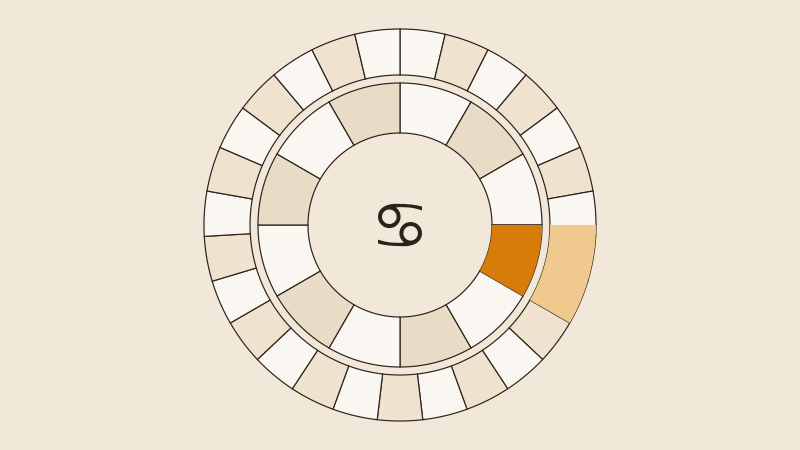
Krittika (also called Karthigai in Tamil, Krittika in Telugu, Karthika in Malayalam, and known in the sky as the Pleiades) — 26°40′ Aries to 10°00′ Taurus, in Aries and Taurus; lord Sun; deity Agni. Lahiri sidereal.
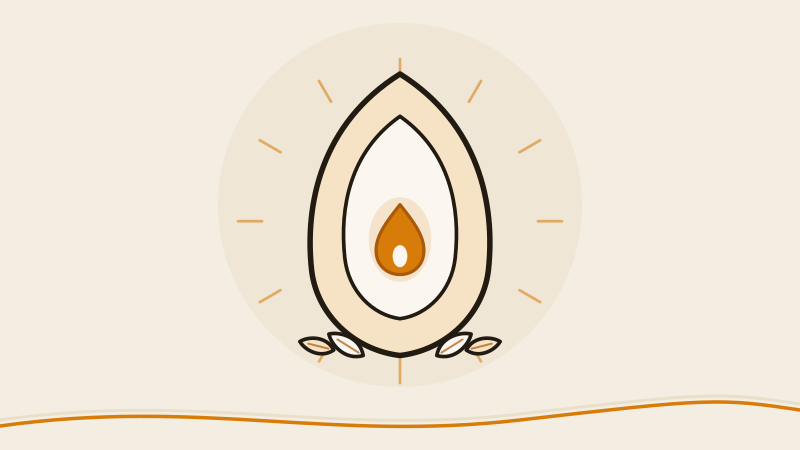
Krittika nakshatra is the third lunar mansion and the first that straddles two signs: its first quarter is the last 3°20′ of Aries and its remaining three quarters are the first 10° of Taurus. Its deity is Agni, fire; its symbol is a blade, or a flame; its lord is the Sun. In the sky it is the Pleiades — the six sisters who nursed the war-god Kartikeya, and the star that once marked the beginning of the year. A person with the Moon here is sharp, clean, exacting and protective, and has to learn that not everything that can be cut should be.
Below, Krittika from the ground up: the two-sign span, the four padas and the navamsa each reaches, the Moon and every other planet here, the sub-lords of the Krishnamurti method, the dasha a birth here begins, and the computed sky this Moon is under in 2026–27. The Sanskrit is glossed as we go.
Krittika nakshatra at a glance
| Span | 26°40′ Aries to 10°00′ Taurus |
| Sign (rashi) | Aries and Taurus |
| Lord (star-lord) | Sun |
| Deity | Agni |
| Symbol | a blade, a flame |
| Gana (temperament) | Rakshasa |
| Nature (for muhurta) | Mishra (mixed) |
| Yoni (animal, for matching) | sheep (female) |
| Nadi | Antya |
| Name syllables (pada 1–4) | A, I, U, E |
| Also called | Karthigai (Tamil), Krittika (Telugu), Karthika (Malayalam) |
| Dasha the Moon here begins | Sun, 6 years |
The story and the symbol
Agni is the mouth of the gods — the fire into which every offering is poured and by which it reaches them — and the oldest hymns of the Rig Veda are his. He purifies, he cooks, he digests, he burns away; and he is the priest who carries what is given to where it must go. Krittika is his mansion, and its symbol is the blade because a blade does what fire does, more precisely: it separates the clean from the unclean, the wanted from the unwanted.
The star's own story is the Krittikas, the six sisters who found the infant Kartikeya abandoned in the reeds and nursed him between them, so that he grew six faces to drink from all six at once. Kartikeya is the general of the gods, the one who defeated the demon Taraka; the mansion that raised him carries both the nursing and the war. Krittika natives are fiercely protective of what they have taken as theirs, and their protection has an edge on it.
The Sun as lord adds authority and heat. The Sun does not negotiate; it is simply there, and everything is seen by its light. Krittika people see clearly and say what they see, and they are surprised — sometimes hurt — when the clarity is felt as a cut. The mansion's gift is discernment. Its shadow is the burning of things that only needed warming.
Which rashi is Krittika nakshatra? (Krittika nakshatra rasi)
Krittika is one of the nine nakshatras that straddle two signs. Its first pada is in Aries (Mesha or Mesh rashi), 26°40′ to 30°00′, and its second, third and fourth padas are in Taurus (Vrishabha or Vrishabh rashi), 0°00′ to 10°00′. So "which rashi is Krittika" has two answers, and the pada decides. A Moon in the first pada is an Aries Moon — Mars-ruled, fiery, with the Sun as star-lord: fire on fire, the hottest degrees of the mansion. A Moon in the other three is a Taurus Moon — Venus-ruled, earthy, fixed, and exalted, since Taurus is the Moon's sign of exaltation with its deepest point at 3°, inside Krittika's second pada. Most Krittika Moons are Taurus Moons, and they are among the strongest Moons in the zodiac: the fire of the star inside the steadiness of the sign gives a mind that is both sharp and settled. The Sun and Venus, the star-lord and the sign-lord, are enemies in the Parashari scheme, and that friction is the Krittika Taurus signature — the plain speaker who also loves comfort.
The four padas of Krittika
Every mansion is cut into four quarters, the padas, each 3°20′ wide and each tied to a navamsa sign — the ninth harmonic, the chart of the inner life and the partner. Krittika's padas run Sagittarius, Capricorn, Aquarius, Pisces, and the first sits in a different sign from the other three.
| Pada | Degrees | Navamsa | Reading |
|---|---|---|---|
| 1 | 26°40′ Aries – 0°00′ Taurus | Sagittarius | Sagittarius navamsa, in Aries: the fiery Krittika — the missionary, the crusader, the one who cuts for a cause. Bold, principled, quick to judge. Includes the Aries–Taurus boundary but not a gandanta (that knot is only between water and fire signs). |
| 2 | 0°00′ Taurus – 3°20′ Taurus | Capricorn | Capricorn navamsa, in Taurus: the disciplined Krittika — ambitious, patient, exact. Holds the Moon's deepest exaltation at 3°00′ Taurus. The most enduring pada, and the one for builders. |
| 3 | 3°20′ Taurus – 6°40′ Taurus | Aquarius | Aquarius navamsa, in Taurus: the reforming Krittika — the sharp mind turned on society. Scientists, editors, critics; the person who improves things by finding what is wrong with them. |
| 4 | 6°40′ Taurus – 10°00′ Taurus | Pisces | Pisces navamsa, in Taurus: the softest Krittika — the blade turned to sacrifice. Nursing, cooking, service; the fire that warms rather than burns. Most emotional, most easily hurt. |
No pada of Krittika is vargottama. The second pada is the strongest for the Moon by dignity, since the Moon's exaltation is at its peak there; the first is the strongest for the Sun and Mars, in Aries.
Moon in Krittika: the janma nakshatra
Of all the placements, the Moon's nakshatra at birth — the janma nakshatra — is the one that shapes the mind and fixes where the dasha begins. With the Moon in Krittika, the mind is one that discriminates. These are people who notice the flaw, name it, and expect it to be fixed; who keep a clean house and a clean conscience; who have strong appetites — Agni digests — and strong opinions, and who will defend anyone they have decided is theirs with real ferocity. The classical lists give them brightness, a fine appearance, a hunger for food and for honour, and a tongue that can wound.
The trait that explains the others is the nursing in the story. Under the blade, a Krittika Moon is a caretaker — the sisters who found the child — and the sharpness is very often in the service of someone weaker. The cost is that they are hard on the people they care for most, because they cannot stop seeing what could be better. What they have to learn is warmth without the edge: the fire that cooks, not the fire that burns.
Since three of the four padas are in Taurus, most Krittika Moons are also exalted Moons, and the strength shows as steadiness under the sharpness. They do not panic. They have a plan, and the plan has a knife in it.
Krittika nakshatra female and male natives
The tradition wrote two portraits, one for each sex; they are kept because readers ask for them, with the caution that a chart is not a sex.
For a woman, the tradition gives Krittika a bright face, a straight back and a straighter tongue; it describes her as capable, proud, a good manager of a house or a business, and quarrelsome when she feels the standard is not being met. The old texts add a caution about the marriage — that she may be the stronger partner and that this needs a partner who can bear it. What they are describing is a woman who holds the line.
For a man, the tradition gives Krittika a strong, well-made frame, a good appetite, courage, a quick and cutting intelligence, and a love of honour; it describes him as generous with those he protects and hard on those he does not. The caution is about anger held too long and about arrogance.
Either way, the sub-lord and the Moon's aspects decide how much edge arrives. A Krittika Moon aspected by Jupiter is a judge; by Mars, a soldier; by Venus, a cook.
Career, money and health
Work. Fire and blade give the trades: the surgeon, the barber, the butcher, the chef, the metalworker, the welder, anyone who cuts or burns for a living. The Sun gives authority: the officer, the administrator, the head of a department, the critic whose word is final. Agni as priest gives the ritualist and the purifier — the auditor, the inspector, the quality controller, the editor. Kartikeya's mansion gives the military and the police. Krittika also does well in any profession where discernment is the product: gemology, tasting, appraisal, diagnosis.
Money. The Taurus padas hold money well and like to see it — property, gold, good food. The Aries pada spends it on the cause. Krittika natives are rarely poor, because they will not tolerate waste, and are sometimes hard to live with for the same reason.
Health. Krittika governs the head at the Aries end and the face, neck and throat at the Taurus end; fevers, inflammations, burns and cuts are its complaints, along with the throat and the digestion — Agni's own organ. The remedy the tradition gives first is cooling.
The other planets in Krittika
Any planet in Krittika picks up the mansion's edge and the Sun's authority, and only then its own nature. Because the mansion straddles two signs, the sign changes the reading at the first-pada boundary.
Sun in Krittika. In its own mansion: the Sun at full authority. In the first pada it is also exalted in Aries — one of the strongest Sun placements in the zodiac, the general, the head of the family, the man or woman whom others simply obey. In the Taurus padas it is in an enemy's sign, and the authority has to be earned against resistance, often through work with money or the land.
Moon in Krittika. Covered above. Exalted in the three Taurus padas, at its deepest exaltation at 3°00′.
Mars in Krittika. In its own sign in the first pada — the soldier's Mars, fire on fire, courageous to the point of recklessness. In the Taurus padas, in an enemy's sign but in its friend the Sun's mansion: force channelled into building, craft, and the defence of property.
Mercury in Krittika. The sharp tongue given a sharper mind: the critic, the editor, the surgeon's precision applied to words and numbers. Mercury and the Sun are friends, so this is a comfortable placement; in Taurus it is steady, in Aries it is quick.
Jupiter in Krittika. In its friend the Sun's mansion — wisdom with authority, the teacher who is obeyed, the judge. In Aries, in a friend's sign, expansive; in Taurus, in an enemy's sign, the wisdom is more practical and more about wealth.
Venus in Krittika. In Taurus, its own sign, for three of the four padas — but in the mansion of its enemy the Sun. Beauty with an edge; love that judges; the artist who is also a critic. A strong Venus for craft and for money, a demanding one for romance.
Saturn in Krittika. In its enemy the Sun's mansion, and in the first pada at its fall in Aries. Authority resisted, or authority won late through discipline. In the Taurus padas, in a friend's sign, Saturn steadies: the long career, the slowly built estate, the patience the mansion otherwise lacks.
Rahu in Krittika. Ambition with fire in it; the outsider who cuts their way in. Rahu in the Sun's mansion is the classical placement of the person who takes on authority they were not born to, and holds it.
Ketu in Krittika. The blade turned inward: renunciation, the cutting away of appetite, sometimes an early separation from the father or from a position. In the Aries pada, sharp and sudden; in Taurus, the slow letting go of possessions.
Lagna in Krittika. A well-made body, bright eyes, a manner that is direct to the point of bluntness. In the first pada the lagna lord is Mars; in the others, Venus — and the difference between a Mars-lord Krittika lagna and a Venus-lord one is the difference between a soldier and a chef.
Notice how much turns on the lord. A planet in one of the Sun's three mansions carries the Sun's signature, but Krittika is not the other two, and inside Krittika the nine sub-lords divide it again. This is the level at which a reading stops being a description of a type and becomes a description of a person. The nakshatra report does that work for your own chart: each planet placed to its pada and sub-lord, each placement read for what it promises and when the dasha lets it through.
The sub-lords of Krittika
This is the level at which the Krishnamurti method (KP) reads a chart: each nakshatra is cut into nine unequal parts in the proportion of the Vimshottari years, and the lord of the part — the sub-lord — decides what a planet here actually delivers. Two planets in Krittika with different sub-lords give different results. It is the step at which two charts that look alike come apart — where real astrology begins.
| Sub-lord | From | To |
|---|---|---|
| Sun | 26°40′ Aries | 27°20′ Aries |
| Moon | 27°20′ Aries | 28°26′40″ Aries |
| Mars | 28°26′40″ Aries | 29°13′20″ Aries |
| Rahu | 29°13′20″ Aries | 1°13′20″ Taurus |
| Jupiter | 1°13′20″ Taurus | 3°00′ Taurus |
| Saturn | 3°00′ Taurus | 5°06′40″ Taurus |
| Mercury | 5°06′40″ Taurus | 7°00′ Taurus |
| Ketu | 7°00′ Taurus | 7°46′40″ Taurus |
| Venus | 7°46′40″ Taurus | 10°00′ Taurus |
The sub-lords of Krittika, three of them in particular. The Rahu sub (29°13′20″ Aries to 1°13′20″ Taurus) holds the sign boundary itself, and a planet there is on the seam between the two readings — Rahu's appetite laid over the mansion's edge, often the most restless degrees of the nakshatra. The Jupiter sub (1°13′20″ to 3°00′ Taurus) ends exactly at the Moon's deepest exaltation, and a Moon here is about as strong as a Moon can be by dignity and by sub. The Venus sub at the end (7°46′40″ to 10°00′ Taurus) is Venus in its own sign, and it softens the mansion's edge more than any other part of it: the Krittika that cooks and hosts rather than cuts.
The dasha the Moon here gives
A Moon in Krittika starts life in the Sun mahadasha (6 years), and the balance left at birth is the fraction of Krittika the Moon has still to cross, times 6: a Moon exactly halfway through Krittika has 3 years of Sun left. The order after that is fixed — Moon → Mars → Rahu → Jupiter → Saturn → Mercury → Ketu → Venus — and it is the same for everyone born with the Moon here; what differs is where in it a life is standing at any moment. A Krittika life begins in the six-year Sun mahadasha, and since the Sun's period is short, most Krittika natives are out of it in early childhood — the father's period, and often the period in which the father's standing shaped the home. Then the ten-year Moon, the seven-year Mars, the eighteen-year Rahu: so a Krittika native's twenties and thirties are typically Rahu's, the long period of ambition and reinvention, before Jupiter arrives in the forties.
Krittika nakshatra compatibility and marriage life
Three tables decide a nakshatra match: the yoni (the animal), the gana (the temperament) and the nadi (the constitution, which must differ). Krittika is sheep yoni, rakshasa gana, antya nadi.
Best matches by yoni — the sheep, whose other mansion is Pushya (full marks); then the elephant (Bharani, Revati), the serpent (Rohini, Mrigashira), the cat (Punarvasu, Ashlesha), the cow (Uttara Phalguni, Uttara Bhadrapada), the buffalo (Hasta, Swati) and the mongoose (Uttara Ashadha), each scoring three with the sheep. Most difficult by yoni — the monkey (Purva Ashadha, Shravana), the sheep's enemy, scoring nothing.
By gana — Krittika is rakshasa, the fierce temperament, which the tradition matches best with other rakshasa mansions (Ashlesha, Magha, Chitra, Vishakha, Jyeshta, Mula, Dhanishta, Shatabhisha) and with manushya; rakshasa with deva is the classical mismatch, though the rest of the chart can carry it.
By nadi — Krittika is antya nadi, and partners should not share a nadi. Krittika with Rohini, Ashlesha, Magha, Swati, Vishakha, Uttara Ashadha, Shravana or Revati is the nadi clash the texts name.
What no table shows: a Krittika native needs a partner who does not take the edge personally, and who will not pretend a thing is fine when it is not.
Which pada of Krittika is best, and which is difficult?
"Which pada is bad" is usually a question about where the trouble sits. For Krittika the tradition's answer is the first pada, in Aries — not because it is weak but because it is the hottest: the Sun's mansion in Mars's sign with the Sagittarius navamsa, fire three times over. A Moon there is not exalted, and the sharpness has nothing to steady it. The second pada is the strongest for the Moon, holding its deepest exaltation. The third is the cleverest. The fourth is the gentlest and the most easily hurt. No pada of Krittika is bad for everyone; the first is hard for the Moon, and good for the Sun and Mars.
The sky for Krittika Moons in 2026–27
The figures are computed, Lahiri sidereal, true node; nothing here is quoted from a panchang. Plainly: a Krittika Moon in the first pada (Aries) is in the opening phase of sade sati, with Saturn on the Moon from June 2027; Jupiter is in the fourth from that Moon for most of the coming year and previews the fifth from 31 October to 25 January; Rahu is in the eleventh and Ketu in the fifth until 25 November, then the tenth and the fourth. A Krittika Moon in the Taurus padas is not in sade sati: Saturn is in the eleventh from the Moon until June 2027 — the classical house of gain for Saturn's transit — and then in the twelfth, where the opening phase of the next sade sati begins; Jupiter is in the third from that Moon until 31 October, previews the fourth until 25 January, and returns to the third until June 2027; Rahu is in the tenth and Ketu in the fourth until 25 November, then Rahu in the ninth and Ketu in the third. Mars enters Leo on 12 November — the fifth from an Aries Moon, the fourth from a Taurus Moon — and meets Jupiter and Ketu there.
→ Sade Sati · Mars Meets Jupiter in Leo
Remedy and mantra
The classical remedy for an afflicted Krittika placement is worship of Agni and of the Sun as the mansion's lord: the offering into fire — a lamp, a homa — and the Sun's mantra Om Suryaya Namah at sunrise, or the Gayatri for those who keep it. Kartikeya (Murugan, Skanda) is worshipped for the mansion's protective side, and Tuesday and Sunday are its days. Cooling is the practical remedy the tradition gives first — for the temper and for the body. A remedy — a puja, a gemstone, a rudraksha, a yantra — is prescribed to the chart, not to the nakshatra, and the chart decides which; so we do not name a gemstone here without it.
Questions we are asked
What is Krittika nakshatra? The third of the 27 nakshatras, from 26°40′ Aries to 10°00′ Taurus, ruled by the Sun, with Agni as deity and a blade or flame as symbol. In the sky it is the Pleiades. It stands for discernment, purification, protection and authority.
Krittika nakshatra is which rashi? Two. The first pada is in Aries (Mesha or Mesh); the second, third and fourth are in Taurus (Vrishabha or Vrishabh). Most Krittika Moons are Taurus Moons, and exalted.
Who is the lord of Krittika nakshatra? The Sun. The dasha for a Moon here begins with the Sun's six years, then the Moon's ten.
What are the Krittika nakshatra characteristics? Sharp, clean, exacting, protective, proud, appetite for food and honour; a tongue that cuts and a heart that nurses.
Which pada of Krittika is bad? None for everyone. The first pada, in Aries, is the hottest and the hardest for the Moon; the second holds the Moon's deepest exaltation and is the strongest for it.
What is the Krittika nakshatra symbol? A blade, or a flame — the two things that separate the clean from the unclean.
Is Krittika nakshatra good for marriage? Krittika natives are loyal, demanding, plain-spoken partners. Match by yoni (sheep), gana (rakshasa) and nadi (antya); the sheep–monkey pairing is the pairing the table puts at zero.
What does 2026 hold for Krittika nakshatra? It depends on the pada. Aries-pada Moons are in sade sati's opening phase; Taurus-pada Moons have Saturn in the eleventh until June 2027, then the twelfth. The computed sky for both is above.
Read this as education. It is not medical, legal or financial advice, and no single nakshatra is a chart.
A page can map Krittika; only a consultation can read your Moon, lagna, sub-lords and dasha in it together, with the questions you actually have.
→ Book a private consultation · Reading the Nakshatra, Not the Sign · Paper C, Nakshatras · ← Bharani · Rohini →