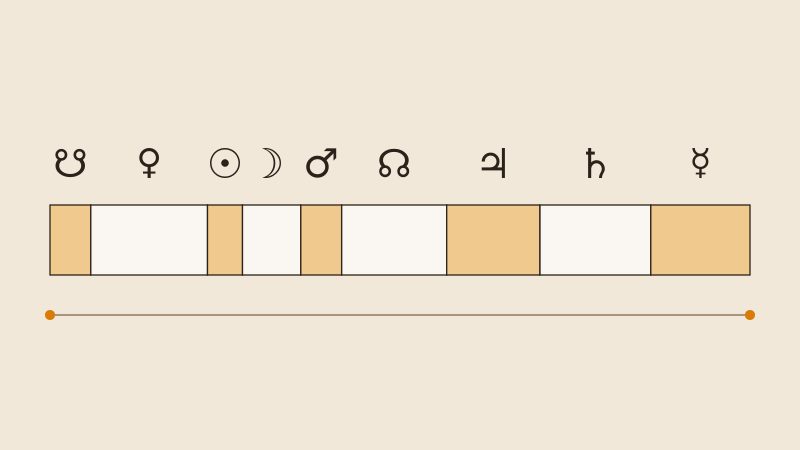
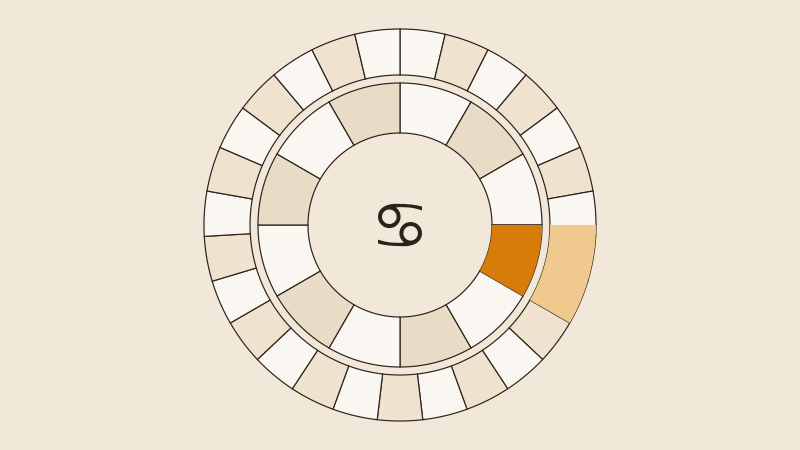
Abhijit (अभिजित्; also written Abhijeet or Abhijith, and known in the sky as Vega) — 6°40′ to 10°53′20″ Capricorn. Lahiri sidereal.
There are twenty-seven nakshatras, and there are twenty-eight. Both statements are true, and the mansion that makes them both true is Abhijit — the one that was counted out of the zodiac but never out of the calendar. Its name is on every panchang (the Hindu almanac) in India, in the daily line that says which three quarters of an hour are safe to begin something in, and yet it has no pada (the quarters every other mansion is divided into), no period in Vimshottari (the 120-year system of planetary periods most charts are read by), and no place in the list every student learns.
This piece explains what Abhijit is, why it was dropped, and why the abhijit muhurat — the window the tradition calls unconquerable — is still the most used rule in Jyotish (Vedic astrology) for choosing a good time, in India and wherever Indian families live abroad.
Where Abhijit sits
Abhijit occupies 6°40′ to 10°53′20″ of Capricorn — a strip of 4°13′20″ wedged between Uttara Ashadha and Shravana.
It is not a twenty-eighth equal division. It is carved out of its two neighbours: it takes the last quarter of Uttara Ashadha and the first fifteenth of Shravana, and the two mansions carry on as though nothing had been taken. That is the first clue to its strangeness. Every other mansion is 13°20′, cut cleanly from a circle divided twenty-seven ways. Abhijit is an overlay, sitting on top of a division that is already complete.
Its star is Vega — Alpha Lyrae, the fifth-brightest star in the night sky and once, around 12,000 BCE, the pole star. Its deity is Brahma, the creator. The name means "victorious", or more exactly "conquering completely" — abhi-jit, the one who wins past all opposition.
Why it was left out
The honest answer is that nobody knows for certain, and the tradition gives more than one reason. Three are worth having.
The arithmetic. The oldest Vedic lists do count twenty-eight mansions, Abhijit among them. Twenty-seven divide the circle cleanly, 13°20′ each, and the systems built on that division leave no seat for a twenty-eighth. Vimshottari divides 120 years among nine planets, three mansions to each, exactly; there is no tenth planet to give Abhijit to. Whatever first set it aside, this is what keeps it out: you will not find Abhijit in a Vimshottari calculation anywhere.
Far from the Moon's path. Vega sits far north of the ecliptic, the Sun's path that the Moon keeps close to — much further than any of the stars that mark the other mansions. It is a star of the sky rather than of the Moon's path, so a division of the Moon's path has a weak claim on it.
The story. The Mahabharata has Abhijit leave. In the Vana Parva, Indra tells how Abhijit, the younger sister of Rohini, jealous of her elder sister's place, went to the forest to perform austerities — and the sky was left with a gap where she had been. The tradition reads the episode as a memory of a mansion that was once counted and then was not.
Whichever reason you prefer, the outcome is the same. Abhijit has no lord in Vimshottari, no four padas, and no place in the twenty-seven-fold scheme used to match a marriage. In the reckoning almost every chart is read by, it is not a birth star: if the Moon stood in its degrees when you were born, your janma nakshatra (birth star) is Uttara Ashadha or Shravana, depending on which side of 10°00′ Capricorn the Moon fell, and your dasha runs from that. The one exception is Ashtottari, a conditional dasha that counts twenty-eight mansions and gives Abhijit to Saturn, together with Purva Ashadha, Uttara Ashadha and Shravana. The Institute reads by Vimshottari.
The abhijit muhurat, which is a different thing
Here is the confusion that brings most people to this page: the abhijit muhurat has almost nothing to do with the Moon being in Abhijit.
They share a name and a meaning — victory, the thing that cannot be defeated — but they are two separate instruments.
The muhurat is a division of the day, not of the zodiac. Take the time from sunrise to sunset and cut it into fifteen equal parts. Each part is a muhurta. The eighth of them — the middle one, with seven on either side — is the abhijit muhurat, and its centre falls exactly on local noon, when the Sun is at the top of its arc. Local noon is rarely twelve o'clock on the clock, which is why the window drifts from city to city.
Here is one day worked out: Sunday 1 November 2026, which is also a Ravi Pushya, when many families will be choosing an hour to buy.
→ Ravi Pushya 2026: the dates and hours
| City | Sunrise | Sunset | Abhijit muhurat (local time) |
|---|---|---|---|
| Delhi | 06:34 | 17:35 | 11:43 to 12:27 IST |
| Mumbai | 06:40 | 18:04 | 11:59 to 12:45 IST |
| Dubai | 06:27 | 17:37 | 11:40 to 12:25 |
| Singapore | 06:47 | 18:49 | 12:24 to 13:12 |
| Sydney | 05:56 | 19:22 | 12:12 to 13:06 |
| London | 06:55 | 16:32 | 11:25 to 12:03 |
| New York | 06:28 | 16:51 | 11:19 to 12:00 |
| Toronto | 06:55 | 17:07 | 11:40 to 12:21 |
| San Francisco | 06:36 | 17:10 | 11:32 to 12:14 |
Look at the widths. In Delhi that day the window is 44 minutes; in London, where the November day is short, it is 38; in Sydney, heading into its summer, it is 54. Outside India the rule is exactly the same and only the clock changes — which is why "what time is abhijit muhurat today" has no single answer, and why any page that prints one fixed time is printing someone else's noon.
How to work it out for your own city
You need two numbers from any weather app: today's sunrise and today's sunset.
- Find the length of the day. Subtract sunrise from sunset. On 1 November in London that is 9 hours 37 minutes.
- Divide it by fifteen. That is one muhurta — about 38 minutes in London that day.
- Find local noon and take half a muhurta either side. Local noon is halfway between sunrise and sunset: 11:44 in London on 1 November. Half of 38 minutes is 19, so the window runs 11:25 to 12:03.
The width changes through the year. In Delhi it runs from about 41 minutes in midwinter to about 56 at midsummer; in Chennai, nearer the equator, it stays between 45 and 52. In London it swings from 31 minutes in December to 66 in June.
Note on conventions: this page computes the eighth of fifteen equal daylight parts, from the Sun's centre at sunrise and sunset. Many panchangs publish a fixed 48 minutes — 24 either side of local noon — which gives the same centre and a slightly different width except near the equinoxes. Whichever you follow, follow one.
What the muhurat is for
The tradition's claim for abhijit is unusually strong: it is auspicious by itself, without reference to the tithi, the weekday or the nakshatra of the day. It is the window that overrides. If a day is otherwise poor and something must be started anyway, the classical answer is to start it in abhijit.
It is conventionally used for beginning work, signing, buying, travelling, opening a shop, filing a paper, and for any act that needs to survive a doubtful day. Rama is said to have been born in it. It is the reason so many Indian offices and shops still open at a time that looks arbitrary to a stranger.
Two cautions that the panchang usually prints in small type:
Wednesday. Most traditions hold that abhijit does not apply on a Wednesday.
Direction. Abhijit is held to be unfavourable for journeys toward the south. The rule is old, widely repeated, and worth knowing because it is the exception people most often trip over.
And one caution the panchang does not print: abhijit is a general rule, and a general rule is what you use when you do not have a chart. It is the floor, not the ceiling. A time chosen properly weighs the tithi (the lunar day), the weekday, the nakshatra, the rising sign at the moment chosen, and the chart of the person acting — which is how a moment stops being generally auspicious and becomes auspicious for you.
When the Moon is in Abhijit
The mansion itself is a different matter from the muhurat. The Moon crosses Abhijit's 4°13′20″ once a month, in seven to eight and a half hours depending on its speed. These are the passages from October 2026 to March 2027, computed with the Lahiri ayanamsa (the standard correction for the sidereal zodiac).
| Moon enters Abhijit (IST) | Moon leaves Abhijit (IST) |
|---|---|
| Mon 19 Oct 2026, 08:58 | Mon 19 Oct, 17:25 |
| Sun 15 Nov 2026, 16:43 | Mon 16 Nov, 01:16 |
| Sat 12 Dec 2026, 23:25 | Sun 13 Dec, 08:00 |
| Sat 9 Jan 2027, 05:30 | Sat 9 Jan, 14:04 |
| Fri 5 Feb 2027, 11:48 | Fri 5 Feb, 20:20 |
| Thu 4 Mar 2027, 18:51 | Fri 5 Mar, 03:23 |
For UTC, subtract five hours thirty minutes. Because it is a single moment for the whole world, a reader in London or New York can convert it directly; nothing here depends on sunrise.
Abhijit in a chart
Since Abhijit is not a birth star, what does a planet in its degrees actually mean?
It is read as Uttara Ashadha or Shravana, by degree, and the reading proceeds normally. What some practitioners add is a note of the overlay: the last quarter of Uttara Ashadha and the first fifteenth of Shravana carry, in this view, a quality of victory that survives opposition — Brahma's mansion, the one that conquers completely, the star that was once the pole.
It is best treated as a grace note rather than a rule. The lordship, the pada, the navamsa (the chart of ninths) and the sub-lord are what the reading is built from, and they come from the twenty-seven. It is the mansion and its sub-lord, not the sign, where real astrology begins — and Abhijit, having neither a Vimshottari lord nor a sub-lord of its own, cannot carry that weight. What it can do is tell you that a placement sits at a particular seam in the sky, and seams are worth noticing.
How the Institute publishes
Three layers, and they are meant to be used in that order.
The pages are free, and stay free. Everything the framework can say in general — the mansions, the houses, the dashas, the sky overhead this year — is published openly and computed rather than repeated. Most people need nothing beyond it.
A written report takes one area of a chart and works it in full. The nakshatra and sub-lord report places every planet to its pada and its sub; the wealth and marriage reports do the same for the houses that govern them; a transit report reads one planet's movement against your own chart. A report is read at your own pace and kept.
A private consultation reads the chart whole, live. Lagna (the rising sign), Moon, sub-lords, dasha and the transits overhead, with your questions rather than ours. It is where the judgement sits that no page and no report can carry.
Questions we are asked
What is abhijit muhurat? The eighth of the fifteen equal parts of the daylight, centred exactly on local noon — about 48 minutes around the equinoxes, and anywhere from about 41 to 56 minutes across the year in Delhi. The tradition holds it auspicious in its own right, without needing the rest of the day's panchang to agree.
Abhijit muhurat kya hota hai? It is the midday muhurat: divide the time between sunrise and sunset into fifteen parts, and the eighth part, centred on local noon, is abhijit. It is held auspicious on any day except a Wednesday, and for any journey except one toward the south.
What is the abhijit muhurat today? It depends on where you are, because it depends on your sunrise and sunset. Take the length of your day, divide it by fifteen, and centre that span on the midpoint between sunrise and sunset. The steps are set out above.
What time is abhijit muhurat in the USA or the UK? Around local midday, worked out the same way as in India. On 1 November 2026 it runs 11:19 to 12:00 in New York, 11:32 to 12:14 in San Francisco and 11:25 to 12:03 in London — local time, not IST. Never convert an Indian abhijit time into your own time zone: the window belongs to your own sunrise and sunset.
Is abhijit muhurat good for everything? Almost. The two standard exceptions are Wednesdays, and journeys to the south. And it is a general rule — a moment chosen against your own chart will always beat one chosen against nobody's.
Why are there 27 nakshatras and not 28? The oldest Vedic lists do count twenty-eight. Twenty-seven divide the zodiac evenly, and Vimshottari, which gives three mansions to each of nine planets, has no seat for a twenty-eighth. Abhijit also sits far from the Moon's path, and the Mahabharata tells of a nakshatra that left the sky. Nobody knows for certain which reason came first; the arithmetic is why Abhijit has no place in the dasha.
Where is Abhijit nakshatra? 6°40′ to 10°53′20″ Capricorn — the last quarter of Uttara Ashadha and the first fifteenth of Shravana. Its star is Vega; its deity is Brahma.
Abhijit nakshatra 2026 dates and time? The Moon is in Abhijit on Monday 19 October 2026, 08:58 to 17:25 IST, then on 15–16 November and 12–13 December. The table above runs to March 2027.
Can Abhijit be my birth nakshatra? Not in Vimshottari, the dasha almost every chart is read by, and the one the Institute uses. A Moon in those degrees is read as Uttara Ashadha or Shravana, and your dasha runs from whichever it is.
Who is the lord of Abhijit nakshatra? It has none in Vimshottari. In Ashtottari, the one dasha that counts twenty-eight mansions, it falls to Saturn. Its deity is Brahma.
Is abhijit muhurat the same as the Moon in Abhijit? No, and this is the most common mix-up. The muhurat is a slice of the day around noon, every day of the year. The Moon passes through Abhijit's degrees for seven to eight and a half hours, once a month. They share a name, not a mechanism.
This page teaches. A muhurta is one factor in a decision, and a nakshatra is one line of a chart.
A moment chosen for you, against your own chart and your own dasha, is what a consultation is for.
→ Book a private consultation · Reading the Nakshatra, Not the Sign · Uttara Ashadha · Shravana · What a Dasha Is · The 27 Nakshatras