Diwali 2026 falls on Sunday 8 November. Lakshmi Puja muhurat for Delhi: 17:54 to 19:50 IST (12:24 to 14:20 UTC). Lahiri sidereal.
Diwali is the night of the new moon of Kartik — the darkest night of the darkest month, on which the lamps are lit and Lakshmi is invited in. The astrology of it is exact, and so is the timing, which is why the question every year is not "when is Diwali" but "when do I do the puja". Here are both, and then something about this particular Diwali that the panchang will not tell you.
When is Diwali 2026?
Sunday 8 November 2026.
The rule: Diwali is observed on the day whose evening falls within the amavasya tithi — the new-moon lunar day — of the month of Kartik. In 2026 the amavasya tithi begins at 11:28 IST on Sunday 8 November and ends at 12:32 IST on Monday 9 November. Sunday evening is inside it; Monday evening is not. So Sunday 8 November is Diwali.
The five days, by tithi: Dhanteras on Friday 6 November (Trayodashi, observed in the evening); Naraka Chaturdashi on Sunday 8 November — the same calendar day as Diwali this year. The Chaturdashi tithi runs from 10:48 IST on the 7th to 11:28 IST on the 8th, and the day is fixed by the pre-dawn Abhyanga snan, the oil bath taken before sunrise while Chaturdashi holds, which falls on Sunday morning. The lamps of Choti Diwali and the night worship of Kali Chaudas belong to the evening of Saturday the 7th, when the same tithi is running; in Tamil Nadu and much of the South, Sunday morning's bath is Deepavali itself; Diwali on Sunday 8; Govardhan Puja on Tuesday 10 November (Pratipada holds at sunrise on the 10th, not the 9th); and Bhai Dooj on Wednesday 11 November.
The exact new moon — the moment the Moon passes the Sun — is at 12:32 IST (07:02 UTC) on Monday 9 November, but the festival goes by the tithi, not the moment.
The Lakshmi Puja muhurat
Lakshmi Puja is done in the evening, in pradosh kaal — the two-and-a-bit hours after sunset — and, within that, in a sthira lagna, a fixed sign rising, so that what is invited in stays. On Diwali evening the fixed sign that rises after sunset is Taurus, Venus's sign, which is exactly the one the tradition wants for Lakshmi.
For Delhi on 8 November: sunset 17:31 IST; Taurus rises from 17:54 and gives way to Gemini at 19:50. The muhurat is therefore 17:54 to 19:50 IST. Do the puja inside that window; the earlier half, with the sky still holding twilight, is preferred by most families.
The window moves with your city. Sunset is a few minutes later in Ludhiana and Chandigarh, half an hour later in Mumbai, and earlier in Kolkata; the Taurus window shifts with it. Anywhere in north India the puja falls between about 17:45 and 20:00.
For those who keep the nishita puja — the midnight worship, more common in Bengal and among tantric lineages — Leo, the next fixed sign, rises at about 00:25 IST on the night of 8–9 November.
The sky that night
This is where Diwali 2026 is unusual, and worth knowing before you light the lamps.
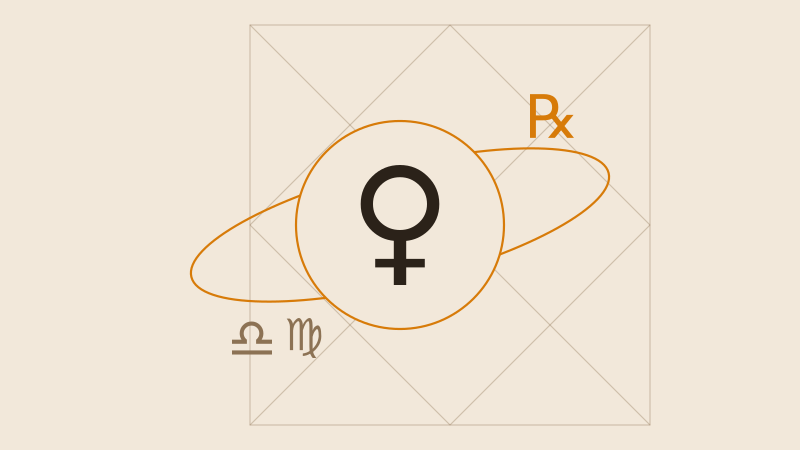
At puja time, three planets are in their debilitation signs at once. The Sun is in Libra — its debilitation, at 22°. Venus is in Virgo — its debilitation, at 29°, and retrograde, four days from turning direct. Mars is in Cancer — its debilitation, at 28°, in its last days there. Three of the nine grahas down, on the same evening, is not common.
And the one that matters most for Lakshmi is Venus. Venus is Lakshmi's planet — the karaka of wealth, beauty, comfort, and the goddess herself. On Diwali 2026 it is debilitated, retrograde, and only just out of combustion. The Moon, meanwhile, is in Swati with Mercury, both in Libra — Venus's own sign — so the evening's Moon is in Lakshmi's house even while Lakshmi's planet is at its weakest.
What does the tradition make of this? Three things.
A debilitated planet gives its results indirectly, not not at all. Venus in Virgo is Venus asked to be practical rather than beautiful. The Lakshmi this Diwali invites is the Lakshmi of accounts, repairs, and the money you keep — not the Lakshmi of the grand purchase. A good year to do the puja with the ledger open.
Retrograde Venus gives things back. Four days later, on 14 November, Venus turns direct. What was reviewed in the retrograde — the deal that stalled, the money that went out, the relationship on pause — begins to return. Diwali 2026 sits at the very end of that review, and a puja done with a specific intention about what should come back is a puja done in the right week.
The Moon in Swati is the wind. Rahu's mansion, in Venus's sign: independent, mobile, self-made. The evening favours the person who lights their own lamp and does not wait to be given one.
Meanwhile Jupiter is in Leo — a week into its preview of the Sun's sign, in Magha, the mansion of the ancestors, with Ketu a degree and a quarter ahead of it on the same evening — and Saturn is retrograde in Pisces, in its own mansion, a month from turning direct. Jupiter in Leo on Diwali is a good omen for the lineage and the family name; Saturn in Uttara Bhadrapada asks that the year's obligations be settled before the new one is opened.
What to do, and what not to do
Do: settle debts and close the year's accounts before the puja — that is what the tradition means by inviting Lakshmi into a clean house. Do the puja in the Taurus window. Make the intention specific and practical; this is not a Venus for vague wishes. If you are starting a ledger, a business year, or a savings habit, Diwali evening is the traditional moment and this year's Venus rewards exactly that kind of start.
Don't: treat the retrograde as a reason to skip the festival's own customs. Diwali evening is for the puja and the household, not for shopping; the buying belongs to Dhanteras, and Dhanteras has its own rule, below.
Dhanteras: the exception to the Venus rule
Dhanteras — Friday 6 November 2026 — is the day of Dhanvantari, the physician of the gods, who rose from the churning of the ocean carrying the pot of amrit. It is the traditional day for buying gold and silver, and the tradition holds whatever the sky is doing. A festival day sanctioned by the calendar carries its own muhurat; the debilitated, retrograde Venus of 2026 does not override it. Buy on Dhanteras if you are going to buy. The purchase is a ritual act of welcome, and the classical texts do not ask you to check the ephemeris before welcoming Lakshmi.
What the sky does change is the scale and the kind. Venus at its weakest favours the modest, practical purchase over the showpiece — the coin over the necklace, the useful over the ornamental. That is a note on emphasis, not a prohibition.
The Dhanteras muhurat, Delhi: the puja and the buying are done in pradosh kaal, after sunset, and in the Taurus lagna window — sunset 17:32 IST, Taurus rising from 18:02 to 19:58 IST (12:32 to 14:28 UTC) on 6 November. Purchases made earlier in the day are still within the festival; the evening window is the preferred one.
What to buy on Dhanteras, if not gold. The tradition gives a long list, and every item on it is a form of the same thing — bringing something new and lasting into the house:
- Silver — a coin stamped with Lakshmi and Ganesha, a small idol, a lamp. Silver is Lakshmi's second metal and the commonest Dhanteras purchase in most households.
- Copper or brass utensils — the samudra manthan purchase, since Dhanvantari rose carrying a vessel. Fill the vessel with rice, water or a coin before bringing it home; never carry it in empty.
- Idols of Lakshmi and Ganesha for the Diwali puja two days later.
- Lamps, diyas, a bell for the puja.
- A broom — a purchase that surprises people outside India, but old and widespread: the broom sweeps poverty out of the house, and it is bought on Dhanteras in a great many families.
- Salt and whole coriander seeds — a rural tradition, especially in north India: salt for protection, coriander for growth, some of it sown in a pot after the puja.
- Vehicles and appliances — the modern extension, and a sound one: anything useful and durable that the house will keep.
What the tradition avoids on Dhanteras: iron and steel (buy those later in the week); black objects; glass and mirrors, which break; sharp tools; and empty vessels brought home unfilled. Different families keep different subsets of these; the common thread is nothing that breaks, cuts, or is empty.
Where it lands — by lagna
Diwali is a festival, not a transit, but the puja is a muhurat, and a muhurat lands differently in each chart — read it from the lagna and from the Moon, the double read every Astro River forecast uses. The signs to note are Libra, where the Sun, Moon and Mercury sit, and Virgo, where Venus sits.
| Lagna | Libra / Virgo are your | The evening's emphasis |
|---|---|---|
| Aries | 7th / 6th | Partnership and the household's work. A puja done with the partner. |
| Taurus | 6th / 5th | Venus is your lagna lord, debilitated: keep the evening simple and sincere. Children and creativity are lit. |
| Gemini | 5th / 4th | Children and home. The traditional family Diwali suits this chart best. |
| Cancer | 4th / 3rd | Home and effort. A puja for the house itself. |
| Leo | 3rd / 2nd | Money and family. The ledger year. Jupiter on your lagna makes this a strong Diwali. |
| Virgo | 2nd / 1st | Venus debilitated on your lagna and the luminaries on your second: a wealth puja in a year of practical money. |
| Libra | 1st / 12th | Sun, Moon and Mercury on your lagna. The most personal Diwali in the zodiac; make the intention about yourself, not the house. |
| Scorpio | 12th / 11th | Gains and expense. Give before you ask. |
| Sagittarius | 11th / 10th | Income and work. A puja for the business. |
| Capricorn | 10th / 9th | Career and fortune. Venus is your yogakaraka; the practical Lakshmi is your Lakshmi. |
| Aquarius | 9th / 8th | Fortune and the hidden. A puja for the family line; Jupiter in your seventh helps. |
| Pisces | 8th / 7th | Partnership and transformation. Saturn is on your lagna in sade sati: a quiet Diwali, well kept, does more than a loud one. |
Diwali in your chart. A muhurat report reads the Lakshmi Puja moment against your birth chart — which houses the evening's planets fall in, what your Venus and second house are doing, and the exact best minutes in the Taurus window for your lagna — and gives a specific intention for the puja from your dasha.
Questions we are asked
Is Diwali on 8 or 9 November 2026? Sunday 8 November. The amavasya tithi runs from Sunday morning to Monday midday, and the festival goes by the evening that falls within it.
What is the Lakshmi Puja muhurat for 2026? For Delhi, 17:54 to 19:50 IST — the Taurus lagna window in pradosh kaal. Adjust a few minutes for your city.
Is it a bad Diwali because Venus is debilitated? No. It is a practical one. Debilitated Venus is Venus put to work. The tradition would say: this year, Lakshmi comes to the house that has done its accounts.
Should I buy gold on Dhanteras 2026 even though Venus is debilitated? Yes. Dhanteras is the exception: the day carries its own sanction and the tradition buys regardless of transits. Let the weak Venus guide the kind of purchase — modest and useful rather than showy — not whether you buy.
What if gold is out of budget? Silver, copper or brass utensils, a Lakshmi–Ganesha idol, lamps, a broom, salt and coriander. All are traditional, and the tradition is clear that the intention outweighs the price.
This article is for guidance. It is not financial advice, and it does not replace a muhurat cast for your own chart and city.
Happy Diwali. Light the lamp in the Taurus window, keep the intention practical, buy what you buy on Dhanteras, and let Venus come back to you on the 14th.